Tag: Central Propaganda Committee

  • Minister of Propaganda Says Vietnam’s Press Should Serve Party, Prevent “Self-Evolution”

    Minister of Propaganda Says Vietnam’s Press Should Serve Party, Prevent “Self-Evolution”

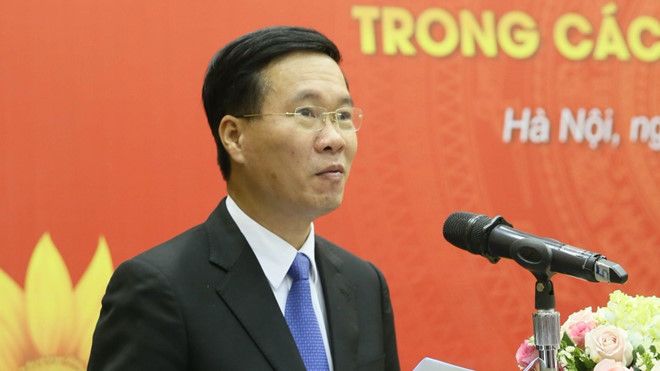
    At a conference on “Strengthening Party-building Work in Press Organizations” last Friday, Mr. Vo Van Thuong, head of Communist Vietnam’s Central Propaganda Committee, reminded attendees that the press must serve the Vietnamese Communist Party (VCP) and the revolution in order to function “stably” and “without error”.

    Referring to a government plan ratified earlier in the year to develop and manage press throughout the country until 2025, Thuong stated that the time for debate had passed and that strict implementation was now key. According to state media and in sentiment echoed by Thuong, the press serves as “an important channel to fight against incorrect information, fake news, news critical of the regime, and that which makes people lose trust in the Party-State.”

    In his remarks at the conference, Thuong stressed the importance of ideological work in press organizations and making sure Party cadres and Party members guard against signs of political, ideological, and moral decay. In particular, Thuong warned against signs of “self-development” and “self-evolution”, negative terms that refer to the shift towards liberal democratic values–values which are anathema to the ruling Communist Party.

    In this vein, Thuong took to admonishing journalists who lacked “proper training” and were critical of society but not sufficiently critical of themselves. He also stressed the importance of proper training for leadership and suggested greater oversight of the Party committees and organizations involved in press organizations, particularly when it comes to adherence to Party regulations.

    “In order to help press organizations develop self-awareness and a more proper nature, we should do as a number of comrades have stated: ‘Sometimes those who educate [Party members and cadres] must themselves be educated’,” Thuong stated.

    Thuong reminded attendees that Vietnam’s journalists were journalists of the revolution, journalists of the Party, and journalists of the state; as such, they should work closely with the Central Propaganda Committee, the Ministry of Information and Communication, various central Party committee blocs, and the Vietnamese Journalists Association, in order to strengthen the leadership of the Party.

    The plan approved April 2nd of this year also seeks to streamline Communist Vietnam’s press environment, limiting government bodies to one newspaper and one magazine, with a shift to electronic rather than print forms, and with the “Vietnamese Communist Party E-Newspaper” and the Central Propaganda Committee serving as the “core” of the country’s press structure.

    Along with head of propaganda, Thuong is also currently a member of the Politburo (short for “Political Bureau”, the leading body of the Vietnamese Communist Party), and the secretary of the Central Committee (from which members of the Politburo are chosen). In the past, Thuong was deputy secretary of the Ho Chi Minh City (HCMC) Standing Committee, first secretary of the Central Committee of the HCMC Communist Youth Union, and secretary of the Quang Ngai Provincial Party Committee.

    According to Reporters Without Borders, Vietnam ranks 176th out of 180 countries in terms of press freedom. Although freedom of the press is guaranteed by Article 25 of the 2013 Vietnamese Constitution, Communist Vietnam is a one-party, authoritarian state that does not tolerate challenges to its power. It controls all official media, newspapers, and publishing houses in the country and regularly censors material that does not conform to sanctioned historical or political narratives.
  • Vietnam: The Communist Party Declared Internet “A Battlefield”

    Vietnam: The Communist Party Declared Internet “A Battlefield”

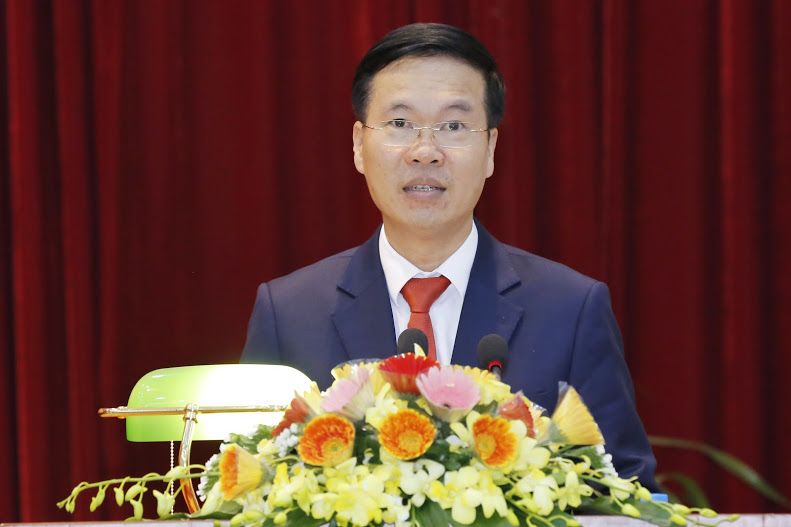
    The Head of the Vietnamese Communist Party’s Central Propaganda Committee – Vo Van Thuong – declared, during his concluding remarks at the committee’s year-end congress on December 29, 2018, that “the internet (in Vietnam) has become a new battlefield” for the Party in the fields of politics, thoughts, and culture.

    A day earlier, Thuong also made another remark at a different congress held explicitly by and for the press, telling journalists in the country to overcome having “vague political thoughts” as news reporters, especially when it comes to posting on social media.

    For non-Vietnamese, Mr. Thuong’s position seems to be quite intrigued and puzzling. Why would he get invited to speak to the journalists in the country at their year-end congress? What does his message to the media representatives even mean?

    On the other hand, for some over 800 editors-in-chief of all newspapers in Vietnam, however, Mr. Thuong’s words equate to an ultimatum as he is the chief of all of them. They would write as his committee directs, and take down those articles when the same committee disapproves.

    The Central Propaganda Committee is part of the VCP’s cord internal structure, with a mission to establish “direction for political thoughts in the field propaganda, news media, publishing, arts, and culture” for the Party. In reality, this committee’s job is not only to control the political thinking and shape the ideology of the four million VCP members but also the society in Vietnam as a whole.

    Its job is so essential for the survival of an authoritarian regime which is to ensure that there would only be one political doctrine for every single citizen to follow: communism. Anyone dares to propose other ideas for a different political philosophy, in many cases, face prosecution and long jail time. Any sign of dissent would be deemed as not accepting the ultimate leadership of the VCP in the country, and is a criminal act.

    However, for more than a decade, the VCP has failed to take control of the internet and social media in Vietnam. As the result, the people indeed took such opportunity to create a vibrant online civic space where they openly criticized officials, exposed wrongdoings, and even organized themselves.

    While the government repeatedly applied draconian and vague penal codes to arrest and imprison dissidents and activists for “propagandizing against the State” and “abusing democratic freedoms”, social media – especially Facebook and Youtube – continues to play a vital role in disseminating information which the VCP may disapprove of, such as reporting on human rights abuses and calling for democratization in the country.

    The new cybersecurity law of 2018 is the latest attempt from the government to practice absolute control over the internet in Vietnam. It is then not a surprise for us to hear strong and determining words from the Head of the Central Propaganda Committee, declaring war on bloggers and freelancers on social media.

    However, in the first few days of the year since the cybersecurity law took effect, the discussions on social media in Vietnam remain active and critical of the government.

    The most recent “battle” between Vietnamese netizens and Mr. Thuong’s Central Propaganda Committee happened last week, concerning the news that the VCP’s Politburo has approved more money to fund the development project for a metro system in Ho Chi Minh City.

    On January 4, 2019, most of the major newspapers in Vietnam published one same article online, stating that the Politburo has approved more than 50 billion VND for the construction of two metro lines in Ho Chi Minh City. Immediately, prominent bloggers and dissidents on social media like attorney Le Cong Dinh[1], questioned the legality of that decision.

    In Vietnam, the power to approve funding of similar projects supposedly belongs to the most powerful governmental body – the National Assembly. However, in reality, the Politburo would be the ultimate decision maker.

    In April 2018, when the people of Vietnam questioned the National Assembly’s reasons to pass the Special Economic Zone draft bill, the Chairwoman responded: “the Politburo has already decided, and the draft bill is not unconstitutional. We have to discuss and come up with the bill.”

    Nevertheless, this time, the Politburo seems to have to forego a “battle” on social media. By the end of the day, all of the articles about the funding of the metro project were taken down, probably at the order of the Central Propaganda Committee.

    ***

    [1] Le Cong Dinh was tried together with Tran Huynh Duy Thuc for subversion against the state in January 2010 where he was sentenced to five years imprisonment and three more years under house arrest.