Tag: Buddhism

  • Venerable Thich Quang Do: A Lifetime Of Struggle

    Venerable Thich Quang Do: A Lifetime Of Struggle

    Thich Quang Do

    Thich Quang Do’s birth name is Dang Phuc Tue. He was born in Thanh Chau Commune, Tien Hai Suburban District, Thai Binh Province, on November 27, 1928, into a family with three other siblings.

    He left his home in 1942 at 14 years of age to become a monk at Thanh Lam Village Pagoda in Ha Dong Province, which is today a part of Hanoi.

    He passed away on the night of February 22, 2020, at Tu Hieu Pagoda in Ho Chi Minh City.
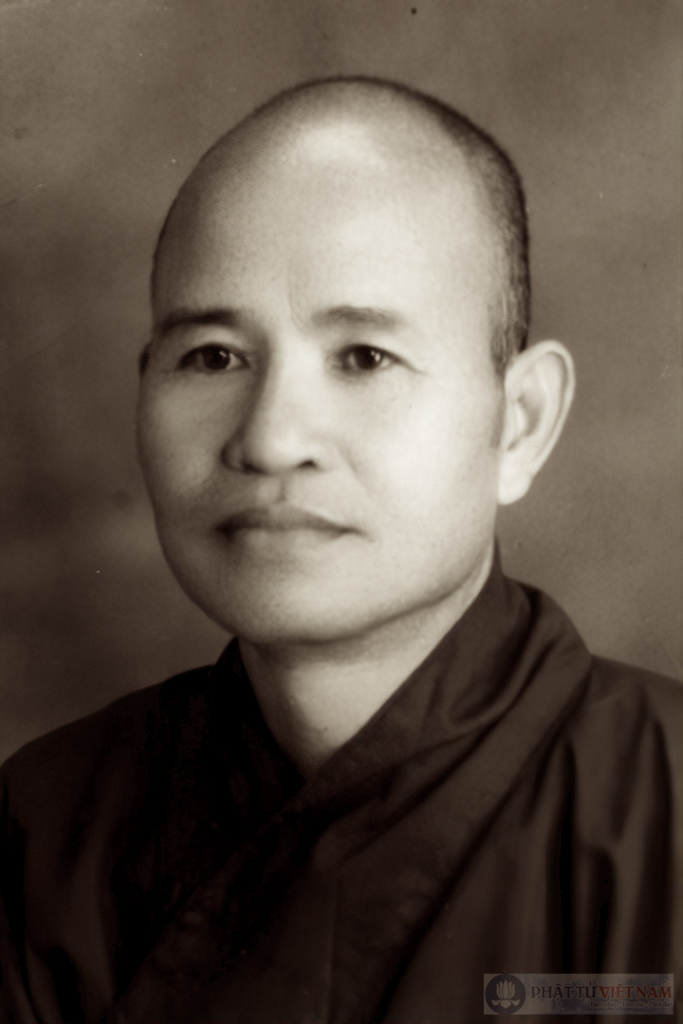
    An undated portrait of Thich Quang Do. Photo: Phattuvietnam.net
    https://2xjs7y10oiyz26vqxu2hok6y-wpengine.netdna-ssl.com/wp-content/uploads/2020/02/line-1px-1024x24.png

    In the beginning months of 1945, famine swept across the northern part of Vietnam, killing two million people. At the time, 18-year-old Thich Quang Do was in training in Ha Dong Province, as a disciple of the Venerable Thich Duc Hai.

    Much later, in 1992, he would recall his early days of entering the monkhood in his memoir:

    “In the year of the rooster (1945), the people were very hungry, especially in the two provinces of Thai Binh and Nam Dinh. Those who had starved to death littered the streets. […] At the time, my master at Thanh Lam Village Pagoda […] heard from people heartbreaking stories, so he travelled out to Ha Dong Township and established a relief group to help the hungry. That was March 1945. My master opened up a food camp to help sustain the hungry. He relied on Ho Dac Diem, who was the Ha Dong Province chief, to intervene with the Japanese and request some rice to rescue the starving. The group was able to carry many people through the famine.” [2]
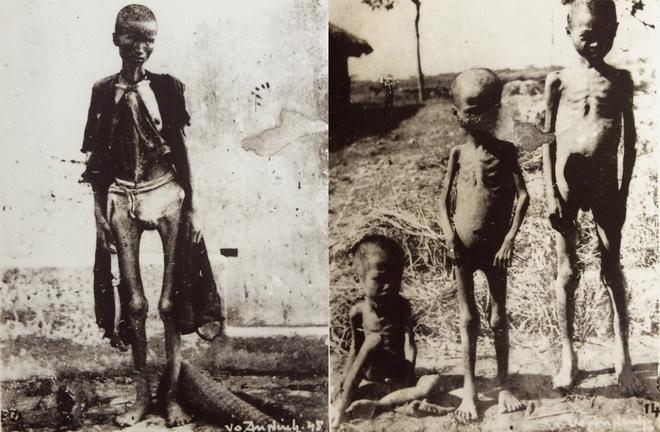
    A young woman (left) and three siblings of another family in Thai Binh during the 1945 famine. The northern famine was caused by the Japanese and the French and led to approximately two million deaths. Photo: Vo An Ninh.

    Right after that disaster, the August Revolution broke out, and seeing that the people were still incensed at the famine caused by foreign countries, the Viet Minh hunted down Vietnamese traitors and those who worked for the Japanese or the French, executing them. The executions were seen – by some – as a way for the Viet Minh to flaunt their prestige. Thich Quang Do’s master was allegedly a Vietnamese traitor.

    He recalled in an open letter sent to the general secretary of the Vietnamese Communist Party, Do Muoi, in 1994:

    ”At 10 AM, on the morning of August 18, 1945 […] as I looked at my master, his two hands bound behind his back by zinc wire, on his neck hung two signs scrawled with the words ‘Vietnamese traitor, national sellout’ […] On both sides, a group of people holding sticks, spears, and scythes, stood guard. A group calling themselves the magistrates of the People’s Tribunal stood on a platform […] forcing my master to kneel down in the courtyard and listen to the court convicted him. They immediately sentenced him to death, carrying him out to the field of grass in front of the courtyard, blood continuing to flow from his mouth [as he had been punched]. Upon reaching the field of grass, they wrestled him down onto his side, shooting him through the ears three times with a pistol. Another stream of bright red blood sprayed straight up, and my master died instantly.” [3]

    Spurred by the exceedingly painful image of his master being executed, Thich Quang Do wrote: “I swore to fight fanaticism and mercilessness, and to devote my entire life to pursuing justice through Buddhism’s teachings on non-violence, tolerance, and mercy”. [4]

    https://2xjs7y10oiyz26vqxu2hok6y-wpengine.netdna-ssl.com/wp-content/uploads/2020/02/line-1px-1024x24.png

    In 1947, Thich Quang Do was ordained as a monk while studying at the Quan Su Buddhist Institute in Hanoi. During this time, he wrote for the magazine Phuong Tien [Means], where Venerable Thich To Lien was editor-in-chief. In 1951, Venerable To Lien dispatched Do to study abroad in Sri Lanka [5]. In that same year, Buddhist temples throughout the country were unified under the leadership of the Vietnamese Buddhist Federation, headquartered at Tu Dam Pagoda in Hue. [6]

    After Sri Lanka, Thich Quang Do travelled to India in 1953 to continue his studies. The year after, Vietnam was divided in two, and the Vietnamese Buddhist Federation splintered. Buddhist sects and associations continued to operate independently, and a number of northern Buddhist temples moved south.
    https://2xjs7y10oiyz26vqxu2hok6y-wpengine.netdna-ssl.com/wp-content/uploads/2020/02/Screen-Shot-2020-02-27-at-9-compressed-1024x675.jpg
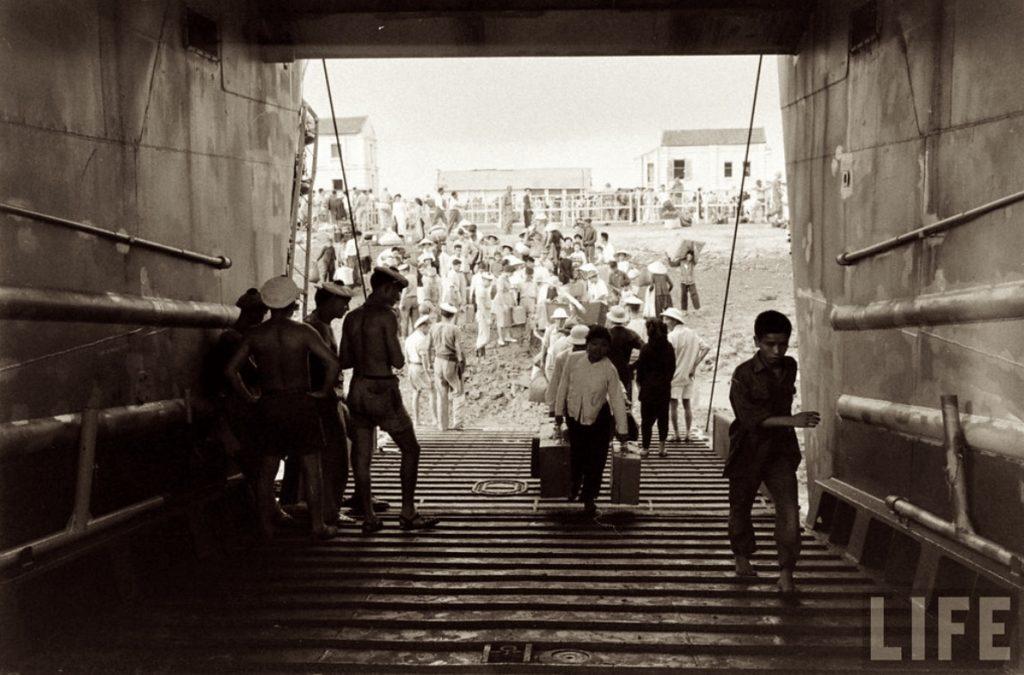
    While Vietnam awaited a free general election, the Geneva Accords split the country at the 17th parallel into two separate militarized zones; residents on each side were free to move to the other side. Approximately 800,000 northerners moved to the south, according to data from the South Vietnamese government. This photo depicts northerners preparing to move to the south. Photo: LIFE.

    In 1958, Thich Quang Do, 30 and fluent in English and Chinese, returned to Saigon to teach and translate scriptures. [7] During this time, the Vietnamese Buddhist Federation moved its headquarters to An Quang Pagoda in Saigon, and Buddhist sects and associations continued to operate independently. [8]

    https://2xjs7y10oiyz26vqxu2hok6y-wpengine.netdna-ssl.com/wp-content/uploads/2020/02/line-1px-1024x24.png

    At the end of 1961, Buddhists and monks were increasingly subjected to excessive religious persecution by the Saigon government. There were reports that many areas banned Buddhists from practising and forced them to give up their religion. By April 1963, as Vesak Day (Buddha Day) approached, monks in Hue were no longer able to tolerate the repression, declaring that they were at odds with the government and commencing a period of impassioned struggle for Buddhism. [9]
    https://2xjs7y10oiyz26vqxu2hok6y-wpengine.netdna-ssl.com/wp-content/uploads/2020/02/Xung-dot-phat-giao-1963-1024x672.jpg
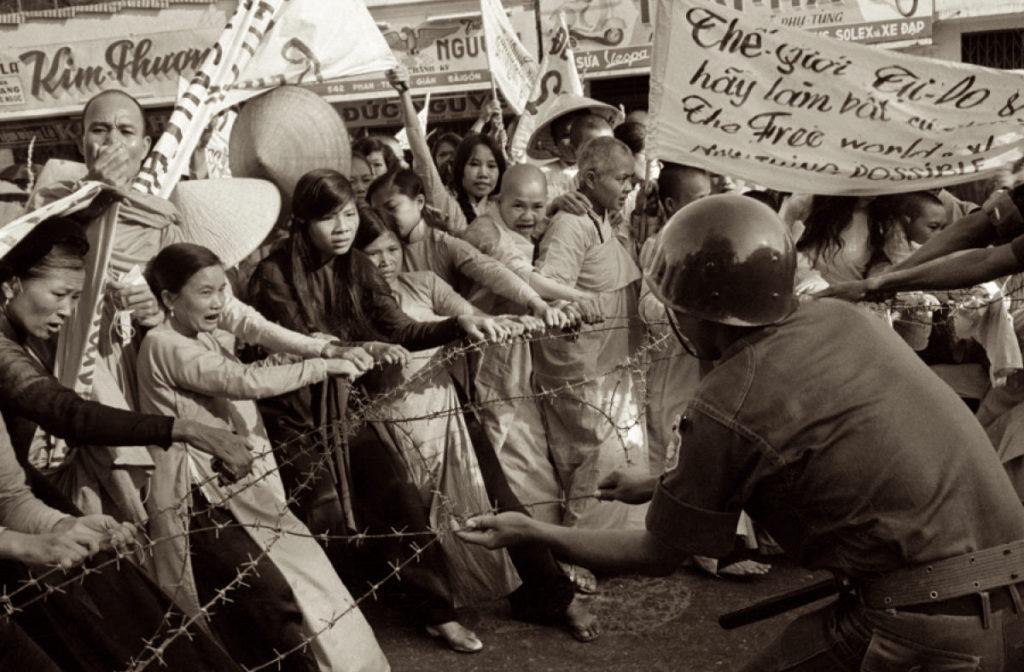
    Nuns, monks, and Buddhists scuffle with police in Saigon, protesting against government repression. Buddhist leaders demanded that the government respect the Buddhist flag, cease the repression of Buddhists, treat them equally, grant them the freedom to proselytize and practice, and make reparations for those killed. Photo: HORST FAAS/AP.

    To weather the religious crisis, the Inter-sectarian Committee to Protect Buddhism was established in May 1963. It comprised 11 sects and associations and was headquartered at Xa Loi Pagoda in Saigon. The committee included 19 individuals, of whom Venerable Thich Tinh Khiet was the highest leader and Thich Quang Do was an assistant to the diplomatic corps. [10]

    The committee organized large-scale protests and hunger strikes. Thich Quang Do hit the streets with thousands of monks, nuns, and Buddhists to fight for the religion. The government cracked down. Many monks self-immolated to demand a resolution to Buddhism’s five aspirations. Dozens of people lost their lives in clashes with police. The tumult lasted for many months, stirring world opinion.
    https://2xjs7y10oiyz26vqxu2hok6y-wpengine.netdna-ssl.com/wp-content/uploads/2020/02/Screen-Shot-2020-02-25-at-9-compressed.jpg
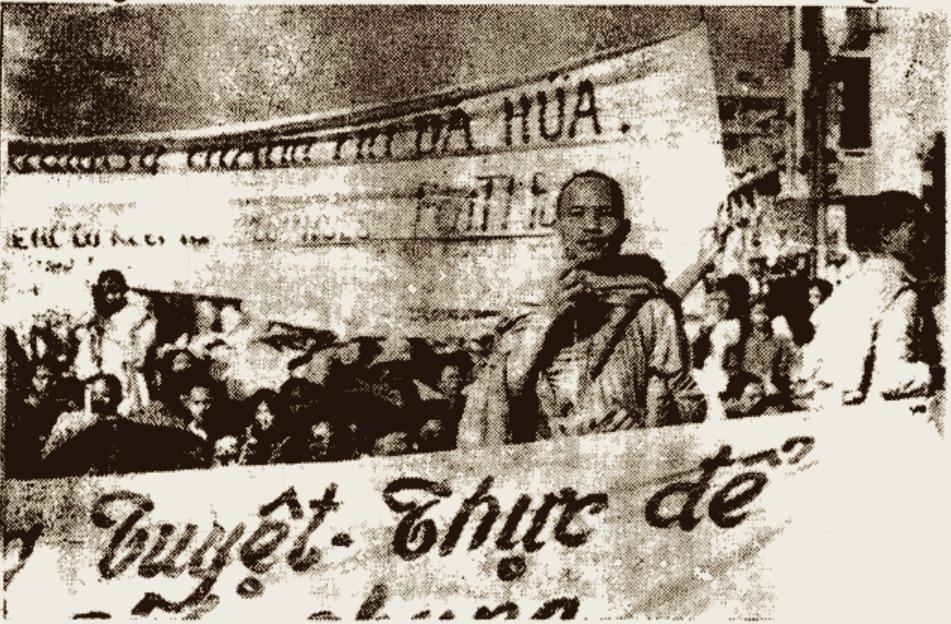
    Thich Quang Do, 35, elaborating on the Buddhist struggle in front of monks, nuns, Buddhists, students, and police. Photo: Buddhist Struggles (Quoc Oai)

    On August 20, 1963, the government arrested Thich Quang Do in its “floodwater campaign,” in which pagodas were raided simultaneously to capture Buddhist leaders. He was tortured in prison. While behind bars, he secretly received English articles, translating them into Vietnamese and then sending them out, where they were reprinted in Buddhist newspapers to encourage the fighting spirit of monks, nuns, and Buddhists. [11]

    The conflict between Buddhists and the government led the United Nations to send a fact-finding mission to Vietnam on October 24, 1963. A week later, President Ngo Dinh Diem was assassinated, and Buddhism was able to gain the upper hand. Thich Quang Do was released but remained seriously ill due to the torture he suffered while in prison. [12]

    https://2xjs7y10oiyz26vqxu2hok6y-wpengine.netdna-ssl.com/wp-content/uploads/2020/02/line-1px-1024x24.png

    Immediately after the 1963 Buddhist crisis and with the flames of solidarity burning bright in the hearts of monks and nuns, a number of well-respected monks reiterated calls to unify Buddhism.
    https://2xjs7y10oiyz26vqxu2hok6y-wpengine.netdna-ssl.com/wp-content/uploads/2020/02/Screen-Shot-2020-02-27-at-10-compressed-1024x647.jpg
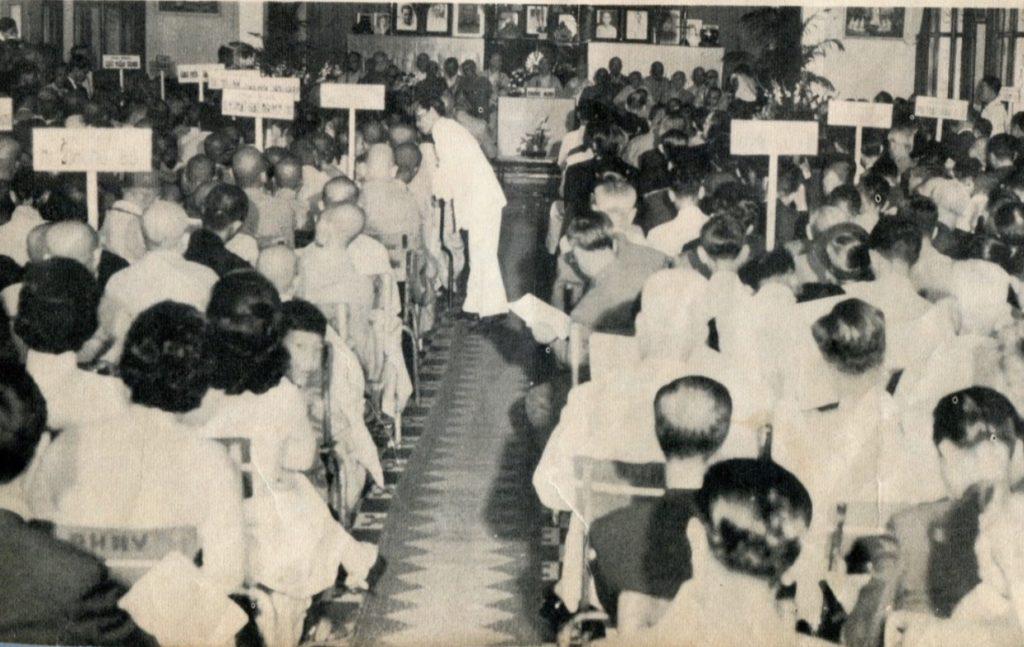
    A scene from the opening of the Buddhist Unity Congress at Xa Loi Pagoda on December 31, 1963; outside the pagoda, thousands of Buddhists gathered to support Buddhist solidarity. Photo: Buddhism’s Historic Struggle.

    At the beginning of 1964, the Buddhist Unity Congress concluded. Eleven sects and associations were merged into a single Unified Buddhist Church of Vietnam (UBCVN), headquartered at the National Pagoda of Vietnam (which was just starting construction). The UBCVN ratified a charter edited by Thich Tri Quang [13] and sat under the supervision of the Supreme Patriarch Institute and the Hoa Dao Institute.

    https://2xjs7y10oiyz26vqxu2hok6y-wpengine.netdna-ssl.com/wp-content/uploads/2020/02/line-1px-1024x24.png

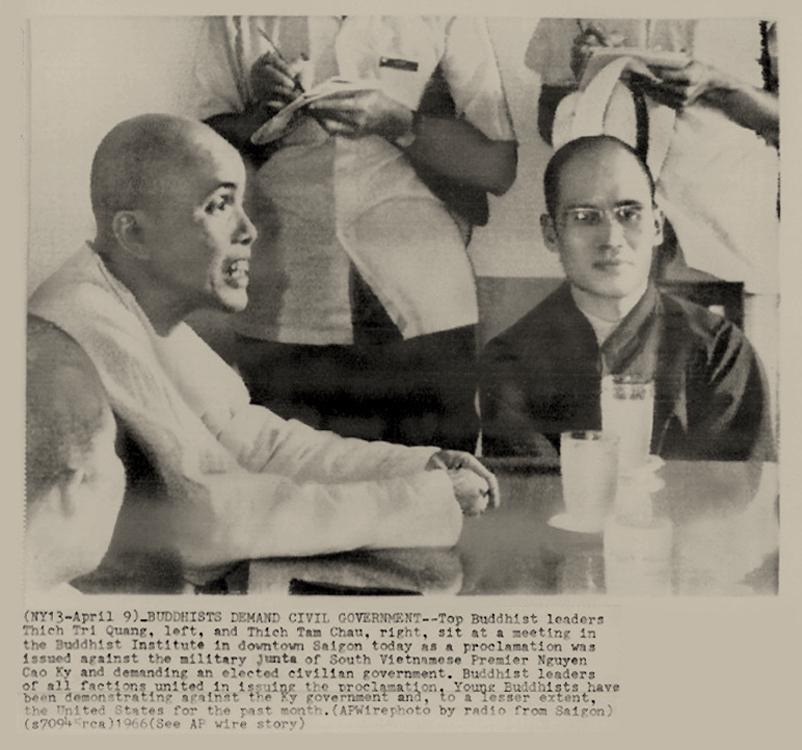
    In 1966, a little over two years after unification, the church began to fracture under pressure. A conflict arose between two groups. On one side was the An Quang bloc, led by Thich Tri Quang, which advocated a fierce struggle to interfere in politics, with its overwhelming force and superior organizational ability. On the other side were the moderated at the National Pagoda of Vietnam, led by Thich Tam Chau, who only fought for religious freedom.
    https://2xjs7y10oiyz26vqxu2hok6y-wpengine.netdna-ssl.com/wp-content/uploads/2020/02/5879313531_12c2a428be_o.jpg
    Thich Tri Quang (left) and Thich Tam Chau(right) sit in a Saigon monastery on April 9, 1966, to announce to the press their demand for the establishment of a Constitutional Committee for the general election of a civilian government. Photo: AP.

    In October 1966, the An Quang bloc established its own and separate Hoa Dao Institute with three sects and associations. [14]

    By 1967, the National Pagoda of Vietnam bloc convened a congress with eight sects and associations to amend its charter, asserting that the 1964 charter sought to eliminate the autonomy of sects and associations. From here, the conflict deepened when the government recognized the National Pagoda of Vietnam bloc’s amendments.

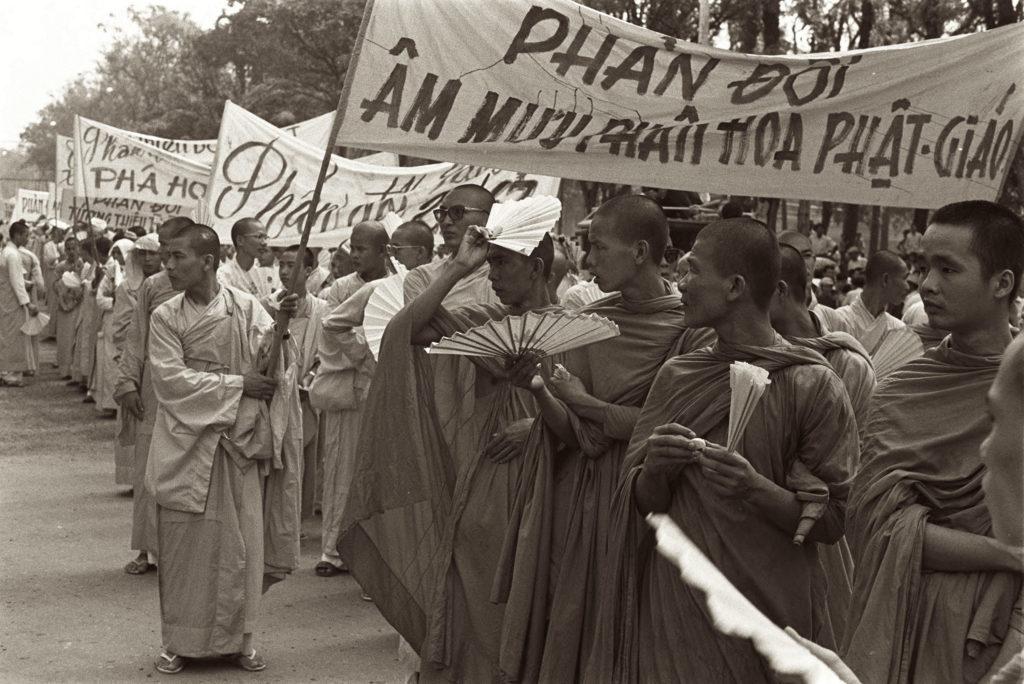
    Also in 1967, the An Quang bloc organized a series of large-scale protests, carrying the Buddhist altars down to the streets to oppose both the government and the National Pagoda bloc. The government accused the An Quang bloc of “sowing chaos” and accordingly cracked down against them. The government later broadly apologized to all Vietnamese Buddhists and monks that it had to maintain social order and there were no other methods except for cracking down against the monks of the An Quang bloc.
    https://2xjs7y10oiyz26vqxu2hok6y-wpengine.netdna-ssl.com/wp-content/uploads/2020/02/Bieu-tinh-chong-chinh-phu-1967-1024x684.jpg
    Not only did the An Quang bloc organize protests, but it also organized other noteworthy activities, such as carrying the Buddhist altars into the streets, hunger strikes, and a number of acts that are still considered controversial to this day for their perceived un-Buddhist spirit. Photo: LIFE.

    According to the Sangha of the United Southern Buddhist Church, Thich Quang Do served both as the spokesperson for and inspector of the UBCVN’s Hoa Dao Institute in 1972; two years later, he was appointed general secretary.

    The conflict between the An Quang and National Pagoda of Vietnam blocs, with their different approaches, continued until April 30, 1975.

    From when he returned to Saigon until 1975, Thich Quang Do taught at Van Hanh University, the Saigon University of Literature, Hoa Hao University (An Giang), even the Pontifical Academy of Pius X (Da Lat), and other Buddhist academies. [15] He also edited numerous scriptures and books on Buddhism.

    https://2xjs7y10oiyz26vqxu2hok6y-wpengine.netdna-ssl.com/wp-content/uploads/2020/02/line-1px-1024x24.png

    After taking control of the south, the victors immediately cracked down on all religions, sending dignitaries to re-education camps, destroying Buddhist statues, and confiscating the property of sects and associations.

    https://2xjs7y10oiyz26vqxu2hok6y-wpengine.netdna-ssl.com/wp-content/uploads/2020/02/The-Fall-of-Saigon-1975-29.jpg
    General Tran Van Tra, head of the Saigon-Gia Dinh Military Management Committee, organizes an international press conference on May 8, 1975. Photo: Herve GLOAGUEN/Gamma-Rapho via Getty Images.

    Thich Quang Do witnessed what the victors did to Buddhism. He recounts in an interview with Radio Free Asia in 2015:

    “On April 30, 1975, the Communists forcibly conquered South Vietnam. All the Vietnamese people were enslaved to an inhumane, cruel, hateful policy that was unmerciful towards religion. Our Unified Buddhist Church of Vietnam was also stripped of its more than 2000 years of legal status, Buddhist leaders were fiercely repressed, and 12 monks and nuns of Duoc Su Pagoda self-immolated.” [16]

    “During the investigation in Can Tho Province into the 12 self-immolations against repressive communist policies [one individual was only 14 years of age], the Communist authorities accused Venerable Thich Hau Hien of being an informant for the Americans and South Vietnamese, committing lewdness against other nuns in their attempt to invalidate 12 immolations. That plot, however, failed because I didn’t sign the final forms legitimizing their scheme.

    […] Things hit a fever pitch on March 3, 1977, when the Communists came to appropriate the Quang Thi Trang convent […], tearing down the “UBCVN” sign and tossing it to the ground. At exactly 11 AM that day, as general secretary of the Hoa Dao Institute, I signed circular urging monks and nuns to prepare to sacrifice to protect the religion and the honor of the Church.”

    On April 6, 1977, Venerable Master Huyen Quang and I, along with a number of others, were imprisoned in Phan Dang Luu Prison in Ba Chieu, Gia Dinh. Later, I would find out that former Venerable Master Thich Thien Minh was also captured and had died of unknown causes at the Saigon police headquarters.” [17]

    According to Amnesty International, Venerable Thich Thien Minh had died in a temporary detention camp in October 1978. [18] To this day, the Vietnamese state has yet to make an announcement about his death in Detention Camp #4 on Phan Dang Luu Rd., Ho Chi Minh City.

    A portrait of the Venerable Thich Thien Minh. He was born in 1921 in Quang Tri and entered the monkhood as a child. After the Buddhist Unity Congress in 1964, he was selected as general director of the Unified Buddhist Church’s youth affairs. Minh stood shoulder-to-shoulder with Venerable Thich Tri Quang during the Buddhist political struggles in the south. Photo: Hoavouu.com.

    Seven members of the An Quang bloc and Thich Quang Do were eventually tried in December 1978. [19]

    The seven were accused of numerous crimes: taking advantage of religion to disrupt national security, disrupting national unity, and acting to oppose the revolution. Under international pressure, Venerable Thich Quang Do and Venerable Thich Thanh The were acquitted. [20] In that same year, Thich Quang Do and Venerable Thich Huyen Quang were nominated for the Nobel Peace Prize. [21]

    https://2xjs7y10oiyz26vqxu2hok6y-wpengine.netdna-ssl.com/wp-content/uploads/2020/02/line-1px-1024x24.png

    From 1980 – 1981, Do, Venerable Thich Huyen Quang, Thich Duc Nhuan, and a number of others disagreed with the remaining An Quang bloc members, who advocated cooperating with the state to establish the Buddhist Church of Vietnam, which would allow the Communist Party to tightly control church activities.
    https://2xjs7y10oiyz26vqxu2hok6y-wpengine.netdna-ssl.com/wp-content/uploads/2020/02/qkien5.jpg
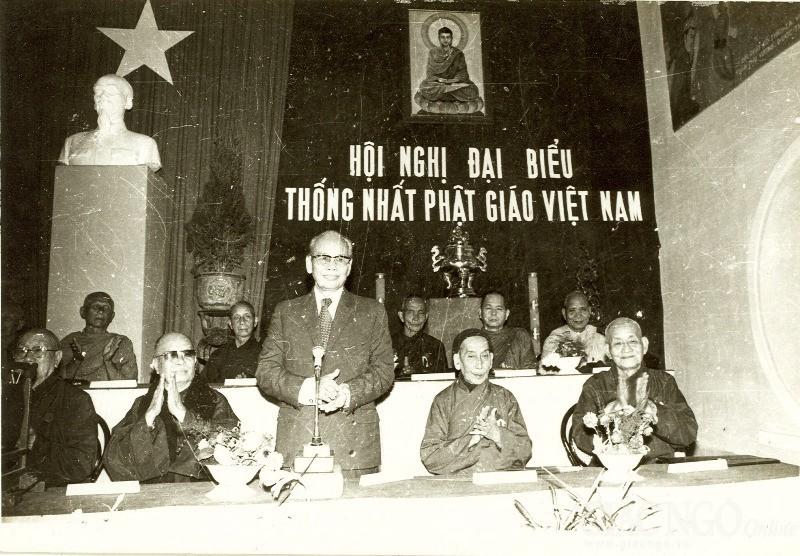
    In just one day, the government united all monks, nuns, and Buddhists across the country during the Conference of Representatives to Unify Vietnamese Buddhism, which took place on November 7, 1981, at Quan Su Pagoda. Photo: Buddhist Church of Vietnam. 

    With the establishment of the Buddhist Church of Vietnam, the UBCVN, with its history since 1951, became illegal and remains so to this day. Venerable Thich Quang Do recalls:

    “From the day former Venerable Master Tri Thu was elected head of the state church [that is, today’s Buddhist Church of Vietnam], the UBCVN no longer had a director leading the Hoa Dao Institute. Without a director, the vice-director stepped up until another congress could be convened to elect officials […]. Because of that, Venerable Master Huyen Quang was the first vice-director to become institute director, and we continued to conduct business with the church [UBCVN] as usual”.

    “At four in the afternoon on February 24, 1982, I received a letter from the municipal police headquarters, with the word ‘express’ written on it. When I opened it, I saw that I had been ‘invited’ down to their office.

    At exactly 8 AM [the next day], I arrived at police headquarters and was led to a waiting room, where two uniformed officers stood guard with pistols. After approximately an hour, I guess when they figured that was enough psychological torture, I was taken in to see Quang Minh. He said: ‘You’re being involved in religion also means you’re involved in politics (!), we’re going to have to handle you accordingly.’ After about five minutes, Quang stood up and read out the decision, […] expelling me from the city.” [22]

    In the ten years after, Thich Quang Do lived alone under the watchful eyes of Thai Binh police: “The Communists […] exiled me to Vu Doai Commune, Vu Thu Suburban District, Thai Binh Province from February 25, 1982, for the crime of ‘being involved in religion and thus being involved in politics.” [23]
    https://2xjs7y10oiyz26vqxu2hok6y-wpengine.netdna-ssl.com/wp-content/uploads/2020/02/Screen-Shot-2020-02-28-at-8.26.10-PM-1024x547.png
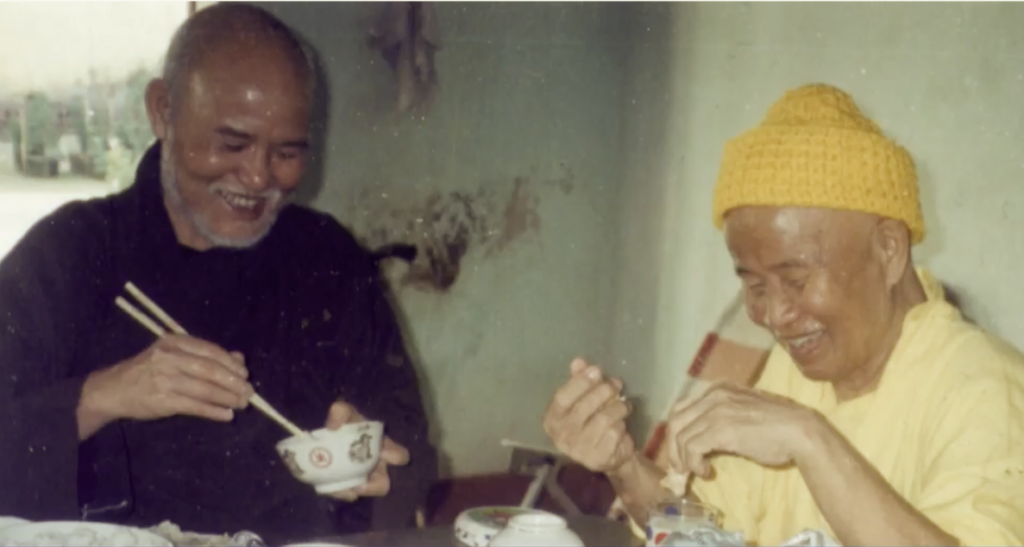
    Thich Quang Do and Thich Huyen Quang in an undated photo, possibly during the time Thich Huyen Quang was exiled in Binh Dinh. Venerable Thich Huyen Quang was born in 1919 and left home to become a monk in Binh Dinh when he was 13 years old. According to the UBCVN, he was detained in the pagoda until his passing in 2008. Photo source: unknown. 
    https://2xjs7y10oiyz26vqxu2hok6y-wpengine.netdna-ssl.com/wp-content/uploads/2020/02/line-1px-1024x24.png

    In the late 1980s, Vietnam entered the era of Doi Moi when the country’s economy changed into the market economy of capitalism. At that time, some monks saw that as the opportunity to fight for religious freedom.

    At the end of 1991, Venerable Thich Don Hau, nearing death, left in his will a call to restore the UBCVN and reactivate the 1964 church charter, amended in 1973. [24] He reminded the dignitaries, among them Venerable Thich Huyen Quang and Thich Quang Do, that they respectively held the positions of director and general secretary of the Hoa Dao Institute.

    Religious repression continued to intensify in 1992 and 1993, and the self-immolation of monks in the Mekong River Delta demanding religious freedom led to enormous protests in Hue, which the authorities cracked down upon and suppressed information about. [25]
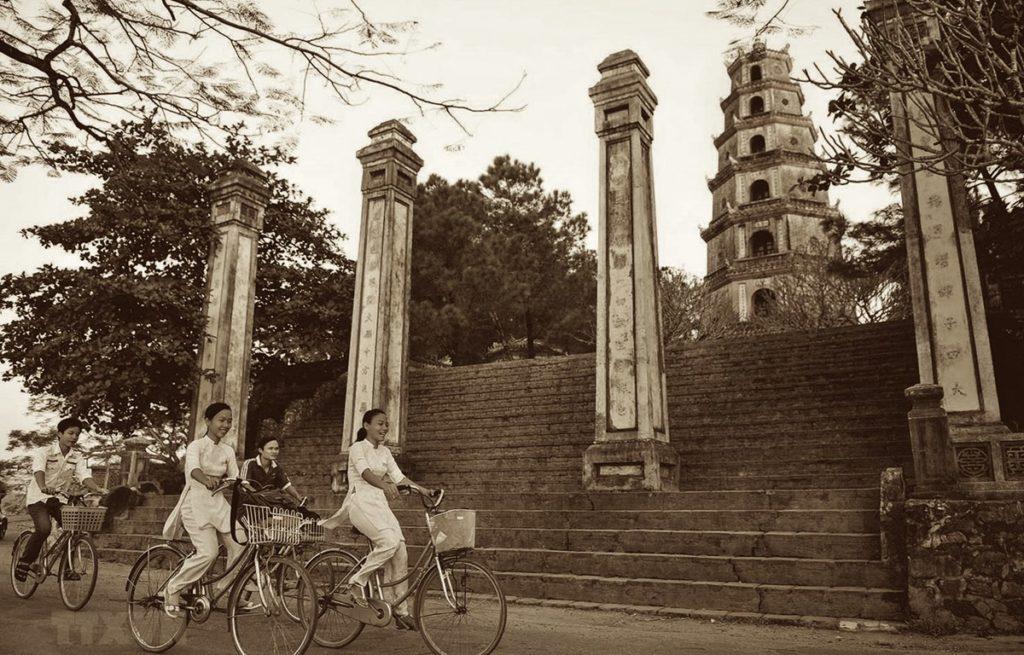
    On May 21, 1992, a man self-immolated at Thien Mu Pagoda, leading to the temporary detention of Thich Tri Tuu, a Buddhist nun. Immediately after that, thousands of monks and nuns took to the streets in protests that shook the city, and a government car was set on fire. Photo: Nicolas Cornet.

    After living in exile in Thai Binh for 10 years, in 1992, Thich Quang Do decided to return to the south a month after notifying the authorities of his plans:

    “On February 10, 1982, the Communists also inexplicably exiled my mother to Vu Doai Commune with me, where she died a tragic death […] in January of 1985 from cold and deprivation.  Left all on my own, I decided that I could no longer allow myself to be hemmed in so senselessly, interminably, and unscrupulously. On March 22, 1992 (after 10 years and 27 days of exile), I returned to Saigon after letting Hanoi police know, arriving on March 25, 1992. [26]

    I returned to the south in 1992 and continued to work on the [Phat Quang] dictionary series; in 1994, I sent to Do Muoi [a former senior leader] a series of assessments regarding the Vietnamese Communist Party’s mistakes towards the nation and Vietnamese Buddhism. After that, I went out into the community to provide aid.” [27]

    In November 1994, the Mekong River Delta suffered an unexpected flood, killing approximately 400 people. Representing the UBCVN, Venerable Thich Quang Do, along with a number of monks and retired scholars, went out to render aid to their compatriots, only to be arrested afterwards.

    “On January 4, 1995, they arrested me and imprisoned me at the temporary detention center on Nguyen Van Cu St. in the middle of Saigon. Venerable Khong Tanh and I each received five years in prison and five years probation”. [28]
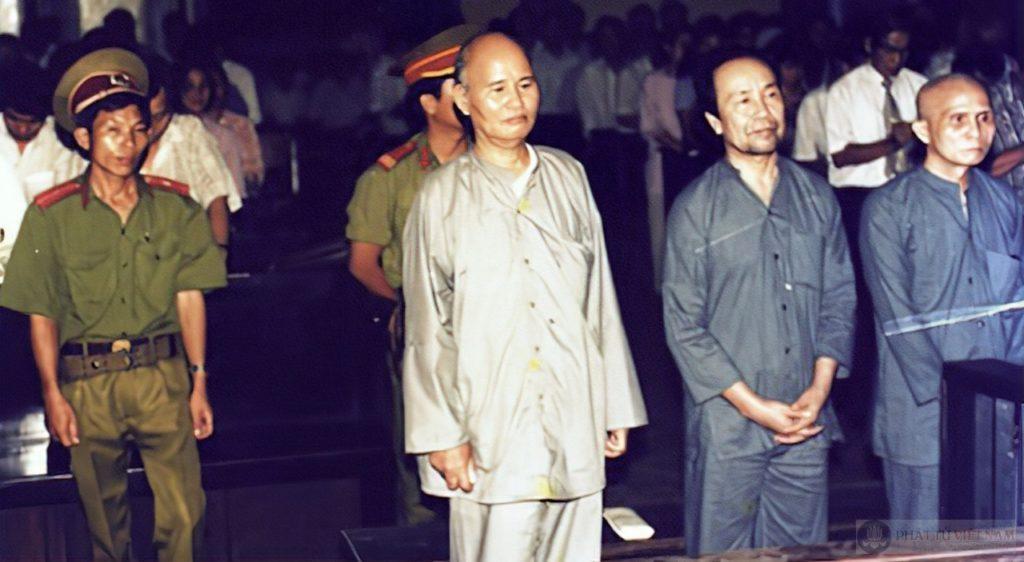
    Thich Quang Do, together with Thich Khong Tanh, Thich Nhat Ban, Thich Tri Luc, and two retired scholars Dong Ngoc and Nhat Thuong, at their August 1995 trial in Ho Chi Minh City. Photo: Vietnamese Buddhists.

    “My time in jail wasn’t too bad; it was fairly leisurely […]. You eat and you go about your work, just like anywhere else […]. Before I was imprisoned, I had requested […] that they give me the Phat Quang dictionary set that I was working on.

    I completed [the dictionary series] while in prison; when I received special amnesty and was released on September 2, 1998, they refused to return the nearly 100 volumes that I had already translated […]. They required I fill out a request form.

    Unreasonable! This having-to-request business. If it’s going to be that way, then I’m not going to request anything. They can just keep it and use it however they like; I’ll just redo everything again at home. So I did, and it took me two years. I redid everything, without having to make a request of anyone. Please be reasonable. Let’s think about this. For example, if you’re hungry, then you go and ask people for food. When people give it to you, you thank them. But in this situation, the government simply kept my work, I didn’t give it to them”. [29]

    https://2xjs7y10oiyz26vqxu2hok6y-wpengine.netdna-ssl.com/wp-content/uploads/2020/02/line-1px-1024x24.png

    At the beginning of 1999, Thich Quang Do went out to Quang Ngai to visit Venerable Thich Huyen Quang, who had just been exiled three days before. Also in the same year, Do became the director of the UBCVN’s Hoa Dao Institute.

    After his trip to Quang Ngai, he was interrogated by police. In February 2001, he was formally put under house arrest for violating the terms of his probation. [30]

    After that trip, Thich Quang Do stated to the press that: “I will continue to speak loudly, strongly, and firmly for freedom, democracy, human rights, and freedom of religion, so that those in and outside the country hear the church’s calls and its support for human rights and democracy.” [31]

    In 2001, Thich Quang Do issued a call for democracy in Vietnam to his domestic and overseas compatriots, as well as to the Vietnamese government:

    “But today, as other countries around the world develop, growing more prosperous, free, and democratic by the day, our country is becoming increasingly paralyzed and impoverished, our people oppressed and trampled on. […]

    This catastrophe persists, nurtured by three factors: the government thinks too highly of itself and refuses to accept the opinions of others, resulting in a single-party dictatorship; the government has broken away from the people and refuses the most basic calls for human rights and citizens’ rights, resulting in an abominable authoritarian regime; the government is too dependent on foreign countries, from ideology to the structure of the state apparatus, causing social and civilizational upheaval [,..] moral decay and national stagnation.” [32]

    https://2xjs7y10oiyz26vqxu2hok6y-wpengine.netdna-ssl.com/wp-content/uploads/2020/02/line-1px-1024x24.png

    In October 2003, after the state lifted its probation order, Quang Do risked his life to bring Thich Huyen Quang from Binh Dinh to HCMC for medical treatment. While on the road, the two were stopped by police and held on National Highway 1A, accused of keeping some state secrets with them [33], resulting in approximately 200 monks and nuns, and more than 1,000 Buddhists from nearby pagodas protesting to protect the two. [34]
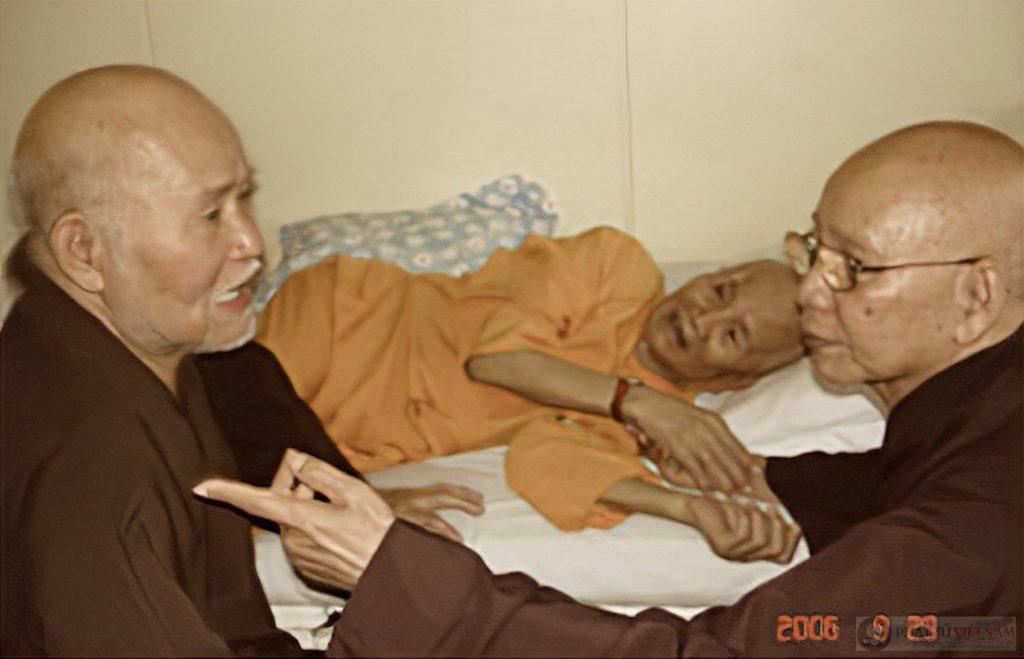
    https://2xjs7y10oiyz26vqxu2hok6y-wpengine.netdna-ssl.com/wp-content/uploads/2020/02/q30d-1-compressed-1024x659.jpg
    Venerable Thich Quang Do visits Venerable Thich Huyen Quang (laying down) in 2006. Venerable Thich Huyen Quang passed away on July 5, 2008, at Nguyen Thieu Monastery in Binh Dinh Province. Photo: Vietnamese Buddhists.
    https://2xjs7y10oiyz26vqxu2hok6y-wpengine.netdna-ssl.com/wp-content/uploads/2020/02/line-1px-1024x24.png

    In 2006, Thich Quang Do received two awards for his human rights work, Norway’s Thorolf Rafto Memorial Prize and the World Movement for Democracy’s Democracy Courage Tribute. However, the Vietnamese government prevented Do from travelling overseas to accept the awards.

    In 2007, the UBCVN began mutually supporting disenfranchised citizens through the Disenfranchised Relief Fund, helping those who had long petitioned the government on land issues.

    And in order to eradicate what it does not approve of, the government began a well-worn campaign of using the press to cast aspersions on Do and the UBCVN.

    Newspapers from Nhan Dan [The People] to Tuoi Tre [Youth] called Do “a religious exploiter” accusing him of “political opportunism,” “inciting the people,” being “on a mission of vengeance,”  and behaving like “an old dog who can’t learn new tricks.”

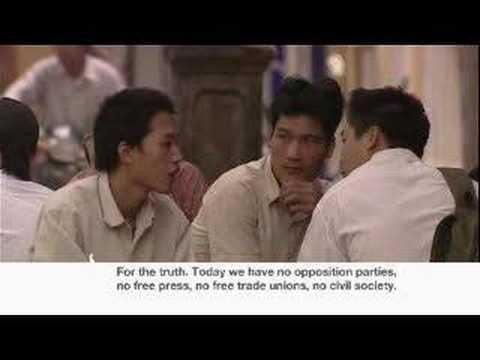
    In the same year, during which he was banned from talking to the press, Thich Quang Do responded to Al-Jazeera through video: [35]
    https://i.ytimg.com/vi/fPlL3ngQraQ/hqdefault.jpg

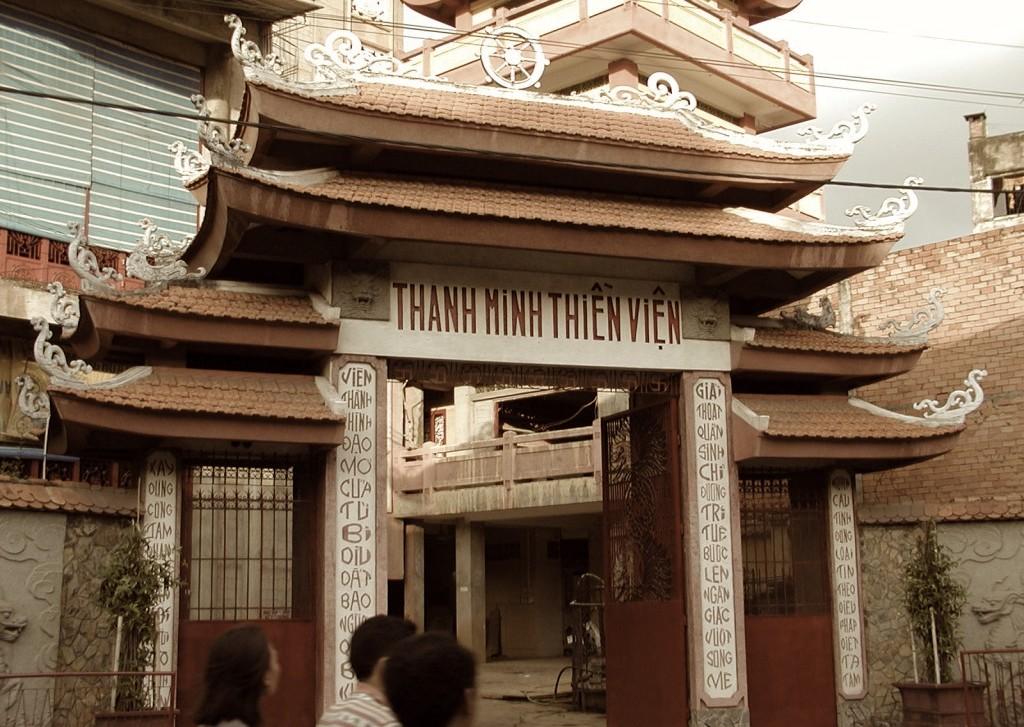
    “We are prisoners in our own homeland, where the government decides who has the right to speak and who has to keep their mouths shut. Even at this very moment, I’m being held at the Thanh Minh Monastery in Saigon. Secret police tail me day and night, preventing me from moving freely.

    I’ve been continuously repressed by the Communist regime since 1975. But I myself am not afraid of anything because I am fighting for what is right.

    Today, we lack an opposition party and freedom of the press, independent religions are being cracked down upon, and anyone demanding political reform, democracy, or human rights could be subject to immediate arrest.

    We must have political pluralism, the right to free elections, and the right to decide our political system […]. In sum, we must have the right to determine our future and our fate.”
    https://2xjs7y10oiyz26vqxu2hok6y-wpengine.netdna-ssl.com/wp-content/uploads/2020/02/line-1px-1024x24.png
    https://2xjs7y10oiyz26vqxu2hok6y-wpengine.netdna-ssl.com/wp-content/uploads/2020/02/P6090026.jpg
    From 2001, Venerable Thich Quang Do was held under house arrest at Thanh Minh Monastery, where he was closely monitored by police and isolated from church activities and the outside world. Politicians from the world over regularly tried to find ways to visit him. Photo: Clochers & Lieux de culte.

    In 2012, while he was meeting with the Australian ambassador in Vietnam, Thich Quang Do had expressed his views regarding the East Sea [South China Sea] problem:

    “Vietnam has already lost a portion, an island in Hoang Sa [the Paracels], eight islands in Truong Sa [the Spratleys]. China just established the Tam Sa [Sansha] district center, setting up administrative and military bodies to control that region. […] For now, I only wish for Vietnam to democratize and then ally itself with the world’s democratic nations. […] As it stands right now, I don’t have any hope for Vietnam.” [36]

    https://2xjs7y10oiyz26vqxu2hok6y-wpengine.netdna-ssl.com/wp-content/uploads/2020/02/line-1px-1024x24.png

    In 2011, Thich Quang Do became the fifth patriarch of the UBCVN but met with many difficulties in developing the UBCVN due to his house arrest at Thanh Minh Monastery:

    “They [the government] have yet to cease discrimination and repression of the UBCVN. Thus, the church has struggled to conduct activities over the past 30 years. We can’t preach, we can’t open schools to teach. […] If they had an opportunity to completely do away with the church, they absolutely would.

    For several decades, [I have been restricted to] a single room upstairs that I inhabit. […] Every two months, I go to the hospital, and that’s it. No one is allowed to come and go, and I can’t move freely either. When I go to the hospital, they [the police] follow.”
    https://2xjs7y10oiyz26vqxu2hok6y-wpengine.netdna-ssl.com/wp-content/uploads/2020/02/efc4965a-ac88-4015-a079-dfa535665125.jpeg
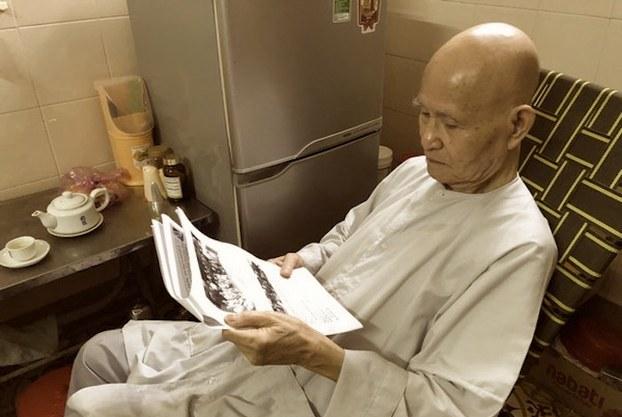
    A photo of Venerable Thich Quang Do in his room at Thanh Minh Monastery on September 3, 2018. Photo: International Buddhist Information Office. 

    “As of now, I eat only one meal a day, which is brought up to me in the morning. There’s a chair outside my door that I leave my plates on after I finish eating. The kitchen will come up to take them away, and then they lock the metal gate. The stairs up to my room have a metal gate, just like a prison cell. It’s been like this for more than 20 years since I returned from the north.

    I owe my residence here to Venerable Thich Thanh Minh’s pagoda […]. Since I left to join the monkhood some sixty years ago, I have lived thanks to the generosity of others. […] As of now, I only recite Buddhist scriptures to myself. I’m not allowed to pray for or preach to others; I can only recite to myself. They have stipulated this very clearly.” [37]

    https://2xjs7y10oiyz26vqxu2hok6y-wpengine.netdna-ssl.com/wp-content/uploads/2020/02/line-1px-1024x24.png

    In mid-September 2018, exactly three months after American Ambassador Daniel Kritenbrink came to visit him, Thich Quang Do was evicted from Thien Minh Monastery, staying at a number of pagodas before heading home to Thai Binh at 90 years of age:

    “I returned to my hometown as an ostensible retreat, but if there were any small pagodas, I would recite Buddhist scriptures there. No matter what happens to the church, even if I die, I could never give it up.”

    American ambassador Daniel Kritenbrink (left) and a colleague visit Venerable Thich Quang Do on June 14, 2018. Photo: International Buddhist Information Office.

    Not long after, Venerable Thich Quang Do, the fifth patriarch of the UBCVN, returned to HCMC at age 90 to continue his obstacle-plagued work of the church.

    https://2xjs7y10oiyz26vqxu2hok6y-wpengine.netdna-ssl.com/wp-content/uploads/2020/02/line-1px-1024x24.png

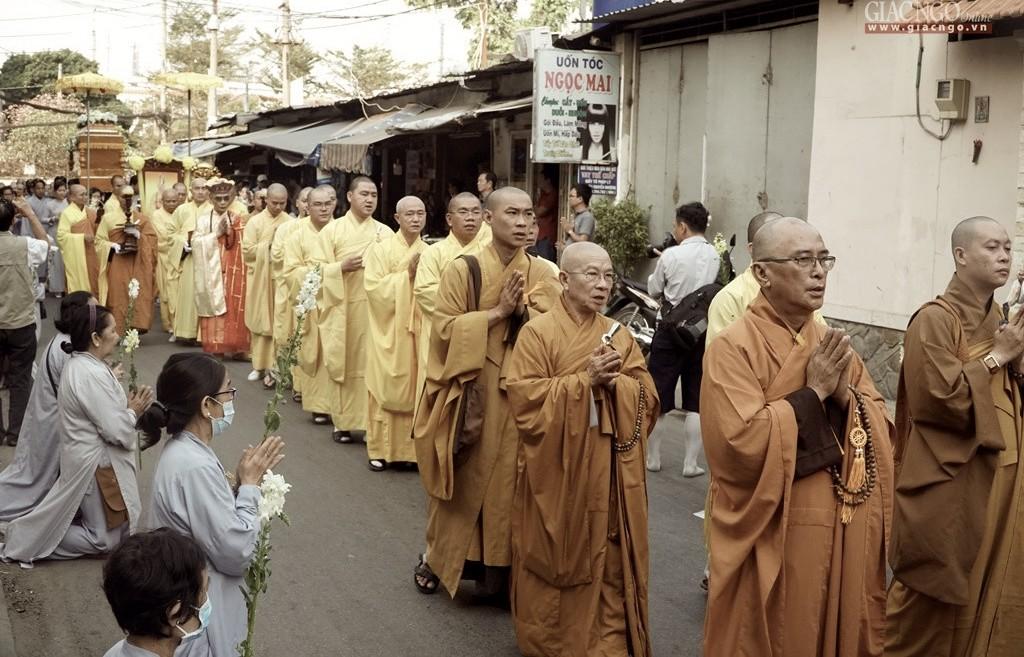
    Two years later, at 9:30 PM on February 22, 2020, Venerable Thich Quang Do, the fifth patriarch of the UBCVN, took his last breath at Tu Hieu Pagoda; his painful endeavor for the Vietnamese homeland finally came to an end.
    https://2xjs7y10oiyz26vqxu2hok6y-wpengine.netdna-ssl.com/wp-content/uploads/2020/02/H33-1.jpg
    On February 25, 2020, three days after his funeral, monks, nuns, and Buddhists escort Venerable Thich Quang Do to his cremation site; his ashes were scattered at sea 49 days later. Photo: Giac Ngo [Enlightenment].

    This article was written in Vietnamese by Tran Phuong and was previously published in Luat Khoa Magazine on March 1, 2020. The English translation was done by Will Nguyen.

    *** In our previous version of this article, we have cited the 1979 report of Amnesty International on the death of Venerable Thich Thien Minh. However, upon our recent re-checking of the cited link, it is unfortunate that the link is no longer accessible. Therefore, we have changed the link to the copy of Amnesty International’s January 1979 newsletter. We apologize for this inconvenience.***

    https://2xjs7y10oiyz26vqxu2hok6y-wpengine.netdna-ssl.com/wp-content/uploads/2020/02/line-1px-1024x24.png

    References:

    [1] Thich Quang Do, Defiant Rights Champion in Vietnam.
    [2] Assessments regarding the Vietnamese Communist Party’s mistakes towards the Nation and Vietnamese Buddhism, Thich Quang Do, written in 1992.
    [3] Letter written to Do Muoi, Thich Quang Do, written in 1994.
    [4] Thich Quang Do is appointed the new leader of the Unified Buddhist Church of Vietnam.
    [5] Brief biography of Elder Venerable Thich Quang Do (1928 – 2020), Sangha of the Unified Buddhist Church of Vietnam.
    [6] Vietnamese Buddhism Monthly Review #1, published by the Vietnamese Buddhist Federation.

    [7] Brief biography of Elder Venerable Thich Quang Do (1928 – 2020), cited material.
    [8] Vietnamese Buddhism Monthly Review #27 and #28, published by the Vietnamese Buddhist Federation.
    [9] Vietnamese Buddhism’s Historic Struggle, Nam Thanh, published by the UBCVN Hoa Dao Institute in 1964. [10] Vietnamese Buddhism’s Historic Struggle cited material.
    [11] Thich Quang Do is appointed the new leader of the Unified Buddhist Church of Vietnam, cited material.
    [12] Brief biography of Elder Venerable Thich Quang Do (1928 – 2020), cited material.
    [13] White paper on the divide between An Quang and the National Pagoda of Vietnam, written by Thich Tam Chau in 1993.
    [14] White paper on the divide between An Quang and the National Pagoda of Vietnam cited material.
    [15] Brief biography of Elder Venerable Thich Quang Do (1928 – 2020), cited material.
    [16] Interview of Elder Venerable Thich Quang Do regarding the UBCVN over the past 40 years.
    [17] Assessments regarding the Vietnamese Communist Party’s mistakes towards the Nation and Vietnamese Buddhism, Thich Quang Do, written in 1992.
    [18] Amnesty International Newsletter January 1979. (1979, January 1). Amnesty International. https://www.amnesty.org/en/wp-content/uploads/2021/06/nws210011979en.pdf.
    [19] Thich Quang Do is appointed the new leader of the Unified Buddhist Church of Vietnam, cited material.
    [20] Amnesty International Report 1979, p.117, cited material.
    [21] Thich Quang Do is appointed the new leader of the Unified Buddhist Church of Vietnam, cited material.
    [22] Assessments regarding the Vietnamese Communist Party’s mistakes towards the Nation and Vietnamese Buddhism, Thich Quang Do, written in 1992.
    [23] Letter written to Do Muoi, Thich Quang Do, written in 1994.
    [24] Venerable Thich Don Hau’s will.
    [25] In Vietnam, Monks Lead Protest to Repression.
    [26] Letter written to Do Muoi, Thich Quang Do, written in 1994.

    [27] Letter of truth Venerable Thich Quang Do sent to HCMC police.
    [28] RFA interviews Venerable Thich Quang Do.
    [29] Letter of truth Venerable Thich Quang Do sent to HCMC police.
    [30] In the News Summer 2001, Tricycle.
    [31] Venerable Thich Quang Do publicizes his call for democracy.
    [32] Venerable Thich Quang Do’s call for democracy in Vietnam.
    [33] Vietnam denounces Venerable Thich Huyen Quang.
    [34] Vietnam backs down over monks.
    [35] In My Review: Vietnam’s Buddhist Monk.
    [36, 37] Australian ambassador visits Venerable Thich Quang Do.
  • June 11, 1963: The Internationally Shocking Self-Immolation Of Buddhist Monk Thich Quang Duc

    June 11, 1963: The Internationally Shocking Self-Immolation Of Buddhist Monk Thich Quang Duc

    The “On This Day” series aims to introduce contemporary Vietnamese history of the twentieth and twenty-first centuries by explaining political events that occurred on this day in the past.


    What happened?

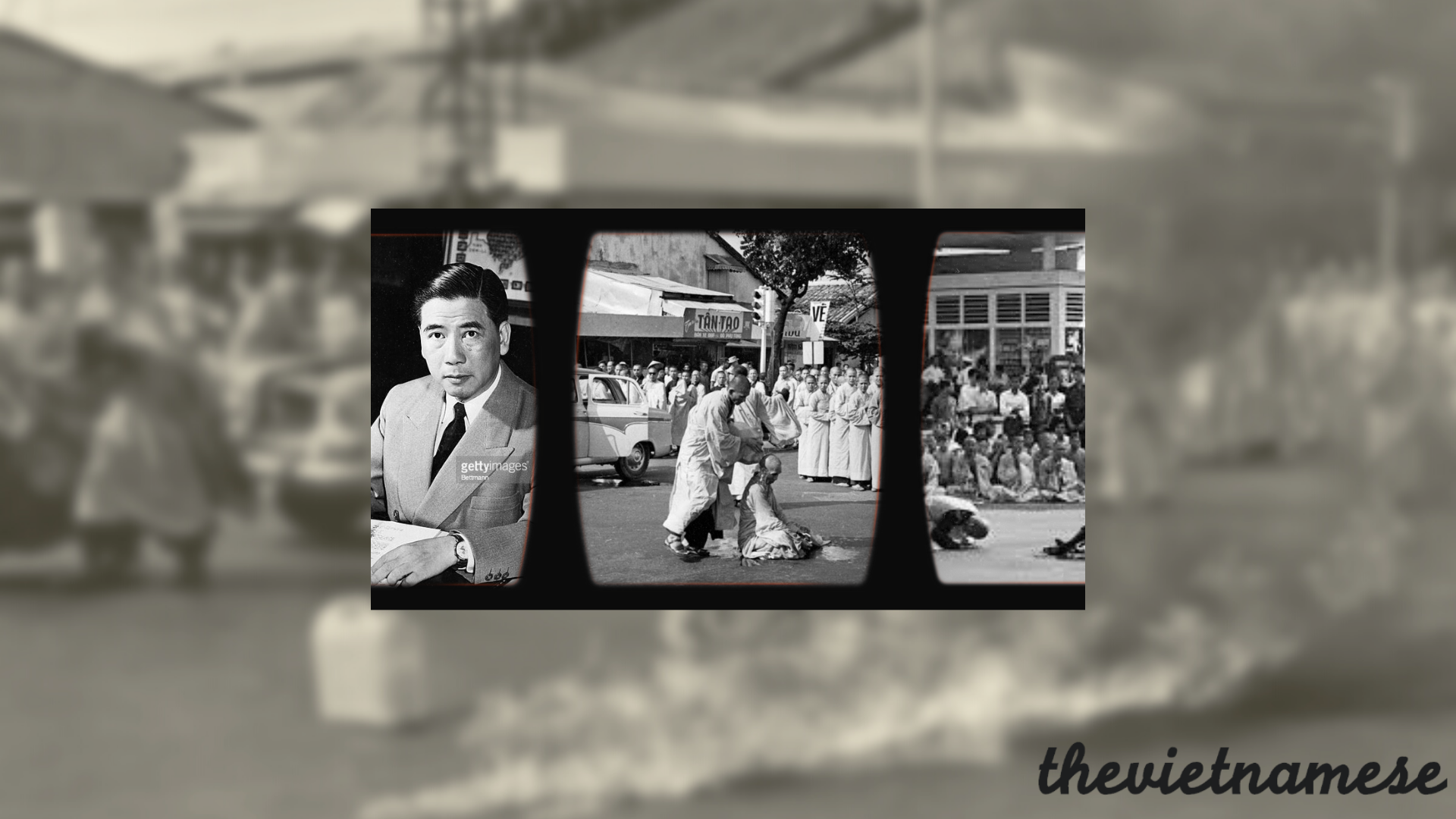
    On the morning of June 11, 1963, an elder Buddhist monk emerged from more than 300 monks protesting on a busy street of Saigon.[1] As the monks formed a circle around him, the elder monk, whose Buddhist name was Thich Quang Duc, stepped forward and sat down in a lotus position. The other monks poured gasoline on him, and one monk handed some matches to Quang Duc.

    Moments later, in a horrifying scene, the elder monk was consumed by fire.

    The onlookers were horrified, and the police present on the street tried to call fire trucks, but the accompanying monks collectively blocked the trucks. Without a doubt, Quang Duc’s self-immolation was a part of a coordinated protest by South Vietnam’s Buddhist monks.

    In the following months after Thich Quang Duc’s self-immolation, at least five other Buddhists committed suicide by burning themselves. His self-immolation also inspired many other Buddhists and bonzes in South Vietnam to do so in the following years.

    As Thich Quang Duc committed suicide publicly, Associated Press photojournalist Malcolm Browne captured the moment. The picture of the burning monk became one of the most circulated and haunting images of the Vietnam War.[2]

    Why did the monk burn himself?

    Thich Quang Duc’s self-immolation prompted multiple interpretations.

    The conventional interpretation from the current Vietnamese Communist state sees the self-immolation as an act of protest against the South Vietnamese government, at the time headed by President Ngo Dinh Diem.[3] Though the leaders expressed some empathy with the Buddhists’ frustration, the South Vietnamese government and its supporters mostly saw them as misled by the Communists.[4] The international public saw the act as protesting the ongoing Vietnam War and the American intervention.

    It is undeniable that the series of Buddhist protests in 1963 in South Vietnam were triggered by the Ngo Dinh Diem regime’s mishandling of religious issues, which made the Buddhists feel like they were discriminated against while their Christian counterparts were given many more benefits.[5]

    However, all of these narratives ignore the fact that the self-immolation and the series of Buddhist protests were a part of the more significant Buddhist crisis ongoing in South Vietnam throughout 1963, motivated by frustration and a unique political ideology.

    According to historian Edward Miller of Dartmouth College, the crisis was the result of not only the regime’s mishandling of religious issues but also because of the Buddhists’ own vision of nation-building for Vietnam, which happened to clash with both the regime in the South as well as the Communists in the North.[6]

    Their political beliefs were neither pro-North Vietnam nor anti-South Vietnam but instead purely Buddhist. They were a part of a more significant movement called Buddhist revival (Chấn Hưng Phật Giáo) that got started in Vietnam at the beginning of the twentieth century.

    Under the belief of Buddhist revival, many monks and Buddhists subscribed to a particular Vietnamese-Buddhist nationalism, which saw Buddhism as the national religion and the only path to Vietnam’s future prosperity.

    Followers of Buddhist revival had a distinctive historical narrative that saw Buddhism as the source of the prosperity of the ancient kingdom Dai Viet, the predecessor of modern Vietnam that flourished around the 10th to the 13th century. The followers of Buddhist revival thought that Vietnam was only weakened and became corrupted due to Chinese colonization and its import of philosophy, from Confucianism to Taoism. Similarly, they viewed both Communism and Ngo Dinh Diem’s Personalist Revolution[7] as Western-imported ideologies that were also unsuitable for Vietnam.

    Thich Quang Duc was a part of this movement. According to Miller, when he came up with the idea of burning himself, Quang Duc understood it as an act of promoting Buddhist reforms and defending his Buddhist revival ideals.

    Therefore, to call the self-immolation of Thich Quang Duc either pro-Communist, anti-Ngo Dinh Diem, or anti-American intervention would be insufficient. His self-immolation was highly political and was meant to express more than just opposition to any regime.

    Bibliography

    [1] Miller, E. (2014). Religious Revival and the Politics of Nation Building: Reinterpreting the 1963 ‘Buddhist crisis’ in South Vietnam. Modern Asian Studies, 49(6), 1903–1962. https://doi.org/10.1017/s0026749x12000935

    [2] Lindsay, J. M. (2012, June 11). TWE Remembers: Thich Quang Duc’s Self-Immolation. Council on Foreign Relations. https://www.cfr.org/blog/twe-remembers-thich-quang-ducs-self-immolation

    [3] Tưởng niệm 50 năm Hòa thượng Thích Quảng Đức tự thiêu. (2013, May 28). vov.vn. https://vov.vn/doi-song/tuong-niem-50-nam-hoa-thuong-thich-quang-duc-tu-thieu-263846.vov

    [4] Vietnam’s Faiths Underlie Rising; Buddhist‐Catholic Disputes Sharpened Under Diem. (1964, September 14). The New York Times. https://www.nytimes.com/1964/09/14/archives/vietnams-faiths-underlie-rising-buddhistcatholic-disputes-sharpened.html

    [5] Joiner, C. A. (1964). South Vietnam’s Buddhist Crisis: Organization for Charity, Dissidence, and Unity. Asian Survey, 4(7), 915–928. https://doi.org/10.1525/as.1964.4.7.01p1727l

    [6] Miller, Religious Revival, 1903–1962.

    [7] Hollingsworth, E. (n.d.). The Church of Ngo: Ngo Dinh Diem’s Personalist Revolution and the Making of Alternative Nationalisms in the Republic of Vietnam, 1954–1963 | MA/MSc in International and World History. Columbia University. Retrieved June 10, 2021, from https://worldhistory.columbia.edu/content/church-ngo-ngo-dinh-diems-personalist-revolution-and-making-alternative-nationalisms

  • Vietnam Officially Announces National Decline In The Number Of Buddhist Followers, Shocking Its Buddhist Sangha

    Vietnam Officially Announces National Decline In The Number Of Buddhist Followers, Shocking Its Buddhist Sangha

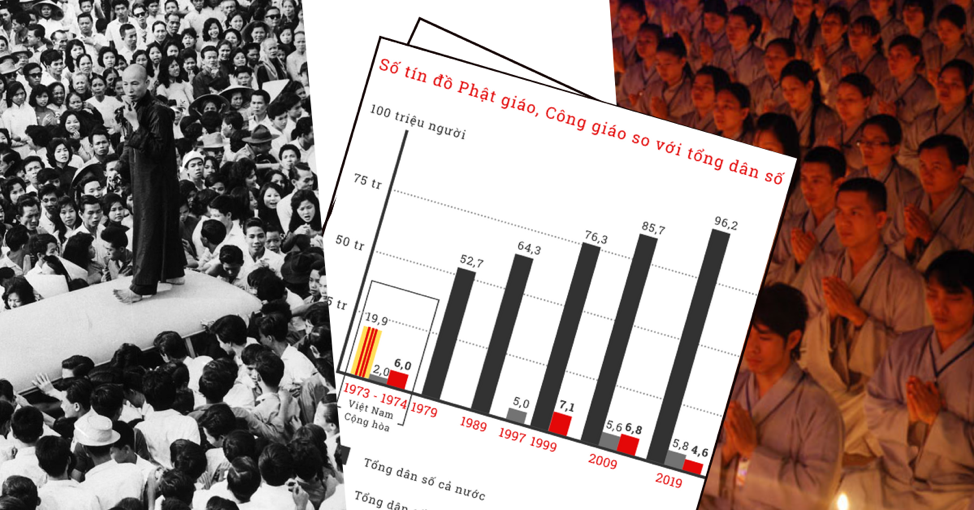
    According to Vietnam’s official statistics, in 2019, the religion with the largest number of followers in the country is Catholics with 5.9 million people. The number of followers of Buddhism is 4.6 million, ranking second. However, the numbers reported by this census contradict statistics from other state agencies, leading religious leaders and followers in Vietnam to question its accuracy.

    The Giac Ngo Newspaper – a Buddhist media – reported that this news “shocked” some monks, and that some  believers “burst into tears” when they heard the news. Many people naturally assumed that Vietnam would have more Buddhists than any other religious group.

    However, over the years, followers, monks and as well as senior sangha officials in Vietnam, have gone from one disappointment to another because the number of Buddhists has fallen dramatically in state statistics.

    The number of Buddhists in the 2009 Population and Housing Census was 6.8 million, a decrease of about 300,000 compared to 1999. Even so, Buddhism remained the religion with the largest number of followers in Vietnam.

    The situation only changed with the 2019 census results.

    In that year, the government announced that the number of Buddhists decreased by 30 percent compared to 2009. From 2019, Buddhism has lost its top position in the number of followers in Vietnam according to the State census.

    Over the past 50 years, Vietnam’s general population increased, but the number of Buddhist followers decreased

    Buddhism – a religion of about 2,000 years of development in Vietnam – now has only 4.6 million followers, accounting for about 4.78 percent of the total population.

    Meanwhile, the number of people who claimed to be Buddhist in the Republic of Vietnam (which only consisted of the south of Vietnam and a portion of the center) in 1963 was 9 to 11 million, accounting for 70 percent to 80 percent of the south’s total population as stated in the estimates that the US Central Intelligence Agency (CIA) compiled that year.

    The current figure of 4.6 million Buddhists is also less than the number of followers identified by the CIA as active Buddhists in the Republic of Vietnam in 1974, which was about 5-6 million.

    After 1975, the vibrant religious culture in the south suffered a period of “government watch” for more than 15 years. During that time period, major religions were restricted in their practices and the smaller religions were completely banned.

    According to State Magazine, a research journal of the Ministry of Home Affairs, in the first two censuses of 1979 and 1989, Vietnam did not record the number of religious followers.

    By the early 1990s, Vietnam began to officially recognize the religions that were previously popular in the South but which were banned after 1975, such as Hoa Hao and Cao Dai Buddhism. In 1999, the government started to keep statistics on the number of religious followers in the country.

    Nevertheless, as more statistics were completed, it was observed that the number of Buddhist followers were reported as having fallen. Throughout the three censuses (in 1999, 2009, and 2019), the number of Buddhists decreased by 35 percent while the national population increased by about 26 percent

    Graphics from Luat Khoa Magazine based on the data sources below.

    The Vietnam Buddhist Sangha refutes the state figures, but also does not publicize its own membership numbers

    Looking back, in 2012, the Buddhist Sangha of Vietnam opined about the number of Buddhists in Vietnam after the 2009 census results were published.

    Although Most Venerable Thich Bao Nghiem, vice chairman of the board of directors and head of the Board of the Dharma Preaching of the Central Vietnam Buddhist Sangha, acknowledged the 2009 census is quite “large, serious, and objective,” he also said at the time: “The statistical results …. about Buddhism are not accurate for many different reasons.” He explained that in Vietnam, apart from those who claim to follow other religions, the rest are really “followers of Buddhism, who love Buddhism and are influenced by Buddhism”. If one accepts Thich Bao Nghiem’s reasoning, then the number of followers of Buddhism in Vietnam could have been about 78 million in 2009 – which is the number we get when we subtract all people who declared themselves to have a different religion than Buddhism from the national population at that time.

    However, in 2019, the Vietnam Buddhist Sangha was again surprised when the State census stated that the number of Buddhist followers declined further and that Buddhism was no longer the religion with the most followers in Vietnam.

    Despite this continuing disappointment, over the years, the Vietnam Buddhist Sangha – with nearly 40 years of operation and the only state-recognized Buddhist organization in the country – still has not published the number of its own followers. The only official figure for Buddhists in Vietnam comes from state statistics.

    Meanwhile, other religions have tallied and announced the numbers of their own followers. For example, in 2018, the Vietnam Catholic Bishops’ Council announced that the whole country had about 7 million Catholics (Vietnam’s state statistics put the number at just about 5.86 million). Overseas branches of Hoa Hao Buddhism also stated that there were about 3 million Hoa Hao Buddhists in 2010 (state statistics in 2009 said just 1.3 million).

    Figures for the number of Buddhist followers from other state agencies are also inconsistent

    Unable or unwilling to declare the number of its own Buddhist believers, the Buddhist Sangha currently uses statistics from the Government Committee for Religious Affairs.

    Accordingly, the Sangha often uses the estimate given by Tran Thi Minh Nga that she used when she wrote an article in 2014 on the website of the Government Committee for Religious Affairs. Nga said that up to June 2010, Buddhism had had about 10 million followers in Vietnam.

    Meanwhile, the number of Buddhists in 2009 announced by the General Statistics Office was only 6.8 million.

    Nga did not cite the data source that she mentioned in her article at that time. In 2014, she was the deputy director of the Buddhist Department of the Government Committee for Religious Affairs. Currently, she is serving as the deputy head of the Government Committee for Religious Affairs.

    In a report on religious freedom in Vietnam in 2019, the US Department of State also used data from the Government Committee for Religious Affairs, which in January 2018 stated that about 14.9 percent of the total population was Buddhist. If applying this ratio to the total population in 2019, the number of Buddhists would have been about 14.3 million.

    According to Associate Professor Hoang Thu Huong of the University of Social Sciences and Humanities, the National University of Hanoi, Buddhist monks believe that Buddhists must include both 1) those believers who take refuge in the Three Jewels or Triple Gem (also known as the “Three Refuges”), and also 2) those who identify themselves as being influenced under Buddhism. Dr. Huong also said that because the criteria for inclined towards Buddhism could not be included in statistics survey questions, and that could be why the number of Buddhist followers differs among different state agencies.

    However, during the period of the Republic of Vietnam, the CIA recorded both of these statistics, including active believers (possibly including the Three Refuges) and self-proclaimed and sympathetic Buddhists.


    (*) Data sources for the chart listed above.


    This article was written in Vietnamese by Thai Thanh and previously published in Luat Khoa Magazine on February 18, 2021. The translation was done by Luu Ly.

  • The Tumultuous Lives of Three Monks:  Thich Nhat Hanh, Thich Tri Quang,  and Thich Quang Do

    The Tumultuous Lives of Three Monks: Thich Nhat Hanh, Thich Tri Quang, and Thich Quang Do

    Long ago, there lived three monks: Thich Nhat Hanh, Thich Tri Quang, and Thich Quang Do. All three were well-versed in the Buddhist Dharma. Nhat Hanh spoke eloquently and wrote well. Tri Quang had talent for leadership and was trusted by the masses. Quang Dao was well-studied and excelled in foreign languages.

    Long ago, there lived three monks.

    When Ngo Dinh Diem’s regime cracked down on Buddhism, these three combined forces to fight back. Nhat Hanh campaigned overseas, calling for peace and religious freedom in Vietnam. Tri Quang led tens of thousands of monks and Buddhist adherents as they protested in Saigon. And Quang Do, the youngest of the trio, stood side-by-side with these Buddhists as they marched on the streets.

    Long ago, there lived three monks.

    When the communists arrived, the paths of these three diverged. Nhat Hanh became world-famous with his Plum Village Monastery. Tri Quang was imprisoned and refrained from speaking about politics again. Quang Do continued the struggle for religious freedom and human rights, ultimately serving the longest period of house arrest of any monk in Vietnam.

    1997

    One day in October of 1997, in a theater in Berkeley, California, approximately 3,500 people, who paid US$20 a ticket to meet their most beloved monk, sat in silence.

    A ringing bell echoed across the theater, and a monk’s voice loudly called out: “All rise!”. Zen Master Nhat Hanh, draped in a deep brown robe, lead 35 monks and nuns as they slowly spread out across the stage.

    Many in the audience clasped their hands before their chests and directed their eyes towards the stage. Sitting on a high podium next to a large, bronze bell and an arrangement of giant sunflowers, Zen Master Nhat Hanh began expounding on mindfulness. “Learn how to stop running,” he advised his audience. “Many of us have been running all our lives.”

    “Society is very individualistic, selfish, with people thinking about himself or herself alone. Each for himself, each for herself alone. But in fact even if you have the desire, the intention, to help others, it would still be difficult for you to do so, because when you are not in peace with yourself, it’s very difficult to relate to people in a peaceful way in order to help them,” he stated to reporter Don Lattin of the San Francisco Chronicle.

    By that point, Zen Master Nhat Hanh had become internationally renowned for this talks on mindfulness and world peace. After 1975, he stopped speaking to the international media about human rights in Vietnam, even though Buddhism there was suffering through hardship.

    At the same time, in a prison cell thousands of miles away from America, Venerable Quang Do was compiling a Buddhist dictionary. He was sentenced to five years in prison in 1995 for helping flood victims in the Mekong Delta. Ten years before that, he witnessed his mother pass away in hunger and poverty after the government exiled both to Thai Binh.

    In 1997, Venerable Tri Quang grew accustomed to his comfortable life. He no longer spoke about politics or peaceful resistance.

    After 1975, he was confined to a wheelchair to heal his feet, which had atrophied after government torture, according to a monk who was imprisoned with him at the time. From the 1980s onwards, the international media stopped mentioning him and the tragedies of Buddhism in the south.

    Childhood in chaos

    Born during the tumult of French and Japanese fighting over control of the country, the three monks were all witness to the historical crises of that era.

    One day in Diem Dien Village, Quang Binh Province, the mother of Tri Quang met two monks who left a deep impression on her, he relayed in his autobiography. Upon returning home, she told her husband that the family should have someone join the monastery, as the two monks had. Thus, on the eve of the lunar new year in 1938, Tri Quang shaved his head and entered the monastery at Pho Minh Pagoda; he was only 15 years old. The next year, he was transferred to Hue to study for another six years. When he was put in charge of the Quang Binh Province Buddhist Committee for National Salvation (seen as a part of the Viet Minh Front), he saw many of his classmates sacrifice their lives in the resistance war against the French.

    https://www.luatkhoa.org/wp-content/uploads/2020/04/01-Thich-Nhat-Hanh-at-16-PHOTO-PVCEB-729x1024-1.jpg
    Zen Master Thich Nhat Hanh, in Hue, when he was 16 years old. Source: Plum Village.

    In Hue, Nhat Hanh grew up the son of a man who worked for Emperor Bao Dai’s government. Nhat Hanh stated the seed of the Great Buddha blossomed within him from when he was very young. Responding to reporter Don Lattin about his childhood, he stated that while he was studying at the village school, he and his friends would go door-to-door begging for bowls of rice to give to those dying of hunger. He relayed that the kids had to decide early on who would get to eat and who wouldn’t because there simply wasn’t enough rice to go around. In 1942, Zen Master Nhat Hanh left his family and entered the monastery at Tu Hieu Temple in Hue. He was only 16.

    In the same year, a 15-year old teenager in Thai Binh traveled to Ha Dong province (today’s Hanoi) to enter the monastery at Thanh Lam Temple. He took on the Buddhist name Quang Do. He recalled, only three years after he left his family, he witnessed his master tied up and brought out to the village courtyard like a criminal, after the Viet Minh suspected him of being a traitor. His master was then denounced and executed by three bullet rounds. It was then the young 18-year old swore to himself that he would use Buddhism’s mercy, forgiveness, and non-violence to fight against fanatics and the unforgiving.

    A united sense of purpose

    After the tragedy at Thanh Lam Temple, Thich Quang Do went to study in Hanoi. During this time, Tri Quang and Nhat Hanh likely met one another in Hue.

    At the time, the Bao Quoc Buddhist Institute had just been established in Hue in 1947. A year later, Tri Quang became a teacher there, and Nhat Hanh a student.

    In 1950, Tri Quang went to Saigon for the first time, concurrent with Nhat Hanh. In Saigon, Tri Quang, along with some other monks, unified three Buddhist institutes into one, locating it at An Quang Temple. Nhat Hanh began teaching here.

    Both Nhat Hanh and Tri Quang had a common desire to unify Buddhism and develop it into a national religion [1]. Both pursued this desire through journalism.

    After the Geneva Accords were signed in 1954 and the country was temporarily divided in two, Tri Quang became the editor-in-chief of the Vien Am paper. A year later, Nhat Hanh was made editor-in-chief of Vietnamese Buddhism, but after two years, he was forced to suspend the paper after pushing for Buddhist unification too vociferously.

    During this time period, both individuals suffered enormous mental anguish. Nhat Hanh was completely “defanged” in his struggle and afterward temporarily withdrew from the limelight, retreating to a solitary location with allies in Lam Dong. Tri Quang, haunted by images of his mother being publicly denounced in 1956, wandered to Nha Trang before returning to Hue in 1960. Buddhism’s suppression (by Ngo Dinh Diem’s government) would add an extra layer of pressure on top of his mother’s tragedy.

    In 1958, Quang Do returned to Saigon after studying abroad in Sri Lanka and India. Under Ngo Dinh Diem’s religiously discriminatory regime, and the conflict brewing between the Nationalists and the Communists hanging over their heads, young Nhat Hanh and Quang Do were not able to accomplish much in the way of big tasks. But it seems all three were able to sense impending disaster for Buddhism in the south.

    In his book Intention’s Road Home, Zen Master Thich Nhat Hanh explained that in 1961, when he and his friends’ place of residence was raided, he had to retreat to Saigon for safety. During this difficult time period, he traveled to the United States, where he conducted research on Buddhism at Princeton University and then taught at Columbia University.

    https://www.luatkhoa.org/wp-content/uploads/2020/04/Untitled-design-3-1024x551.jpg
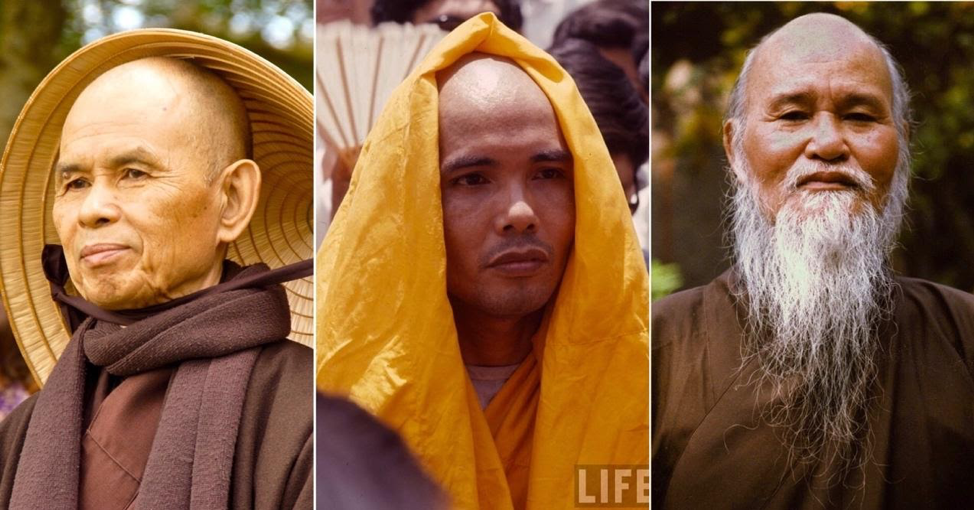
    Pictures of Zen Master Thich Nhat Hanh, Venerable Thich Tri Quang, and Venerable Thich Quang Do, taken in 1960. Source: PVCEB, AP, and Vietnamese Buddhists.

    Days of struggle

    On the night of May 8, 1963, as Venerable Tri Quang, head of central Vietnam’s Buddhist Association, stepped into Hue’s radio station together with the provincial leader to resolve ongoing protests as gunfire rang out among the Buddhist crowds surrounding the station. That night, Hue Radio did not broadcast as promised the program celebrating Vesak, recorded earlier that morning. Compounding popular anger was the fact that the government had prevented the flying of Buddhist flags. The crowds did not disperse until two in the morning. That night, many were seriously injured, resulting in eight deaths.

    In the gloom of the next morning, as Venerable Tri Quang was  resting, roiling crowds of young people began filling the streets, holding Buddhist flags. That same day, Buddhists in Saigon decided to establish the Inter-party Committee to Protest Buddhism (abbreviated as the “Inter-party”), confirming a drawn-out struggle. Venerable Tri Quang sat on the Advisory Board, while Venerable Quang Do worked as assistant to the public relations committee of the Inter-party.

    The objective of the Inter-party was to get the government to respond to five demands: withdraw the decree banning the flying of Buddhist flags, put Buddhism on equal footing with Catholicism, end the suppression of Buddhist followers, grant Buddhist monks and nuns the freedom to proselytize, and compensate for the deaths caused (during the crisis) and punish those responsible.

    In the two days following the incident at the Hue radio station, Buddhists protested spontaneously, but thereafter, they gained a sense of order and organization with Venerable Tri Quang’s direction, the monk recounted in an autobiographical short story. He also found ways for Buddhists to come to Tu Dam Temple to pray each week for those who had passed away. In Saigon, monks organized spiritual processions from one temple to the next, as well as protests and hunger strikes.

    The government only ramped up its repression; many temples in Hue were blockaded, and monks and nuns were publicly attacked. It wasn’t until Venerable Thich Quang Duc, 73, immolated himself on June 11th, 1963 that the situation improved in any meaningful way. Tri Quang traveled from Hue to Saigon to enter into discussions with the government.

    In the weeks and months that followed Venerable Quang Duc’s self-immolation, the Inter-party signed a joint communiqué with the government responding to Buddhism’s five demands. However, the government never implemented the communiqué, greatly angering monks, nuns, and the general population.

    According to Thich Nhat Hanh, at the time he was in America campaigning for religious freedom and a cessation of war in his own homeland. He appeared on television, met journalists, translated materials detailing the human rights violations in Vietnam, and pushed international organizations, including the United Nations, to intervene in the increasingly volatile situation in South Vietnam.

    As Thich Tri Quang relayed in his autobiography, on the morning of July 17, 1963, Venerable Quang Do was unable to deliver translated international press updates to Xa Loi Pagoda. That day, countless Buddhists poured into Giac Minh Temple, where the monks were on a hunger strike. These crowds quickly morphed into an enormous protest. As the Buddhist adherents tried to approach Giac Minh Temple, they were blocked by police. Venerable Quang Do was among them, directing the protests to struggle not only against the police barricade but for Buddhism itself. In his book History of the Vietnamese Buddhist Struggle, Monk Tue Giac writes that after 10 am that morning, the protests had devolved into a fighting match with police. Venerable Quang Do suffered a head injury, blood pouring down his face. Any Buddhist who had not been arrested by police returned to Giac Minh Temple, resisting as barbed wire fencing kept more than 600 monks, nuns, and adherents barricaded for 54 hours.

    https://www.luatkhoa.org/wp-content/uploads/2020/04/Xung-dot-phat-giao-1963-1024x672.jpg
    Thich Quang Do (circled) directs a protest on the streets of Saigon, July 17h 1963. Source: HORST FAAS/AFP.

    By August 20, 1963, Ngo Dinh Diem’s government was determined to restore order. A day after martial law was imposed, monks were arrested and adherents attacked. Venerable Quang Do was apprehended. Venerable Tri Quang went to the American Embassy to apply for amnesty.

    From that point until President Ngo Dinh Diem’s assassination on November 2, 1963, the struggle raged between Buddhists, the Army, and international pressure.

    In December 1963, after the struggle had succeeded, Venerable Tri Quang along with other monks established the Unified Buddhist Church, Venerable Quang Do went overseas for medical treatment, and Venerable Nhat Hanh returned to Saigon.

    While Venerable Tri Quang mobilized Buddhist adherents, monks, and nuns to continue the political struggle, Nhat Hanh was able to fulfill his wish of establishing several campuses, including the La Boi Publishing House, Van Hanh University, the Youth School for Social Services, and the Tiep Hien Congregation (a congregation centered on the full integration of Buddhism into daily life).

    https://www.luatkhoa.org/wp-content/uploads/2020/04/6206336914_6d4295429e_o-1024x707.jpg
    Thich Tri Quang walks among South Vietnamese soldiers in Danang, January 1965. Source: Christian Simonpietri/Sygma/CORBIS.

    In May 1966, Thich Nhat Hanh headed to the US to campaign for an end to the war in Vietnam. After three months, the South Vietnamese government refused to let him return home. At the time, Thich Nhat Hanh began becoming world-renowned as the face for peace in Vietnam. The next year, Reverend Martin Luther King nominated him for the Nobel Peace Prize.

    https://www.luatkhoa.org/wp-content/uploads/2020/04/06-Thich-Nhat-Hanh-at-an-airport-PHOTO-PVCEB.jpg
    Thich Nhat Hanh on his way to the United States to campaign for the end of war in Vietnam. His trip was originally planned to span three months, but after he left, the South Vietnamese government refused to let him return home again. Source: PVCEB.

    A road diverged three ways

    At the beginning of 2005, as the people proudly and warmly greeted his arrival, Zen Master Nhat Hanh was finally able to return home after more than 40 years away, accompanied by a Sangha of approximately 200 adherents. He conducted talks with audiences that included party members in Ho Chi Minh City, Hue, and Hanoi.

    Meanwhile, Venerable Quang Do lived in solitary confinement, locked in a room at Thanh Minh Zen Monastery in Ho Chi Minh City. Across the street were police whose only job was to keep an eye on him day and night.

    During his trip, Zen Master Nhat was able to visit Venerable Tri Quang but not Venerable Quang Do.

    In the eyes of the Vietnamese media, Zen Master Nhat Hanh was someone to be immensely proud of, he was “flesh and blood” who had returned to his homeland to further contribute to the people’s well being. Venerable Quang Do, on the other hand, was a boil that the government tried every means to remove. But back then, both monks were cut from the same cloth, up until the day Saigon fell.

    After 1975, as Zen Master Nhat Hanh set up his Plum Village Monastery in France, Venerable Tri Quang was imprisoned for a year and a half in a hole the size of a coffin, which he was only allowed to leave for 15 minutes each day to wash up. From then on, people no longer saw him calling for protests or making demands for Buddhism; the international media was never able to make direct contact with him again for as long as he lived.

    After the war, Venerable Quang Do along with a number of other monks fought for those who had self-immolated in the name of religious freedom and in protest of the new regime’s intention to eliminate the Unified Buddhist Church of Vietnam. In a country with no international media, no independent courts, and no freedom of association, these efforts would be in vain, the number of immolated corpses perhaps outnumbering that of the old regime. He was never able to reach a compromise with the government, up until the day he died.

    Long ago, there lived three monks: Nhat Hanh, Tri Quang, and Quang Do. When the communists arrived, the lives of these three diverged completely.

    Correction (April 12, 2020): in a version of this article, we had written that Zen Master Thich Nhat Hanh had entered the monastery at Tu Dam Temple. We wish to correct this to Tu Hieu Temple, in Hue.

    Footnote:
    [1] See numbers 2 to 28 in Buddhism Magazine, and Intention’s Road Home (Zen Master Thich Nhat Hanh).

    References:

    This article was written by Tran Phuong and published by Luat Khoat magazine on April 12, 2020. It was translated by Will A. Nguyen.