Tag: BOT

  • Vietnam Continues To Violate People’s Rights After Human Rights Dialogue With EU

    Vietnam Continues To Violate People’s Rights After Human Rights Dialogue With EU

    Less than a day after the Human Rights Dialogue between the European Union and Vietnam on March 4, 2019, was conducted, the Vietnamese police continue to commit blatant violations of the people’s rights.

    Two hours ago, the police came and arrested one of the active members of a group consisting of concerned citizens who have been fighting against what they alleged as illegal activities associated with the BOT (Build-Operate-Transfer) toll booths across Vietnam.

    Ha Van Nam, the victim, posted on Facebook that the police came and searched his house. Later, other Facebookers cited his wife’s statement to confirm his arrest.

    Ha Van Nam was viciously beaten up by men in plainclothes back in January 2019 whom he alleged that they were plainclothes officers. He suffered two broken ribs and other injuries. The perpetrators later threw him at the front gate of Dan Phuong hospital in Hanoi.

    Today, his last post on Facebook stated that the police came to his house and alleged that he committed the crime of “inciting public disorder.”

    “Inciting public disorder” is a crime that has been routinely used against activists and protestors in Vietnam in the most arbitrary manner.

    Often, the government would accuse anyone of committing this crime when they participate in any civil disobedience act.

    Journalist Pham Doan Trang wrote on her Facebook this morning after the incident went viral on social media:

    “Upon the arrest today of driver Ha Van Nam for ‘disrupting peace,’ once again, we highlight that it is time the Vietnamese government immediately decriminalizes and depoliticize civil affairs. We firmly believe that government-endorsed violence with impunity can only lead to more violence in society.”

  • Robbery Unwittingly Exposes Potential Corruption In Vietnam

    Robbery Unwittingly Exposes Potential Corruption In Vietnam

    The story first sounded like the twisted plot of a comedy about feudal Vietnam a few centuries back. It went like this:

    Three bad guys robbed a court official’s post and shocked the township when news on the enormous amount of money the robbers had taken, spread like wildfire. The officials scrambled to explain the origin of the funds while trying to scale down its size, but only to raise even more suspicion on their corruption among the public.

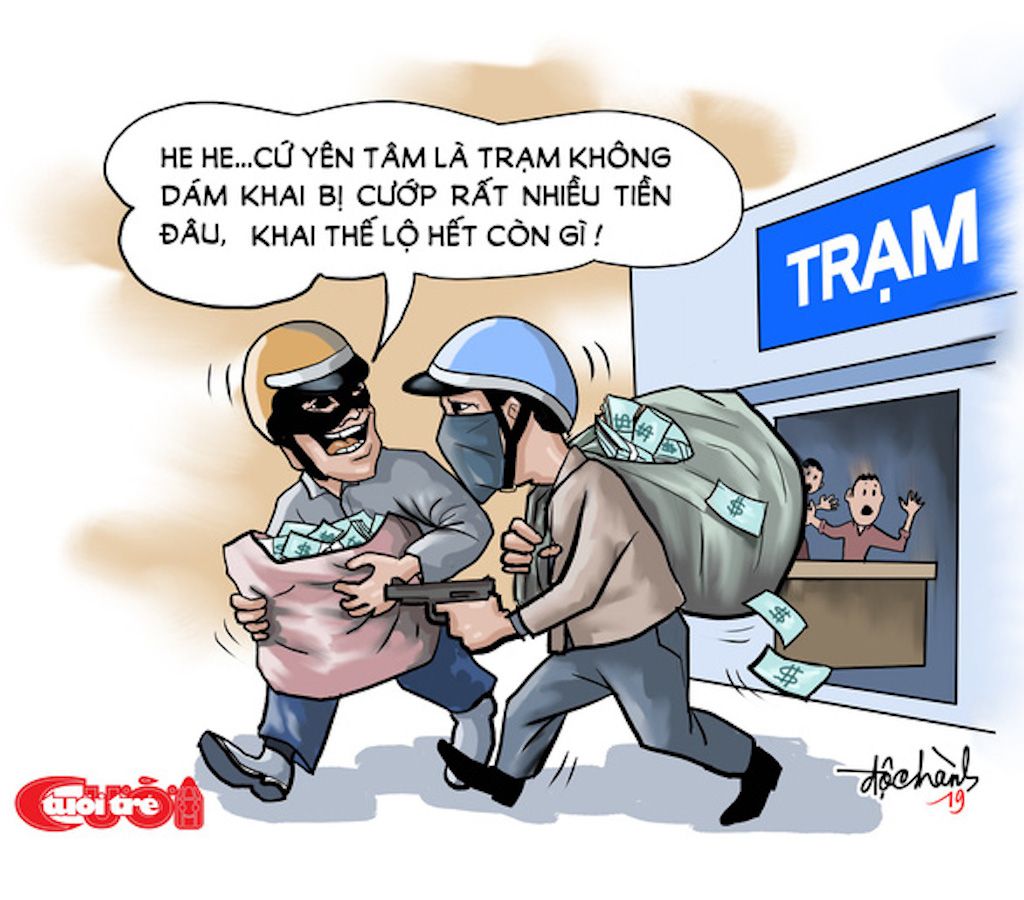
    It was, however, not a movie plot but a real story in Vietnam 2019 with a small difference: the location of the robbery was a well-known BOT (Build-Operate-Transfer) toll booth near Ho Chi Minh City.

    During the Tet celebration last week, three men robbed the BOT booth of the Ho Chi Minh City-Long Thanh-Dau Giay expressway in Dong Nai Province. They allegedly took over 2B VND or approximately 86k USD at once. The amount was rumored to be from only one shift of the BOT’s collection activities that day.

    Netizens were quick to point out that the robbery happened during the biggest holiday in the country where traffic flow through the main highways and expressways decreased dramatically in Vietnam, leading people to believe that the usual amount this particular BOT booth collects during a regular day would have been a lot higher.

    The BOT’s owner – Vietnam Expressway Services Engineering Joint Stock Company (VEC E) – tried to diffuse the situation in an interview with Tuoi Tre newspaper on February 8, 2019, the day after, stating that the amount taken was collected from eight different shifts, not one.

    But by then, the amount taken by the robbers was no longer the public’s primary concern.

    Instead, people started to demand answers on the validity of the very existence of the toll booth. According to the Facebook page of journalist Ngo Nguyet Huu, the information on how long this particular BOT could continue to collect toll fees seemed to be missing.

    Quick math on the average amount of money the BOT booth could generate daily raised more concerns over the potential sum that could have been taken illegally from the commuters if it indeed, did not have the authority to collect.

    Some people had pointed out that the BOT booth in question has been operating long enough for it to recover the costs of construction and make enough money in return, casting more doubts on the legality of its existence.

    To add fuel to the fire, on February 11, 2019, people on social media went livid when VEC E announced that it would refuse services to two particular vehicles at their Ho Chi Minh-Dau Giay BOT booth indefinitely, alleging the drivers of these cars “had incited disorder behaviors.” Its decision would have the effect of not letting these two cars use the expressway where the BOT booth is located.

    Almost immediately, netizens started to call VEC E’s action “unconstitutional,” violating the people’s freedom of movement. Others questioned the company’s authority to enforce their decision. Although considered as a “quasi” government enterprise in Vietnam due to its investment structure, whether VEC E could act under “state action” is still debatable.

    The people’s anger has caused the Transportation Department to immediately reassure the public on February 12, 2019, that it will not allow VEC E to refuse services and that all violations at BOT booths should be dealt with according to Vietnam’s administrative procedures.

    Allegations of corruption involving BOT booths have been raised in numerous cases in Vietnam recently, and some saw VEC E’s announcement as evidence of BOT’s investors acting under the “protection” of the authorities.

    A group of drivers acting as Vietnam’s freedom riders has been protesting against some BOT booths where they openly questioned the legality of some of these booths.

    Their works faced intimidation, false imprisonment, and physical assaults by masked men in civilian clothes when they protested at or near the locations of these BOTs.

    When these drivers tried to complain to the authorities but only received a slow, and sometimes even no response from the local police forces, the public began to suspect shady business deals between the owners of the BOT projects and the officials.

    One of the latest incidents of intimidation happened just last Saturday night, February 9, 2019. A driver names Nguyen Quang Tuy alleged that he was physically assaulted and suffered significant injuries after getting involved in a minor dispute over payment types at Ben Thuy BOT in Nghe An Province.

    More Vietnamese people have become vocal and voiced their complaints and discontentment about the BOT fees because they see these as unreasonable additions to the transportation taxes already imposed on them by the government for roads maintenance.

    During the past two years, with more than 60 booths stationed throughout the country’s main highways and expressways, BOT is a social and political problem that could only get more severe with time.

  • Vietnamese Police Faced New Brutality Allegations Amid State’s Obligations To Follow Up UN’s Recommendations Against Torture

    Vietnamese Police Faced New Brutality Allegations Amid State’s Obligations To Follow Up UN’s Recommendations Against Torture

    Today, January 28, 2019, a driver in Hanoi who was supportive of the movement to fight against illegal BOT (Build-Operate-Transfer) toll booths in Vietnam, Ha Van Nam, was kidnapped by allegedly plainclothes police.

    Nam alleged that he was brutally assaulted, resulting in two broken ribs and other injuries. The perpetrators later threw him at the front gate of Dan Phuong hospital in Hanoi.

    Ha Van Nam and his injuries. Photo courtesy: Truong Chau Huu Danh’s Facebook.

    In recent days, friends and supporters of the protest against “dirty” BOTs in Vietnam have asserted that there are corrupt individuals from the police force who act in concert with thugs and BOT An Suong’s owner to suppress those who challenge the BOT’s legal merits to collect toll money.

    On January 24, 2019, a man named Ngo Cong Tuan from Hanoi was visiting friends in Ho Chi Minh City happened to pass by BOT An Suong and got picked up by the local police of Tan Tao Ward.

    He alleged that he was physically beaten by the police right after he was arrested and the beating continued during the car ride to the station. He was then detained with no criminal charge for two days, from 24-26 January.

    Ngo Van Tuan being taken to the hospital. Photo courtesy: Truong Chau Huu Danh’s Facebook.

    Tuan further alleged the police officers continued to beat him during the detention, ordered him to take off his clothes, and also starved him during the two-day-detention.

    He was released on January 26, 2019, with no investigative report. Almost immediately after his release, Tuan went back to the same police station to report the assault and file a statement, but the police officers tried to close their door on him.

    All of this was captured on a live-stream video posted on Facebook. In the end, Tuan was able to make the report, but he also had to be admitted to a hospital for a check-up.

    Tuan was not part of the BOT protest; he was only a passerby.

    In an unrelated event happened in a different province, on January 28, 2018, while working on location, reporter Ngoc Thanh was involved in a physical altercation with police officers from Ward 4, Vinh Long Province. Thanh received injuries and had to be admitted to the hospital on the same day.

    Reporter Ngoc Thanh in hospital. Photo courtesy: Truong Chau Huu Danh’s Facebook.

    In November 2018, Vietnam underwent its first review under the UN-Convention Against Torture which the country had ratified in 2015.

    In December 2018, the Committee Against Torture issued its concluding observations on the initial report of Viet Nam with specific recommendations to the government.

    Portions of these recommendations specifically raised concerns over allegations of police brutality and death in police custody/detention (Paragraphs 20-23).

    The Committee specifically requested that the State of Vietnam elucidates and informs the Committee about the outcome of the deaths in police custody of the following individuals by December 7, 2019:

    Do Dang Du, a 17-year-old minor, who reportedly died in custody on 5 February 2015 as a result of severe injuries to the head and body while in police custody in Chuong My district, Hanoi;Nguyen Huu Tan, a Buddhist who was detained and whom the police alleged had committed suicide while in custody. No independent investigation of the death was carried out, and the detainee’s family was subjected to reprisals from the local police after complaining to the authorities;Ma Seo Sung, a Hmong Christian who was arrested and detained by the police and allegedly committed suicide by hanging and whose family also received threats of reprisals;Ksor Xiem of the Montagnard Evangelical Church, who died of injuries sustained in police custody, andY Ku Knul a Montagnard Christian who died while under arrest and whose body showed signs of electric shocks.

    Among the above, the case of Do Dang Du shocked the nation when it happened in October 2015, partly because it involved a minor who was detained illegally by the police in Hanoi – the Capital city of Vietnam.

    However, after his family’s attorneys also got physically assaulted by thugs and one police officer in plain clothes, it seemed that information had stopped coming forward.

    Mrs. Nguyen Thi Mai, the mother of Do Dang Du, the most shocking case in the last three years involving deaths in police detention in Vietnam. Photo Courtesy: Chau Doan.

    Neither Du’s family or the public in Vietnam was satisfied with the explanation given by the authorities that he was beaten to death by a cellmate over “dirty dishes.”

    The UN-Committee Against Torture seemed to agree with them when it asked the State to report back to the committee with further details later in 2019.

    However, in reality, the police forces in some 63 provinces all over Vietnam probably did not get informed about the UN-CAT’s findings and recommendations because allegations of police brutality continued to grow in the first month of the new year.

  • Protest Against BOT: How Vietnamese Drivers Fight Back

    Protest Against BOT: How Vietnamese Drivers Fight Back

    BOT, this three-letter-word probably does not have any special meaning for anyone but the Vietnamese people. It is a daily nightmare for many commuters in the country of close to 95 million in population.

    BOT stands for Build-Operate-Transfer, which is a form of contracts between a private company and the government that has become very popular in transport projects across Vietnam. By April 2018, it was estimated that 67 BOT(s) were in operation throughout the country.

    To put it simply, in a typical BOT development plan, the government would contract with a private company to build a transport project – for example, a section of a highway or a new highway bridge – and later allowed the company to operate a toll booth for a number of years to collect money from commuters to recover their investment.

    However, in Vietnam, once these BOT(s) began to open toll booths to collect fees, some of them faced enormous opposition from the people, namely the drivers who were subjected to paying such fees.

    In August 2017, a massive protest initiated by drivers when BOT Cai Lay in Tien Giang Province began to collect fees had lasted for days, causing this toll booth to stop collecting fees indefinitely.

    The drivers’ reason for protesting the fees was because the toll booth was wrongly situated, collecting money from people who did not use the road that was constructed under the BOT project.

    On August 6, 2017, the drivers started to use small bills to pay for the toll fees – which range from 35.000 VND – 180.000 VND – creating long delays on the highway in many days. After about two weeks, the BOT’s owner had no choice but to close down the toll (“xả trạm” in Vietnamese) and let traffic goes through without collecting the required fees until the government could come up with a resolution.

    BOT Cai Lay, however, remains completely shut down from December 2017 until today, while both the local and central governments have yet to finalize a plausible, alternative plan to resolve the problems. Their latest proposal – announced on January 15, 2019 – was to reduce the fees and extend the collecting period, but such a plan still failed to address the concern about the wrong location.

    In early December 2018, allegations regarding another wrongly situated BOT stormed both social media and the news in Vietnam because this toll booth is stationed on the most important highway in the country – National Highway 1 – at the outskirt of Ho Chi Minh City in Binh Tan District.

    The drivers alleged that the toll booth continued operating after its contractual time with the government had ended for more than 31 months, collecting fees that it was not entitled to. When being confronted, the owner of the BOT – IDICO company – claimed that the toll remained because it had built other transport projects nearby and could continue to collect fees.

    However, the drivers did not accept this explanation, stating that if IDICO had constructed other projects, the toll should be stationed in those areas.

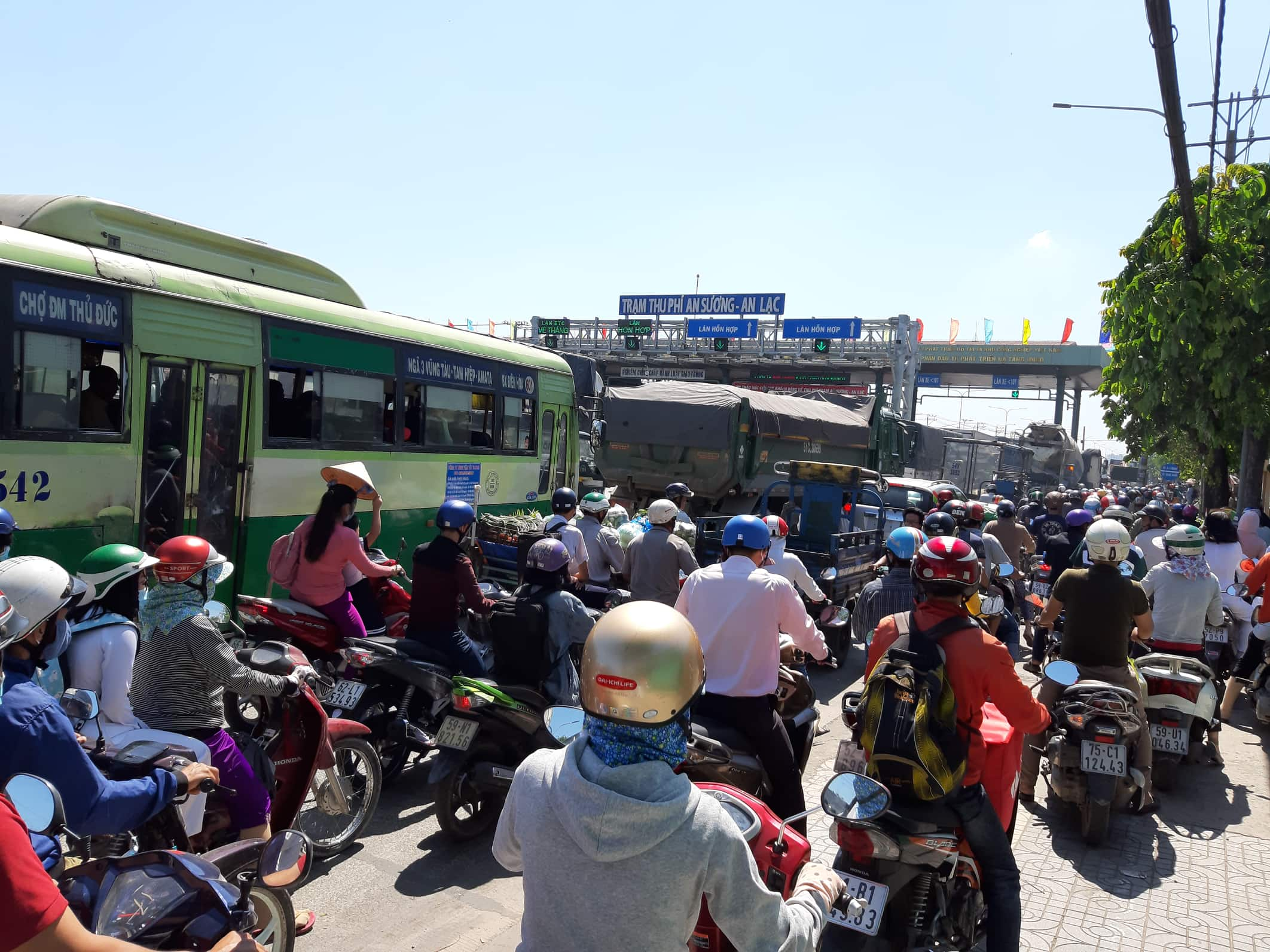
    BOT An Suong locates at a critical junction for traffic entering and leaving Ho Chi Minh City, and the toll collects fees both ways for at least 15.000 VND each. For those who have to travel through this area daily, the amount they pay could be quite substantial in any given month.

    On December 6, 2018, about one hundred drivers showed up to protest the fees collection at An Suong, and they faced hundreds of men, as well as police officers and civil security forces. A group of men wearing masks opened the door of a protesting driver’s car, dragged out Le Thai Hung who was sitting on the passenger’s seat and physically assaulted him.

    Hung was then taken to the nearby police station by the same group where he alleged that he got beaten up during his 12-hour detention. The police did not charge him; they later released him and said he fell and suffered injuries.

    On January 14, 2019, the story of BOT An Suong got heated again on social media where four drivers (one of them is journalist Truong Chau Huu Danh) who protested the fees collection at this toll booth were detained illegally in an alley nearby for over 30 hours.

    The victims live-streamed their plight where they were confined in a car, surrounded by hundreds of masked men and police throughout the night.

    Their three cars were picked up by a towing truck which they claimed was acting under the order of the owner of the BOT. They were towed from the BOT to an alley about 50 meters nearby where the four persons were held against their will. Barricades were put up at the only entrance/exit of a dead-end alley, effectively stopped them from leaving. They also claimed that their cars were damaged due to the removal. A fifth person was attacked and taken away earlier in the evening of January 14, and his car later was towed to an unknown place.

    In the live-stream clips, viewers could see police officers were present at the scene but failed to act and protect the victims from both the removal and the false imprisonment. Also present at the scene was a large group of men in “blue masks” who acted most aggressive, yet it was impossible to know their true identity.

    The four continued staying together in one car, a Ford Ranger, where no one was allowed to get close to them. Food delivery, their lawyer (who came by the next morning), and even an ambulance, all were denied entry.

    Around 9:00 P.M., one of the drivers, Huynh Long, stepped off the car to find a restroom and disappeared. He later was found unharmed, but his wallet and cellphones were taken.

    Long said he was held against his will by a group of men on motorbikes, who then rode around town with him and threatened him to stop his protest against BOT An Suong. They later left him stranded on the streets after taking his belongings, but Long got help and was able to come back to the alley the following morning to be with his friends.

    By January 15, 2019, the police attempted a few times to write up their investigative report about the incident, and the four victims finally were allowed to leave the scene in the late evening. They stated that they would initiate legal action against those who were involved in the false imprisonment.

    On January 16, 2019, the protest by the drivers and others continued at An Suong, asking the BOT to stop collect fees. One driver said in a live-stream on Facebook that he has prepared for the worst, and that if the BOT’s owner would again try to detain drivers, he could last up to ten days.

    At about 2:00 P.M. local time, according to the same protesting driver, the toll booth gave up and let cars pass through without having to pay.

    There is a Facebook group of drivers who participated in these BOT protests in recent years calls Friends on the Long Road (Bạn Hữu Đường Xa).

    One of the reasons these protests were successful and received public support was the fact that a lot of Vietnamese people got frustrated when they have paid a lot of taxes for improving and maintaining road conditions, and yet the country’s infrastructure and transportation remained the worst in the world.

    Further, whether it was the Formosa environmental disaster, the land eviction in Loc Hung garden, or these BOT projects, the people did not get to participate in the decision-making process nor were they even consulted. Often, the public never knew about these projects until they became disastrous for the people’s daily life.