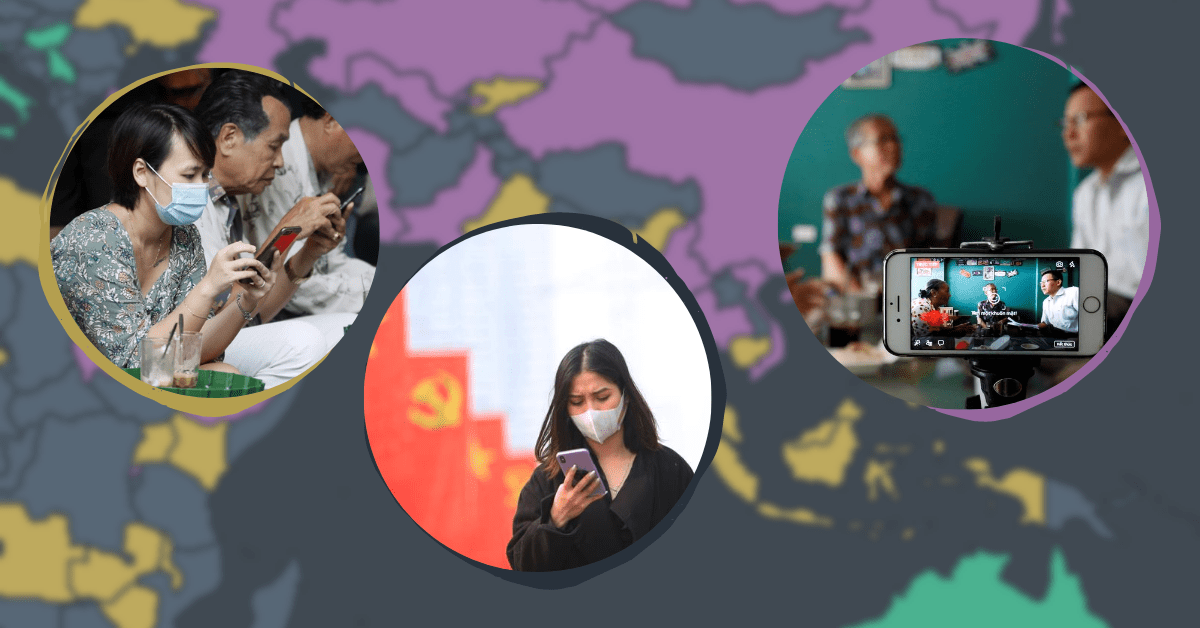
Internet freedom in Vietnam has always been at the mercy of state censorship and strict government control. Journalists, bloggers, and activists face the genuine risk of harassment by state forces and even imprisonment. On September 21, 2021, Freedom House, a US-based organization founded to support and defend democracy worldwide, released its annual report titled Freedom on the Net 2021. Disappointingly, Vietnam continues to fare poorly in its metrics and analysis as the situation surrounding Vietnam’s internet freedom continues to worsen year after year.
Freedom House’s Methodology
In its annual report, Freedom House rates each country on a scale of 100 to 0, with a score of 100 representing the freest conditions and with 0 signifying the least free. The highest possible score of 100 is then divided into three categories, namely: Obstacles to Access (25 pts.), Limits on Content (35 pts.), and Violations of User Rights (40 pts.). These three categories are then further split into several specific questions, which are then used by Freedom House to determine a country’s appropriate standing.
Countries that attain a grade between 70-100 are classified as Free, those with scores between 40-69 are noted as being Partly Free, and nations with a score from 0-39 are considered to be Not Free.
Freedom House’s full methodology can be found here.
Key Events
Vietnam’s rating for 2021 in Freedom House’s report is 22, which classifies it as being Not Free. This score is 2 points lower than its rating of 24 in 2019 but is equal to its 2020 score, which was also 22. However, just because Vietnam’s rating is the same in last year’s report does not mean that the situation in the country has remained unchanged. For instance, in 2020, Freedom House reported a temporary connectivity disruption in Đồng Tâm coupled with Facebook’s servers in the country were taken offline in February 2020, which led to a lower accessibility score for that year. No similar issue has happened so far in 2021, which leads to Vietnam having a higher rating in this category. In the same vein, several issues in the past may no longer be present, and several issues today may not have been problematic one or two years prior.
Freedom on the Net 2021 report begins by listing several key events that affect Vietnam’s overall score.
Firstly, the report states that the Vietnamese government had threatened to shut down Facebook’s activities in the country if the company refuses to comply with the government’s requests to restrict content it deems to be “sensitive” or “critical.”
Secondly, the report discusses the prior elections and the Vietnamese government’s censorship, arrests, and smear campaigns related to several independent candidates. Related to this are the long-running and ongoing arrests of activists and bloggers.
Lastly, the report mentions the draft decree regarding personal data protection, which was released in February 2021; if passed, this would require online platforms to collect and store the personal data of Vietnamese users for the purposes of providing it to the government upon request.
These events give us much-needed context into how Freedom House came to its rate for Vietnam in its 2021 report.
Internet Freedom in Vietnam
Regarding Obstacles to Access, Vietnam scores 12 out of a maximum of 25 points, or around 48 percent of the total. The report states that internet penetration in the country is at around 68.70 percent of the population and that smartphone penetration is at around 61.37 percent. Internet prices have also become more affordable, even to those in rural areas. Despite these positives, connectivity remains an issue for those in extreme poverty and for ethnic minorities who live in remote mountainous regions.
Any business or firm is allowed to operate as an internet service provider in Vietnam; however, some informal barriers prevent many from doing so. Currently, the Vietnam Posts and Telecommunications Group (VNPT) and Viettel dominate the industry, with these companies controlling 40 percent and 38 percent of the market respectively. The mobile sector is no different, with Viettel accounting for 50.5 percent, VinaPhone 24.6 percent, and MobiFone 21.1 percent, comprising the lion’s share of all subscriptions. As such, smaller companies in both the internet and mobile sectors cannot hope to compete with these already established businesses.
The Vietnamese government still retains the ability to restrict connectivity on a whim. Various government agencies tasked with regulating and overseeing digital technology remain secretive and operate without public oversight.
Regarding Limits on Content, Vietnam scores 6 out of a maximum of 35 points, or roughly around 17 percent of the total.
The Vietnamese government actively and continuously blocks or filters any form of content that, from their point of view, challenges the ruling Vietnamese Communist Party (VCP). High-profile blogs, individuals with many followers, content which promotes religious organizations, and local and international news websites which are critical of the regime are often the targets of government censorship. This 2021 Freedom House report states that Vietnam’s Department of Cybersecurity and High-Tech Crime Prevention has “monitored and blocked almost 3,400 overseas websites that have ‘published harmful and toxic information’ in 2020.” The regime has also threatened to shut down Facebook, and so, even this social media giant was forced to comply and agree to remove content that the VCP deems “anti-state.”
The passing of the controversial Cyber Security Law in January 2019 has also led to the expeditious removal of content. State authorities have “imposed heavy fines and suspended online publications” for having comments that criticize the regime on their platforms. In addition, mounting government pressure has made social media platforms subservient to the government’s wishes, and in effect, they restrict content that the VCP deems inappropriate.
The social media accounts of activists and dissidents are also under the constant threat of being suspended for “violating the platform’s community standards.” Even normal internet users, commentators, and journalists have to practice some degree of self-censorship or risk being detained or questioned by the authorities.
This situation of mass censorship and control gives the Vietnamese government the perfect setting to be able to influence, sway, and dictate public opinion. The report quotes the Oxford Internet Institute (OII) which claims, “Vietnam employs a network of approximately 10,000 people that manipulates information on Facebook and YouTube [, and at] least one government agency is involved.”
Regarding Violations of User Rights, Vietnam scores 4 out of a maximum of 40 points, or roughly 10 percent of the total.
Even if the Vietnamese Constitution affirms the rights of freedom of expression, access to information, press freedom, and the like, these are not actually protected by the Vietnamese state. Freedom on the Net 2021 report states that “police routinely flout due process, arresting bloggers and online activists without a warrant or retaining them in custody beyond the maximum period allowed by law.” And it says further that the Cybersecurity Law also “prohibits a wide range of activities conducted online” in addition to putting additional pressure on internet users and social media platforms.
As of June 2021, according to the report, 235 activists are being held in detention for practicing their freedom of expression. Several journalists, activists, and even ordinary everyday users were also given outrageous prison terms or made to pay hefty fines for their online activities for allegedly violating several provisions under Articles 117 and 331 of the Penal Code. Prominent journalist Pham Thi Doan Trang, a co-founder and editor of The Vietnamese Magazine, has been detained since October 2020 and charged with “creating, storing, and disseminating information, documents, items, and publications opposing the Socialist Republic of Vietnam” under Article 117.
Also mentioned in the report is the controversy surrounding Bluezone, a COVID-19 tracing app. People were unaware that this application disclosed private user information to the government; in June 2021, the state announced that it would sanction people who did not have this app installed on their mobile phones when they entered certain public areas. This is a blatant infringement of a person’s right to privacy.
Cases of intimidation and physical violence by the authorities are also noted in the Freedom House report and the names of prominent bloggers and activists who were put under surveillance and de facto house arrest. A notable case cited is the situation of Le Anh Hung, a blogger and democracy activist. Hung was arrested in July 2018 for criticizing Vietnam’s one-party communist state in online posts. He was “beaten with a metal folding chair, tied to his bed, and forcibly medicated while being held in a psychiatric hospital without his consent” in July 2020.
Conclusion
The state of internet freedom in Vietnam continues to remain abysmal and disheartening, with no improvement in terms of the protection of the rights of individual users. The state maintains its tight grip on the flow of information by pressuring or outright censoring social media platforms, journalists, and media outlets and by stifling any discussion by everyday people through the internet. It’s business as usual for the VCP even during the height of the COVID-19 pandemic in the country.
Yet, the report points out that “young, educated Vietnamese people are increasingly turning to blogs, social media platforms, and other online news sources for information, rather than state television and radio broadcasters” and that “tools for circumventing censorship” exist and can be easily found. Hence, while the state may continue on its crusade to monopolize the flow of information, its efforts are failing; the truth is still being spread, and the Vietnamese people are always looking for ways to circumvent the walls being built by the regime.
Trinh Huu Long, an editor of The Vietnamese Magazine and co-director of Legal Initiatives for Vietnam, is the author of the Vietnam chapter of Freedom House’s Freedom on the Net 2021.