A discussion with some students in my Theory on State and Law class back in 2020 led me to a surprising revelation: over 50 percent of them have visited Taiwan. They could remember and name their favourite tourist attractions, either Sun Moon Lake near Taichung, the “Spirited Away” Jiufen to the country’s northwest, or the vibrant streets of Ximending in Taipei. For them, Taiwan seemed to be a lively place – an exemplar of modernity, politeness, and peacefulness.
Not only that, many of them had paid a visit to the Chiang Kai-Shek Memorial Hall and took pictures with his infamous Lincoln-like statue. Most unexpectedly, they knew that Taiwan was not China, or at least Mainland China. One student mentioned that her Chinese visa was useless for visiting Taiwan, and she suggested that the Taiwanese visa application process was more straightforward. And Chiang Kai-Shek, as they described, could be someone akin to their “Uncle Ho” in Vietnam.
For a country where the youth hardly know the Vietnamese heads of state – the president, the prime minister, or the general secretary – their knowledge of Taiwan was astonishing.
***
I have come to realize that the depiction of Taiwan in Vietnam has changed dramatically over the past 20 years.
During the 90s, Taiwan was infamously known in Vietnam for the poor and old Taiwanese farmers who could not get married in their hometowns, wandering the most disenfranchised areas of Vietnam’s rural areas to look for brides.
Nowadays, Taiwan is considered a cultural, economic, and intellectual hub of the region – a place worth living in, especially in the eyes of Vietnamese youth. What has caused this distinct shift in perspective? Perhaps it is the billions of US dollars worth of investments pouring into Vietnam from Taiwan since the 1990s.
Dubbed by Professor Samuel C. Y. Ku as the “Southward Policy” of Taiwan, at the beginning of 1993, Taiwanese presidents started to privately visit and form business ties with Southeast Asian countries that had no formal diplomatic relations with the Republic of China (ROC) before.
The objectives on the surface were clear: (1) expanding two-way economic, trade, and investment relations with these countries; and (2) expanding the production size of Taiwanese enterprises, while at the same time reducing the trade and human resource dependence on mainland China.
More importantly, Taiwanese leadership hoped that such a close connection between economies would strengthen substantive relations between governments, allowing them to participate in other international and regional commercial and political activities.
In Vietnam, Taiwan succeeded in certain aspects. Taiwan has a decisive say in the contemporary economic stability of Vietnam. Taiwanese enterprises ownroughly 2,500 projects, and they have invested over US$30 billion in the country. Bilateral trade between Vietnam and Taiwan has just exceeded US$16 billion, and most of Vietnam’s exported labor is directed towards Taiwan. Any political instability or economic issues that are not in favor of this arrangement will impact Vietnam’s performance.
On the other hand, China continues to be seen as a taboo in Vietnamese cultural and intellectual discussions. The recent promotion of the Chinese propaganda military drama named Ace Troops (Chinese: 王牌部队; Vietnamese: Vương bài) has again sparked debates and serious boycotts in Vietnam. Focusing on stories about the establishment and the development of the Chinese People’s Liberation Army, Ace Troops glorifies the Sino-Vietnam War of 1979 and the continuous border/maritime skirmishes during the 80s. By praising the conflicts that led to hundreds of thousands of Vietnamese casualties as heroic and patriotic wars, it can be seen why this drama infuriates China’s southern neighbour.
Even though Taiwan has the same claims as to the People’s Republic of China regarding the South China Sea, it appears to be a much milder, friendlier, and negotiable partner to the Vietnamese public.
***
One week after China expressed its desire to be a part of the Comprehensive and Progressive Agreement for Trans-Pacific Partnership (CPTPP), Taiwan also formally applied for a seat in this organisation.
Taiwan has reasons to hasten its membership in this organization. If it fails to secure a seat in time, it would have to go through the consultation process with all the signatories, which would, at this point, include China, and then protect its interests before a CPTPP Council where Beijing would already hold a seat.
Taiwan had experienced this kind of stubbornness and tantrum-throwing behaviour of China when it dealt with the WTO. During the 2000s, Beijing had repeatedly refused to attend any dispute resolution proceedings between themselves and Taiwan, justifying this on the grounds that these issues were solely the internal affairs of China.
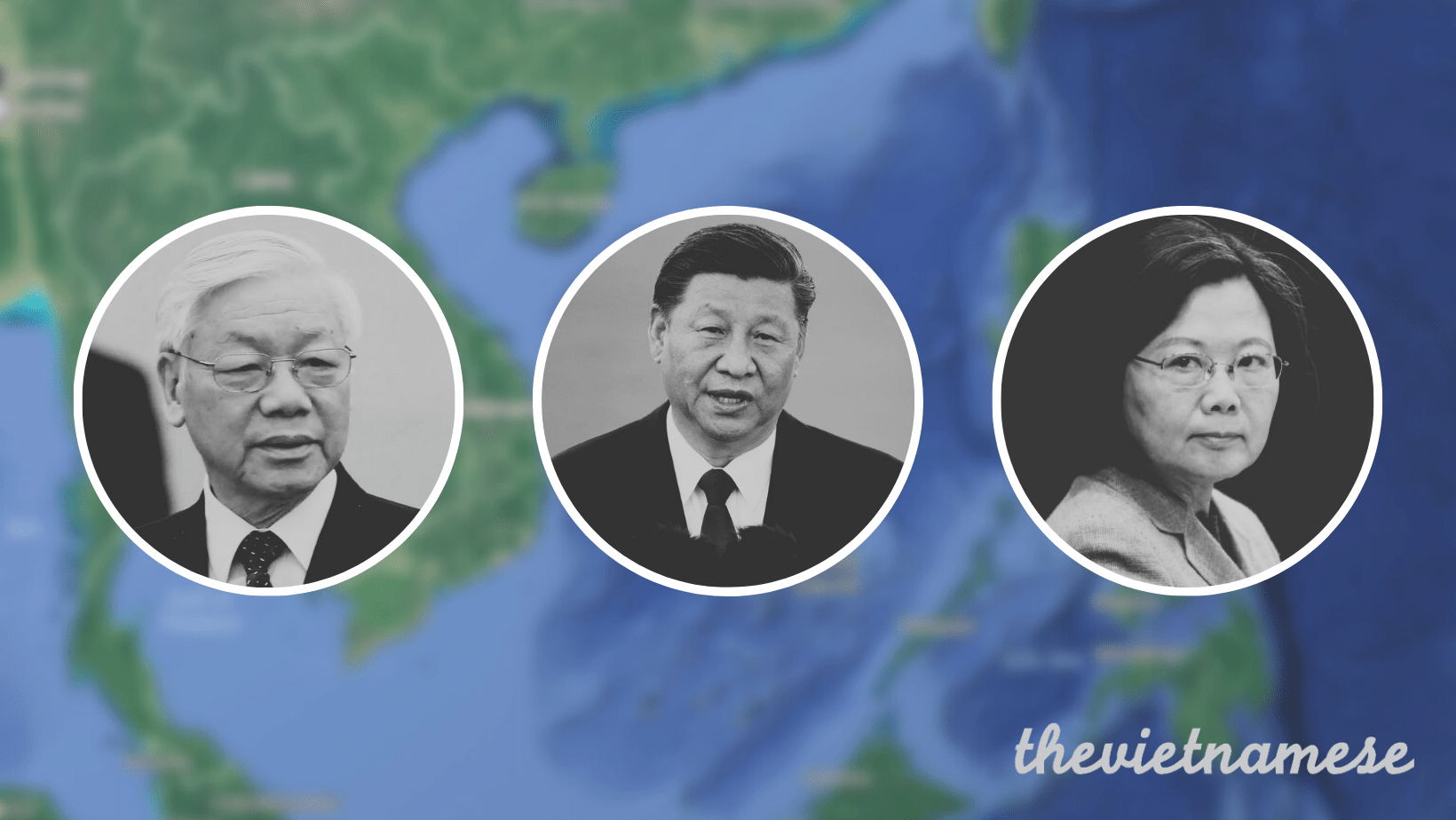
A couple of days after China’s and Taiwan’s announcements on the CPTPP, President Xi Jinping had a phone call with General Secretary Nguyen Phu Trong. This action raised some questions on whether Vietnam would act as an agent of China inside the CPTPP to prevent the accession effort of Taiwan.
If it has to, the Vietnamese government is very unlikely to side with Taiwan; no country has ever dared to, including the United States.
But upon understanding the socioeconomic situation between Vietnam, Taiwan, and China, it is also reasonable to argue that Vietnam gains nothing by explicitly objecting to Taiwan’s membership in the CPTPP. The economic ties between Taiwan and Vietnam are too significant to be sacrificed.
Moreover, such an effort requires fierce political commitment and diplomatic loyalty to mainland China, and Vietnam rarely exhibits this in the international arena. Recently, at the 48th session of the Human Rights Council, a declaration of 65 countries denounced the interference in China’s internal affairs by several actors under the pretext of human rights. Vietnam, however, did not participate. Vietnam’s action is a bit cold for two socialist neighbouring countries that claim to have a golden friendship.
Yet, this action illustrates one essential facet of Vietnam’s diplomatic playbook: pragmatism. Taiwan has been a beneficial friend to the Vietnamese government and remains hopeful for the country’s economic recovery and internal stability after the pandemic.