This op-ed article was written in Vietnamese by Trinh Huu Long and was previously published in the Luat Khoa Magazine on October 10, 2020.
Every time an activist is arrested, several campaigns for his or her release emerge in response to the government’s persecution of human rights. This method is the oldest, most common, and most familiar form the common citizenry uses to call for justice.
I have been a part of those movements and have even organized several campaigns many times in the past nine years.
Yet, despite everything, I constantly ask myself if these calls to action actually do any good? “How long am I going to do this,” I ask myself, “and are there any benefits to this or not?” These are just some of the questions that constantly linger in the back of my mind.
Most likely, those arrested will remain in prison; their sentence will be upheld. In fact, the length of the individual’s imprisonment might even be made longer. Despite all our work, more and more people are still being incarcerated. There has been no change in our laws or institutions, despite all our efforts at home and abroad.
And even if we’re blessed with the smallest amount of luck, those arrested are granted asylum in another country, defeating the primary purpose of our campaigns.
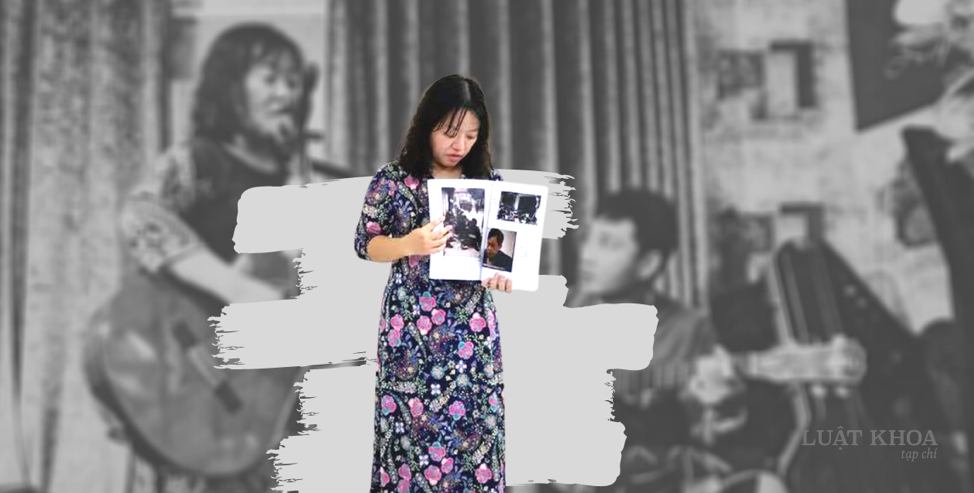
Pham Doan Trang, imprisoned activist, blogger, journalist, and co-founder of The Vietnamese and Luat Khoa online magazines has put some of my concerns to rest.
“I do not need my own freedom; I need something much more significant than that: freedom and democracy for the whole of Vietnam,” she wrote in a letter on May 27, 2019, her 41st birthday, and while she was on the run from the police. “This goal sounds grandiose and far-fetched, but reaching it is actually possible with everyone’s help.”
Doan Trang wanted this letter to be released to the public only when she was indeed convicted and not when she was merely detained. Eventually, she was arrested and now faces a sentence of up to 20 years in prison.
If Doan Trang merely wanted freedom for herself, she had at least two opportunities to attain this in the past.
The first was after her nine-day criminal detention in 2009. If she was obedient and ceased all her activities regarding sensitive topics and cut all her ties with social elements deemed “anti-state,” she would have continued to live a safe and full life.
The second was when she studied in the United States and could have chosen a path towards residency or citizenship. In fact, at least three agencies and organizations wanted to sponsor her permanent stay in America.
So, why did Doan Trang choose to return to her homeland? It is because she understands that her freedom means nothing compared to the whole of Vietnam. Vietnam needs people to step up and work for the freedom of everyone.
Such a concept is simple and easy to understand, yet making it a reality is challenging to attain.
Doan Trang could have chosen to contribute to Vietnam’s fight from the outside as many others, including myself, are doing. Yet, she chose the most complex, most painful, and most difficult way to contribute to the cause. She returned home and faced the problem head-on. She published various works, wrote books, and even taught about democracy and freedom right in front of the police.
Doan Trang often told me that the best way to fight is to be an example, to be an inspiration for others to do the same. Only then can we, as a society, start to see what democracy, human rights, and the rule of law look like in reality. Words without actions are meaningless.
Sadly, I do not know how successful Doan Trang’s efforts have been, nor how many lives have been touched by her words and deeds. But regarding her arrest in October 2020, I would like to say this.
Activists have a saying called “sharing fire,” which means sharing the tasks and responsibilities of dangerous activities with many people to reduce individual risk. Sometimes we coordinate with each other, but more often than not this is not the case; people passively participate in this phenomenon without discussing plans in advance.
What if the deeds Doan Trang had done in the past five years were divided among five or 10 people, would she still have been arrested? More recently, if she had not produced the two Dong Tam reports, would she be in jail right now?
She often told me that these things are not difficult to accomplish and that there are many people who share similar ideas with her. If so, why are there so few people standing up for what is right? Granted, some people do, and Doan Trang was one of them. Yet because of inaction, apathy, or fear, she and the handful of brave, noble souls like her shoulder the entire risk.
Many of them will go to jail, while those who are content to watch from the sidelines will get angry again. They will once again clamor for the release and freedom of those imprisoned. But in the end, nothing gets done. Rinse and repeat.
Will we Vietnamese forever play the same old games with the government? Will we continue to sheepishly and ineffectively demand the release of our friends? Then, when nothing gets done, will we once again forget and return to the tolerated normalcy of life in this great prison that the government has made?
Things will be different if more people actively do their part to create social change, just like Doan Trang. Doing so has two advantages.
The first is to “share the fire” with those still fighting to reduce their risk and limit their chance of getting captured. Government resources are limited, and they can only invest in monitoring and controlling a few people.
Those outside Vietnam can do their part as well. For instance, to write something similar to the Dong Tam Report, we just need to collect data on the internet and conduct interviews online or through the phone. It is not necessary to live in Vietnam physically to accomplish these tasks.
The second is to normalize press freedom, independent publishing, and political activities considered “sensitive.”
When these activities become commonplace, the government will be forced to accept them. This was observed in the past when private businesses were considered illegal. Nonetheless, they continued to operate, and gradually the government had to admit that these establishments were a fundamental component of the country’s economy. Since 1986, the state no longer considers owning a private business a criminal offense.
For me, the best way to help Doan Trang and people like her is to play a more active role. Eventually, everyone will benefit when the political space expands. No one will ever be arrested or imprisoned again for writing or publishing books. I will no longer have to clamor for one person’s freedom every single time someone gets arrested. I will finally be able to rest.
Calls for Freedom are good, but they are often not enough. We should release ourselves from the shackles of fear, apathy, and apprehension to actively fight for progress and change.
Doan Trang has completed her mission and the responsibility now falls on our shoulders. Even if she were to be released tomorrow, even if she chooses to stay in Vietnam or decided to leave, the fight continues in each one of us.
And if you love Doan Trang, I implore you to do what she would have done.
This article was written in Vietnamese by Y Chan and previously published in the Luat Khoa Magazine on February 2, 2021.
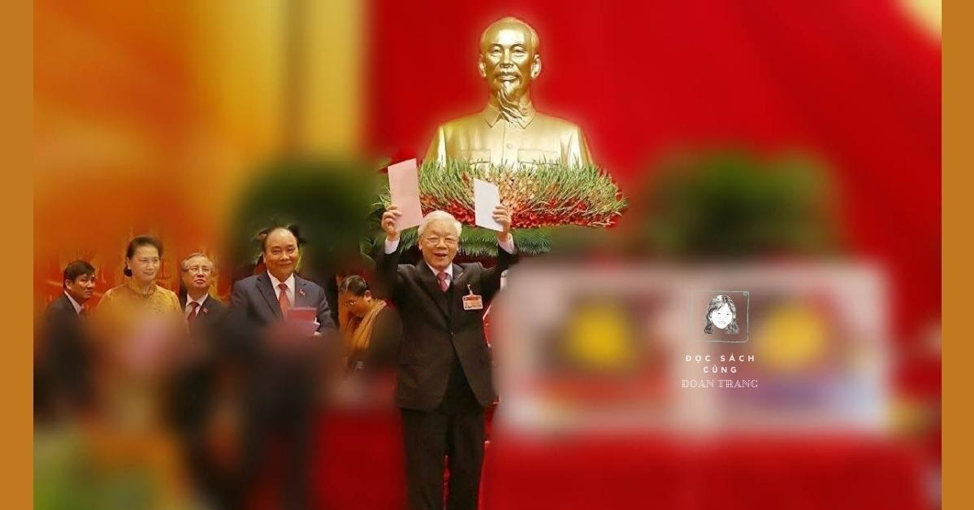
The 13th Party Congress ended in Vietnam in February 2021, and the list of the country’s top leaders has finally been leaked after many attempts to keep this information “top secret.”
Yet, despite the confidentiality and mystique surrounding this event, the identities of Vietnam’s new leaders did not catch anyone by surprise because they were also of no particular interest to the ordinary Vietnamese citizen.
The names of Vietnam’s top four leaders are Nguyen Phu Trong, Nguyen Xuan Phuc, Pham Minh Chinh, and Vuong Dinh Hue.
The rumors also stated that Nguyen Phu Trong would continue to be the general secretary of the Vietnamese Communist Party (VCP). Nguyen Xuan Phuc would be the president of Vietnam. Pham Minh Chinh would be the prime minister, and Vuong Dinh Hue would be the chairperson of the National Assembly. In April 2021, more than a month before the general election of Vietnam, the VCP also announced these top leaders with the same positions that the rumors had spread.
Knowing the country’s top leaders before they could even vote, it is not a surprise that Vietnamese citizens have been more interested in the US presidential elections than their own.
Why is this bizarre phenomenon the case in Vietnam?
The answer lies in the state governance model of a diarchy that restricts Vietnamese citizen representation in government and eliminates all hope of participating in governance.
In Machinery of the Government, which is in Part VI of the book Politics for the Common People by Pham Doan Trang, the meaning of this phenomenon is fully explained.
The 1st Rule: The Party Controls the State; the State is in the Party’s Hands
Part VI begins by explaining the roles, functions, and nature of the three fundamental branches of government in detail.
Doan Trang introduces the models and activities of the legislative, executive, and judiciary arms of countries worldwide. At the end of each section, the author references the situation in Vietnam.
Readers can see that while the tripartite branches of government in democratic institutions are designed according to the principle of independence limited by checks and balances, the Vietnamese model is the exact opposite.
In the legislative branch, we have the National Assembly. In principle, this body is supposed to be the people’s representation, with its members directly chosen by Vietnamese citizens. The National Assembly is supposedly responsible for making laws in accordance with the desires of the people.
To fulfill this function, the National Assembly needs to truly reflect what the people want, with each delegate acting on behalf of the Vietnamese public.
In reality, Doan Trang wrote, “at least 95% of the members of the National Assembly belong to the Communist Party.” The few remaining delegates, she continued, “may not be party members at the time of the election, but they may be admitted to the Communist Party in the future, and they are sympathizers of the VCP.”
With this structure, she concluded that the National Assembly of Vietnam has “deficient actual representation and does not stand for the people at all.” More than that, in effect, the National Assembly’s “ability to supervise and control the executive branch is almost non-existent.”
In terms of legislation, “since the beginning, the law-making program was based on … the undertakings of the VCP, not on the needs of the people.” In other words, according to Doan Trang, “making laws is only meant to actualize the resolutions of the VCP.”
In the executive branch, aside from the head of state and the head of government, the real “big boss” is the man who holds the title of general secretary of the VCP. The general secretary is the “biggest boss” in Vietnam because he controls the VCP.
Pham Doan Trang described Le Duan, the person who is considered the most powerful general secretary of the VCP. She wrote, “he was not the head of state, nor the head of government. He was just a one-party leader, yet for generations, this general secretary had the power to command the entire political system, in effect, making both the president and the prime minister of Vietnam fade into obscurity from 1976 to his death, 1986.”
The general secretary is not elected publicly, and his identity is even kept secret until the last minute, even though everyone already suspects who will hold the position.
The judiciary branch “has the function of interpreting the law and on that basis, has the responsibility of adjudicating and resolving legal disputes,” Doan Trang wrote in her book. To perform this function well, agencies in the judiciary must be neutral and independent. But this is not the case in Vietnam.
“In Vietnam, the judge must also be a member of the Communist Party,” writes Doan Trang. Yet, you will not find this in any legal document; it is an unwritten law.”
In summary, as Pham Doan Trang has observed, “Vietnam’s political system seems parliamentary in that it has a president who is not the head of government, and the members of the previous government are selected from Congress and appointed by them as well, with Congress being the most powerful body. However, the Vietnamese political system has a distinct characteristic that sets it apart from other parliamentary regimes: it is a one-party system, and the VCP is central to all three branches of government.”
The 2nd Rule: The Military Controls the Government; the Government in the hands of the Military
“Military” is the term used to refer to the armed forces and police of Vietnam.
Doan Trang dedicates chapter VIII of part VI in her book to a discussion of these two forces.
Accordingly, “the military and the police play a crucial role because they deal with national sovereignty. […] Briefly, it can say that the police safeguard domestic sovereignty, and the military protects national sovereignty. Without them, these two important components of a country are impossible to retain. Hence, both the military and the police are essential for every independent nation.”
Doan Trang says that the most critical feature of these forces is “their monopoly and use of weapons and force.”
“In any country, the military and police are assumed to be the only two forces in society that have the right to use weapons and force when necessary,” she writes. “Society assumes that they have the legitimacy to use weapons and violence.”
“Because of this, there is always a tendency for both the military and police to abuse their power.”
The military can build a regime, defend it, or even overthrow it. At the same time, it can also use its power to become the government itself. In a similar vein, Doan Trang also wrote that the police “could dominate the government, intervene in and control the course of policies, monitor every aspect of civilian life, and create a police state or a police government.”
Democratic countries often take a liberal approach to control this potential problem.
Accordingly, Doan Trang concluded that “the constitution and laws of a country must ensure that the military is completely neutral, non-political, or out of politics, and that the military system is under the leadership of the civilian government.”
The military, in this case, she emphasized, “must be loyal to the nation and not to any party or government.” In liberal democracies, this is the way of ensuring that their citizens remain free without the risk of militarization or abuse by state forces.
The criterion for selecting the US secretary of defense is an illustrative example of this approach. Accordingly, the head of the military must be a civilian and not a person serving in any armed forces.
If the person nominated for this position has served in the military, he or she must leave the military beforehand and have been a civilian for at least seven years. In American history, there have been three exceptions to this rule.
The most recent example is that of current US Secretary of Defense Lloyd Austin of President Joe Biden’s administration. Retired General Austin was only out of the service for four years when he was appointed. General James Mattis, who served in this same position in former President Donald Trump’s administration, also had been retired for just four years when he was appointed.
In these specific cases, US lawmakers unanimously agreed that these appointments should not be seen as a precedent to change this already established rule.
In contrast, Vietnam and other communist states such as China and North Korea address this issue differently.
Doan Trang wrote in her book that these countries aim to bring about “the radical politicization of the military, towards allowing the ruling party’s ideology to penetrate the army fully.”
From “instead of loyalty to the nation, the people, and the constitution,” the military is asked to “be loyal to the ruling party and its ideology.”
This approach is accomplished by (1) “granting special privileges to the military and the police, especially the officer ruling class,” (2) “fiercely propagating the ruling party’s ideology within the armed forces,” and (3) “punishing, eliminating, and destroying dissident elements within state forces, while rewarding soldiers who are loyal to the Party.”
This penetration makes the armed forces a powerful tool of the Party in ruling the country. Every aspect of the nation, from security and defense to economic development, culture, and education, every single one has the fingerprints of the military or the police all over them.
As a result, people can no longer distinguish between the military, the police, and the civilian government.
***
The US Supreme Court once stated that the military is a “special society” separate from civilian life, with its own rules, disciplines, and traditions.
The laws and regulations of the military are often incompatible with civil society, but the existence of the military allows for the continuation of everyday life.
However, most people in democratic states are aware that the armed forces should never overwhelm civil society. In communist states where the army governs the people, the nation will inevitably drift towards authoritarianism.
Those in power rely on the armed forces to rule and control the people.
If in the past, Vietnam had the Trung sisters, who helped regain freedom for the people and became queens who ruled together, then today we have a regime of diarchy that restricts the people’s right to proper representation in the government and inhibits them from questioning the power of the ruling party.
The party controls the state, and the state is in the party’s hands. The army controls the government, and the government is also in the hands of the military.
This is why the secret of the party’s leadership is unsurprising to any citizen of Vietnam because the VCP and its general secretary still rule the country today.
This article was written in Vietnamese by Vo Van Quan and previously published in the Luat Khoa Magazine on October 6, 2020.
The term burning furnace (đốt lò in Vietnamese) is a frequently used term in Vietnam to describe the anti-graft campaign that Nguyen Phu Trong pledged would eliminate corruption in the country.
After nearly ten years of the Vietnamese Communist Party (VCP) being under the leadership of General Secretary Nguyen Phu Trong, many people seem to be proud that the Vietnamese government has done well in its political task of purging the moral degradation that affects the people’s trust in the Party and the State.
For instance, in the first six months of 2020, Nguyen Phu Trong ordered several investigations of senior party officials: a member of the Politburo, a former member of the Politburo, four current and former members of the Party Central Committee, and 186 other members of the Party who were under the Central Committee’s management. These investigations seem to affect a broad number of Party members.
Big-name politicians such as Hoang Trung Hai, Dinh La Thang, Le Thanh Hai, Nguyen Duc Chung, Truong Minh Tuan, Nguyen Bac Son, and Tat Thanh Cang, all seem to have either been brought to justice, have been reprimanded for their actions, or have lost any chance for a long-term political position in the future. Since the beginning of the VCP’s Doi Moi policy in 1986, it can be seen as one of the unprecedented successes for the Party.
However, after the new Party Congress concluded in early 2021, it immediately became apparent that all of these achievements would have been for nothing if another faction becomes the majority in the Party’s leadership.
If the ruling faction’s victories against corruption under Trong’s leadership have been so triumphant, why are they at risk of falling apart after just one new congress?
Philosophical or social science discussions related to corruption in Vietnam are sparse. On the rare occasion that they do take place, they are mainly carried out by members of the VCP themselves to serve their interest.
This article will introduce another perspective on anti-corruption science and explain why the “blazing furnace” of Nguyen Phu Trong does not have any significant value over the long term.
The concept itself and the philosophical problems associated with corruption are innumerable. Great philosophers from ancient times, such as Plato and Aristotle, to the more modern era, such as Machiavelli and Montesquieu, all discussed this topic in great detail.
Hence, to prove the lack of current anti-corruption policies in Vietnam, this article will only focus on these two concepts: individual corruption and institutional/systemic corruption.
Individual corruption, in the simplest sense, pertains to the selfish actions of a specific person while they work in public service. Such behavior may involve accepting bribes, abusing power, or giving special consideration to family or friends in government deals, contracts, or bidding.
Personal corruption is at the lowest level in terms of organization and state functions. This concept is often used when corruption is the exception and not the norm of the system.
Because of this, individual corruption can be present in any country regardless of its development and level of democracy. Individual corruption is inevitable, but it is also the easiest to deal with. Several laws, ethical appeals, and judicial campaigns are aimed at limiting or eliminating it.
We can immediately recognize that this is the VCP’s current approach to fighting corruption in Vietnam. However, the success rate of stopping individual corruption greatly depends on stopping this form of government misconduct at this level.
At this point, we need to discuss institutional corruption.
Professor Dennis F. Thompson of Harvard University, one of the first academics who introduced the concept of institutional corruption, suggests that corruption becomes an integral part of a system in three ways:
1. Corruption benefits the system’s survival while at the same time undermining it.
2. Corruption is of an impersonal passive nature.
3. Corruption becomes a phenomenon that can be generalized to the whole society.
However, Professor Thompson was speaking about the political situation in the United States, and it would be difficult to apply his theoretical archetype to Vietnam. That said, his ideas can be used as the foundation for analysis.
Regarding his first point, it can be said that corruption in Vietnam has reached a level of coexistence with the political system because of the close relationship of objective and subjective factors, such as a cumbersome state apparatus, meager wages and benefits, and the overwhelming power of state authority.
The need to align government interests with those of a large population in Vietnam is not something new.
Recently, many people in Vietnam were surprised when the Ministry of Public Security announced that the Civil Defense force and the other grassroots security forces had a combined number of 1.5 million people, equivalent to nearly 1.5 percent of the Vietnamese population. And these 1.5 million people are on the government payroll.
But the story does not stop there. In 2017, official government statistics recorded up to 11 million workers receiving direct salaries from the state budget.
The number of officials at the commune level is stated to be 1.3 million.
Units belonging to the public non-business sector, such as education, health, culture, and sports, have more than 73,600 units and employ 2.5 million people. This is a 14.7 percent increase compared to 2012. The number of political organizations, unions, and associations is at 35,100 units, and they employ more than 237,000 people.
A cumbersome state apparatus keeps the budget in a condition of exhaustion, even though wages and benefits are generally meager. In effect, when people decide to work for the state, they expect something else when they join, and that is power. They can then use this power to generate other sources of income.
A pattern starts to form. People spend money to gain access to the state apparatus. Then, they use this newly acquired power to participate in various corrupt practices, that become an integral part of maintaining and operating the government machinery of Vietnam.
Running for office has also become so popular that the head of the Party Inspection Committee of Hanoi had to admit, “Comrades, now people say less than 100 million dong cannot buy a position.”
Therefore, even though abuse of power, corruption, bribery, budgetary overspending, and the like have become problems and seriously affect the reputation of state agencies, they have become essential in maintaining the existence of the status quo.
Thus, in Vietnam, corruption has gradually become universally accepted into the system. This means that the decision to commit an act of corruption no longer depends on the rationality or morality of an individual. It has become an instinct of those who participate in the system.
This phenomenon has also been argued to have become integral to the Vietnamese political apparatus through many studies by both Vietnamese and international scholars.
For example, in a short study conducted by the Anti-corruption Resources Center, between 2005-2010, 95 percent of the public saw the police force as degenerate and corrupt. The same study also noted that 59 percent of businesses consider the bribes that they have to pay as “additional operating expenses”.
A more recent study by Nguyen Thai Hoa confirms that corruption and informal fees are some of the biggest drivers of developing the informal economy in Vietnam.
There is also no mechanism for citizens and civil society organizations to denounce, criticize, and intervene in an organized manner. The process of dealing with corruption depends heavily on the political will of the local Communist Party’s internal forces. Corruption has become a mindset, a culture, or a thought that permeates the entire Vietnamese society, whether in the public or private sectors.
The above features are consistent with the warnings of Roberto Laver, a guest researcher at the Center for Ethics in Harvard Law School. He said that once corruption becomes ingrained and widespread, the system itself will nurture, or even encourage, corrupt behavior.
Those who do not participate in acts of corruption or abuse of power quickly discover that they cannot survive in such a system and are often left to fend for themselves. They realize that they must sacrifice their values and ideals and compromise if they want any chance of promotion in their chosen career.
Looking back at the “blazing furnace” project of General Secretary Nguyen Phu Trong, from central government to local government, from administrative agencies to non-business agencies, from state-owned companies to party committees, we can finally say with certainty that corruption is no longer just a peculiar phenomenon that revolves around an individual’s morality or behavior. It is a type of cancer, festering and growing at the core of Vietnamese society.
***
Due to the above-mentioned nature of institutional corruption, we have grounds to believe that Nguyen Phu Trong’s blazing furnace will end very quickly.
He can remove one Politburo member or even five Politburo members.
He can arrest 100 or 200 members of the Party Central Committee.
He can even purge all Party members of a city if conditions permit.
But these are merely superficial solutions that fail to address the sickness at the heart of the issue.
The anxiety of the supporters of the blazing furnace movement in the future is not without basis. In the end, the furnace only burns individual corruption.
Yet, the corruption that thrives in the veins of the Vietnamese government itself requires more vigorous efforts to excise. And this is something the Communist Party may never dare to do because it will call for an end to the monopoly of the VCP’s political power in Vietnam and replace the authoritarian regime with pluralism.
This article was written in Vietnamese by Vo Van Quan and was previously published in the Luat Khoa Magazine on February 4, 2020.
Regulation 214
On February 2, 2002, Vietnam’s Politburo officially announced Regulation 214 on the Standard Framework for titles of cadres belonging to the Central Executive Committee, the Politburo, and the Secretariat.
Accordingly, the Politburo amended and supplemented specific provisions on the required qualities and capabilities of important internal party positions.
To put it simply, Regulation 214 is comparable to job descriptions and position requirements that we often see in job listings. As for members of the Party Central Committee, Regulation 214 requires them “to be a representative of political courage, ethical qualities and working ability; have the capacity to organize the successful implementation of the Party’s policies and duties.”
If one is a member of the Politburo and the Secretariat, the candidate must be “an official member of the Central Committee for a full term or more; has experienced and completed essential tasks in key leadership positions at the provincial level.”
However, it is worth mentioning that Regulation 214 does not set out specific criteria for certain titles such as the president, prime minister, or chairperson of the National Assembly, all of which are state positions. Theoretically, these are not party positions and are therefore outside the influence of the VCP’s internal politics.
Regulation 214, however, dictates that the person in the position of State president is required to have “high prestige,” a “solidarity center”, and “comprehensive, outstanding” talent; while the prime minister must “stand out comprehensively … in strategic planning for socio-economic development, national defense and security, [possess] sensitive thinking, [be] dynamic, decisive”.
Obviously, it can be understood that the VCP was setting the criteria for its members to consider in order to have a basis for nominating, recommending, voting, and selecting “ideal” candidates for the National Assembly and the People’s Council in 2021.
However, with the electoral mechanism in Vietnam, it is completely understandable that the Party’s Regulation 214 will be used to determine leading positions in the State. However, these regulations still have to be approved by a group of 17 members of the Politburo.
So, are the above rules able to replace the popular vote? Are the Vietnamese people so incapable of choice that they must give authority to the elites (such as the VCP) to choose their leaders?
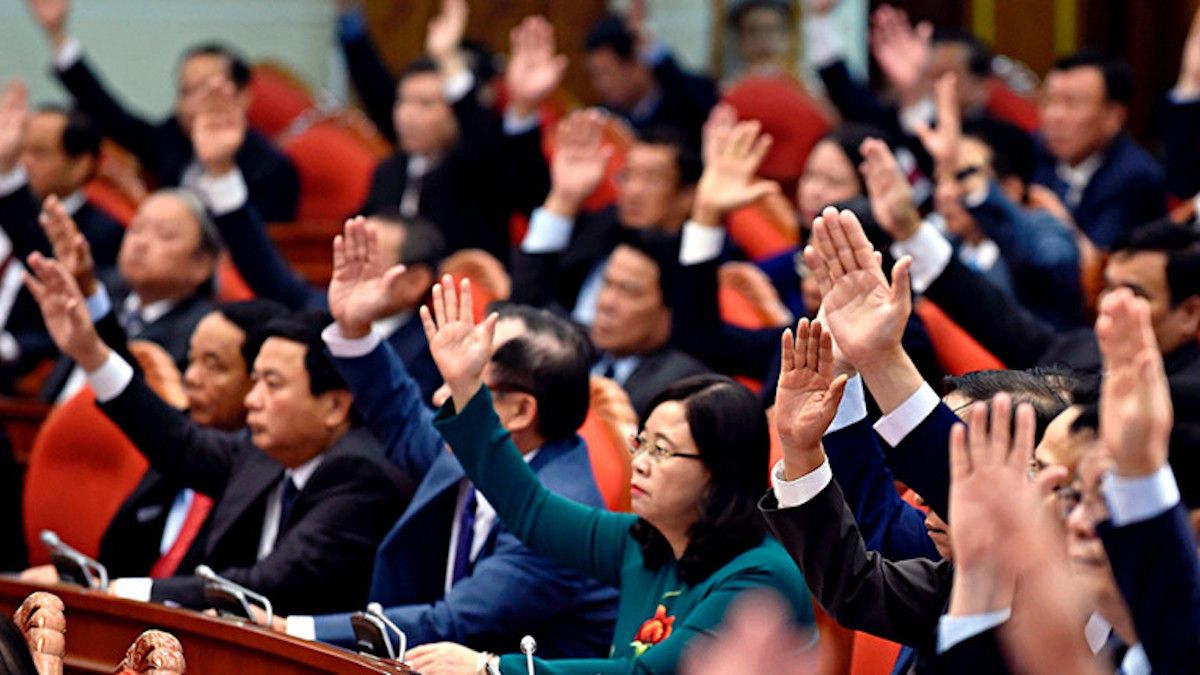
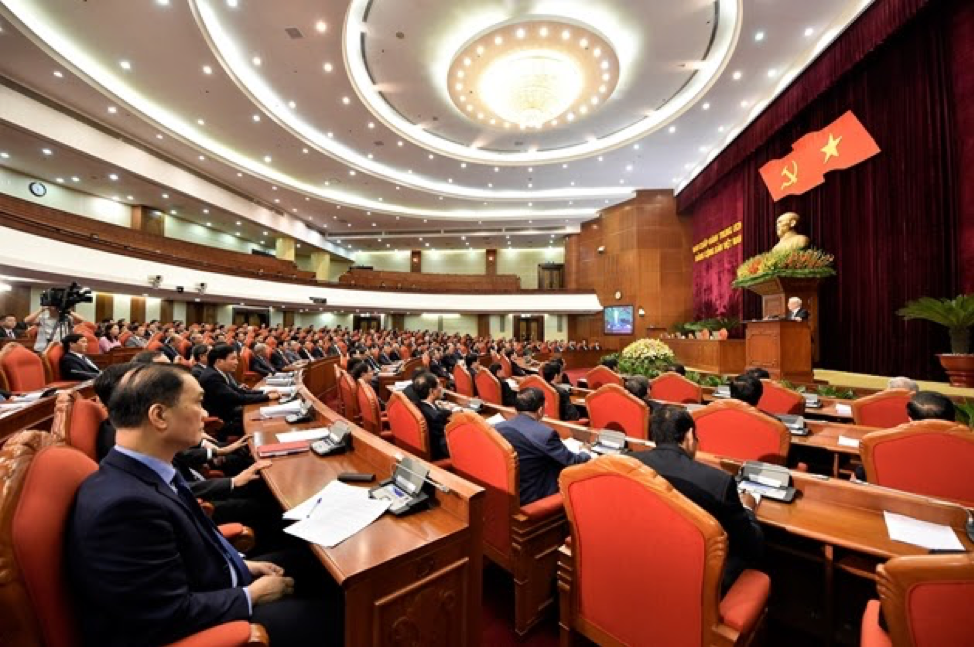
A meeting of the Politburo – Communist Party of Vietnam, May 2019. Photo: VNA.
The political elite
An argument exists to justify the Communist Party’s electoral mechanism. This argument is that the Vietnamese people are not well educated, are easily provoked, and are unsuitable for democratic elections. So, it is better for an elite minority to choose the country’s leaders; this elite minority is now believed to be the VCP.
Such an argument is found not only in Vietnam but in other parts of the world as well.
For instance, theories such as technocracy (a model of governance that believes that only experts in certain fields can be elected to corresponding positions in government related to their field of expertise) and epistocracy (a system that assumes only “qualified” citizens with enough information and political authority can vote or run for government) are not really new.
The famous 19th century philosopher John Stuart Mill used to support an electoral system based on voters’ caste and professional work. Experts who have complex knowledge and skills get six votes, farmers and merchants get three or four, skilled workers two, and unskilled workers one ballot.
More recently, Jason Brennan in his article The Case Against Democracy also promotes a political environment where only qualified and knowledgeable citizens should be allowed to vote or stand for office.
He writes that most of the political questions in contemporary life have become too complex for common voters to understand; they are too fond of simple answers to complex questions. Worse, he argues that the common people are not only ignorant, but that they also believe that they know more than what they actually do; they even claim that they are right. He believes that this makes their political decisions ignorant and stupid.
Brennan does not propose a voting model based on qualifications and educational levels like Mill, but rather recommends a test of voters’ political capacity before allowing them to vote.
The rules of the VCP electoral mechanism seem to be loosely based on or inspired by these two aforementioned technocratic and epistocratic theories:
Party members are considered “qualified” citizens who make the initial decisions regarding the formation of government through voting among themselves to elect members of the Party Central Committee. Then, the members of the Party Central Committee who are considered “high quality” citizens choose the “elite” members who will sit in the Politburo and the Secretariat seats, and also thoroughly become the state leaders, regardless of the outcome of local popular elections.
Meanwhile, the Politburo, which claims its membership to be the technocratic masters, sets the required standards for the new leaders, and then nominates and fills in the state positions for Vietnam.
The VCP considers this a brilliant method to select the top leaders for the country. But is it?
The defects of democratic elections
Democratic elections are clearly not liked by everyone, and some even find them to be very disappointing. The election of former US President Donald Trump is a very fitting example.
Donald Trump and Melania Trump were at voting booths in November 2016. Photo: Getty Images.
During the primaries in the 2016 US presidential election, as many as 50 Republican Party members openly voiced their disapproval of Donald Trump.
Specifically, General Michael Hayden (a four-star general, and former director of the CIA and NSA) said that Trump did not have the right temperament to lead. More specifically, he said that Trump lacked the personality, patience, disposition, knowledge, curiosity, or even the willingness to learn. These qualities, according to Hayden, are needed by candidates to be deserving of the title of president of the United States.
Using similar language, David French, a writer of The Dispatch, never concealed that he belonged to the “Anti-Trump” movement. He strongly affirmed that personality is essential in being a world leader. A person’s temperament, knowledge, and integrity will shape his or her behavior. And even though the democratic process and expert advisors can help shape and steer a president lacking in these qualities, mistakes can still happen, especially for someone as stubborn as Trump.
In the end, with his victory in the 2016 election, Trump showed that he was well supported by a large number of American voters, regardless of how many critics said that he was not worthy enough or deserving of the US presidency. In fact, during the middle of his impeachment fiasco, Trump’s ratings were not only stable, they also increased.
I will not go too deep in regards to Trump, because his assessment is still very controversial, even among the Vietnamese. However, this entire situation gives us this sliver of truth: people sometimes may vote for unworthy candidates.
The above-listed statistics is rather a detailed study conducted by Pew Research on voter views of candidates for elected positions in the United States, which found that voters did not take into consideration the quality and competency of political candidates.
Only 47 percent said that the quality of the candidates was good, and even less than 5 percent rated the quality and competence of the candidates as very good. The remaining 52 percent had a negative view. As for the presidency, 58 percent said they were not satisfied with the choices they had.
Furthermore, according to Pew, people in democratic countries tend to be dissatisfied with the way their countries operate. The list includes centuries-old democracies such as the United States and Great Britain. In line with this, the people’s opinions of their elected officials are also not high.
For instance, in Greece, up to 90 percent of the population believes that their elected officials do not care about the will, views, and aspirations of ordinary citizens.
Also, more than 58 percent of the US population share this opinion about their own politicians. Even though the indicators of transparency and corruption in the United States have always been evaluated positively by independent organizations, up to 69 percent of respondents agree with the opinion that national politicians are both corrupt and decadent.
In some African countries, democratic elections have turned into a game of those who can spend the most money to rile the mob.
So then, why have most nations in the world still chosen to maintain a universal electoral system? Why has most of the world not surrendered political power to the elites who are allegedly more knowledgeable, educated, and are supposed to have leadership qualities that can help them steer and rule a country?
Popular elections are still the best method
There is much to discuss about leaders who are chosen by the people, and those chosen by the elite.
The first misconception of those who oppose popular elections is that they think the majority will end up choosing the wrong candidates. In the same vein, they also believe that this choice should be left to the “elite.” They think that this small group of people can accurately decide without being influenced by interest groups, personal preferences, or other hidden agendas. These claims are utterly baseless.
Even Mill himself realized that countries needed to build a system that fully reflected current attitudes in society, and the idea of an administration full of economists frightened him.
For instance, why should a lawyer get three times the votes of a skilled worker when law is such a broad and diverse field? Politics and welfare issues are just small specializations in law and not all lawyers are knowledgeable enough to talk about them, let alone determine the best course of action in a field they may not be trained in.
Regarding Jason Brennan’s voter-competency test model, David Runciman, a professor of politics at Cambridge University, identifies that this model just pushes his questions to the starting point and fails to answer any more.
Who will be considered qualified to prepare this test model? College professors? They also have their own political interests and opinions. Economists? They may be talkative on a variety of market rules, but their predictions about the future of the market are often incorrect.
And Brennan, himself a university lecturer, has probably also seen countless students cramming knowledge into their heads just to pass exams.
Proponents of the “epistocracy” model also have to deal with the fact that the educated, and also the elites, are in fact influenced by the crowd and are biased just like everyone else in the world.
As social scientists Larry Bartels and Christopher Achen pointedout: History shows that intellectual groups, elite or not, can be as deviated from political morality and political thinking as anyone else.
There are shortcomings and problems in today’s modern electoral and representative democracy, but this does not mean that it is neither efficient nor just. As in marriage, anyone can choose the wrong partner, similar to how we can elect the wrong person. But with democracy, various checks and balances exist that can help ensure that the system can function as intended. As with marriage, we can get divorced and then marry again.
And when the people’s decision-making power is taken away, words such as “ability,” “quality,” “elite,” “technocrat,” or “epistocratic” are just flimsy excuses for control.
This article was written in Vietnamese by Vo Van Quan and was previously published in the Luat Khoa Magazine on February 1, 2021.
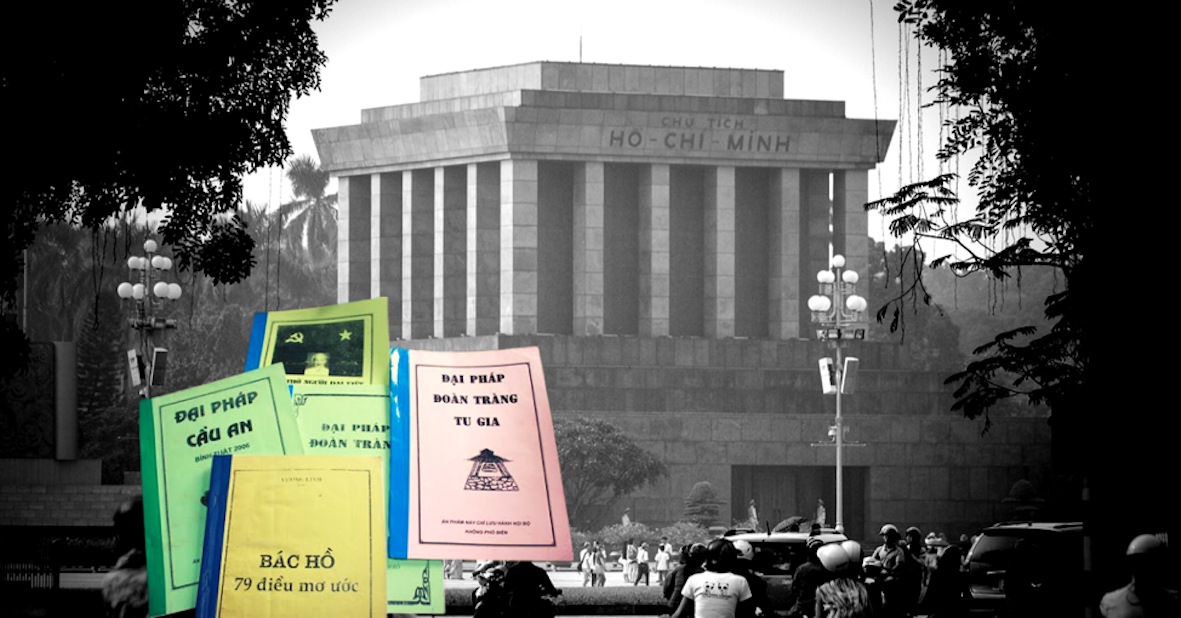
The religion Way of Uncle Ho aims to start a spiritual revolution in order to save the nation from foreign enemies, both past and present. This revolution also aspires to harmonize the balance between the worlds found in this religion’s metaphysical framework. These worlds include the Heavenly realm, the Buddha’s realm, the Earthly realm, and the Yin realm.
“A spiritual heavenly revolution.
Replace the old, change to the new. This religion will bring the people and our country up and we will no longer be slaves of others.
From now on there will be a new order. By the law of God, by the demand of our ancestors.”
According to the teachings of this religion, the Heavenly realm rules over the other three realms. However, the blasphemous behavior, attitude, and way of worship in the Earthly realm destabilizes the harmony of the other worlds.
This religion espouses that, because of Ho Chi Minh’s achievements, the purity of his soul, and his moral conduct on earth, his soul was “elected” to become the leader of the Heavenly Palace upon passing away. Henceforth, he leads the spiritual revolution which claims to promote the right path to reach heaven in the material world.
1. A mistaken understanding of the origins of the Vietnamese people and the their neglect of ancestor worship;
2. The overuse of joss paper and objects;
3. The incorrect performance of traditional rituals to the Mother Goddess;
4. A mistake in dating the death anniversary of Ho Chi Minh;
5. The invalidity of rituals of spiritual possession;
6. The pervasive worship of foreign spirits and gods, such as the Indian Buddha, Jesus Christ, and Chinese spiritual figures (Guan Yin or Bodhisattva);
7. Disrespect for heroic martyrs; and
8. Making mistakes in medical diagnosis and the treatment of illnesses caused by spiritual entities.
The religious texts of the Peace Society state:
“In the twenty-first century
The first Vietnamese Buddha was born.”
Monism has since become the motto of Ho Chi Minh’s religion. This religion states that the Vietnamese people can only worship the Vietnamese Buddha: “Uncle Ho.” Worship of any other foreign power also goes against their tenets and beliefs.
“Do not worship foreign gods
We worship our own Buddha in our country.”
Most importantly, Vietnam is seen as the leader of the entire revolutionary process that determines the future of mankind; this demonstrates a somewhat extreme form of nationalism.
“Vietnam is the eldest son of the Emperor.
Born first in the Earthly world.”
If people disobey the Jade Buddha’s commands, natural disasters, epidemics, wars, and social disorder will befall human society. This punishment is therefore not limited to just one nation or to one group of people, but extends to the entire world.
What is the Way of Uncle Ho’s religious practice?
The Ho Chi Minh religion has its own form of exorcism and this practice, in general, is very popular in the north. However, Madam Xoan believed that those who perform this act, if they come from the Mother Goddess religion or other popular sects, would often lose their cognitive abilities. On the contrary, Madam Xoan claimed she was a disciple of the Jade Buddha, so she could hear and preach the voice of the Jade Buddha without losing her reason.
As for worship, adherents of this religion are guided to worship Ho Chi Minh at home.
These worshipers have an altar that includes a statue or photo of Ho Chi Minh, the Communist Party’s version of the Vietnamese flag, and a bowl of incense. This altar should also be higher than all other altars in the house. Each day believers are required to offer fresh flowers, cakes, or fruits. Prayer is optional, but burning joss paper and other objects is prohibited. Their holidays also follow the official Vietnamese national holiday calendar which somewhat shows the religion takes a political stance.
One of the Ho Chi Minh Shrines in Ben Tre. Photo: The Vietnamese.
With respect to mass religious gatherings, the Peace Society spends most of its time performing activities such as the annual ancestral worship ceremony, which obviously includes Ho Chi Minh and the martyrs. They also provide magic spells and incantations.
It is also quite interesting to note that the Way of Uncle Ho has a very high anti-Chinese sentiment.
According to the leaders of the Peace Society, evil spirits are the wandering souls of the Chinese invaders who died years ago. They still haunt Vietnam, harm the people’s health, and negatively influence the future of the nation.
“Don’t listen to evil spirits. In the past, they were the enemy who deceived us and harmed us.
They admired evil and always wanted to invade our country.”
When the Hai Duong 981 drilling rig entered Vietnamese territorial waters in 2014, Madam Xoan and 400 other followers gathered, prayed, and condemned the behavior of the enemy in the north, the Chinese.
“I pray to Uncle Ho, he will pour out the safe water
[…] So that he could protect our sovereignty over seas and islands
from being invaded, in heaven and on earth.”
Madam Xoan has repeatedly tried to register this religion with the Vietnamese government, but the answer from officials is usually to wait for a decision from their superiors. She is also believed to have close connections with more than 30 figures in the central government, including scientists working in state agencies, ministry officials, and intellectuals interested in studying and learning about this religion.
According to research estimates, there are believed to be more than 10,000 official followers of the Way of Uncle Ho, and major ceremonies take place with more or less a thousand believers in attendance. This is a significant figure if you consider the fact that other domestic religions are slowly dying.
In addition, although not officially recognized, the followers of Ho Chi Minh’s religions, such as the Jade Buddha, receive approval from the government, along with the ability to exercise their freedom of religion easier than others.
However, these were the study’s conclusions up to the time of publication (2017).
In more recent times, the Way of Uncle Ho as the Jade Buddha has also fallen under the close scrutiny of local authorities. For example, the People’s Public Security newspaper published an article that claimed the Way of Uncle Ho had used Ho Chi Minh’s image with “misguided claims,” such as alleging that it “received Uncle Ho’s blessings” and its leaders offered some medicinal leaves to cure all diseases of the people. The authorities of some provinces, such as Vinh Phuc, also warned that this religion was an act of “illegal” religious activities.
The Vietnamese government is now in a dilemma. Should it maintain the treatment of Uncle Ho as a well-loved political figure and expect all Vietnamese citizens to continue worshiping his life? Or will the authorities rein in the Way of Uncle Ho and other cults and illegal religions involving Ho Chi Minh, and deal with these religious activities as it has often dealt with other different religions in the country? Only time will tell us how the authoritarian government of Vietnam will act on this issue.
This article was written in Vietnamese by Vo Van Quan and was previously published in the Luat Khoa Magazine on January 31, 2021.
“The nation of Vietnam will stand forever
with Jade Buddha – Chí Minh – Ái Quốc”
(A quote from a 2010 prayer)
The process of globalization in Vietnam has made major religions such as Buddhism and Christianity overshadow the silent development of local belief systems. However, overlooking them would be a mistake.
In a certain sense, these domestic religions most accurately and clearly reflect the dynamics of religious beliefs among the masses, and they can also show some of the implications of development in Vietnam’s societal relationships.
The religion called “Way of Ho Chi Minh as the Jade Buddha” (referred to as the Way of Uncle Ho in this article) is one significant example we can use to learn about how religion is practiced or how it is imbibed by the Vietnamese people. Up till now, there has not been an official study, or even an official government statement, on this strange and peculiar religion.
Dr. Chung is currently the head of the Department for Research on Policy and Law on Religion at the Institute for Religious Studies, under the Vietnam Academy of Social Sciences. He obtained his Ph.D. in Sociology from La Trobe University (Australia) in 2014, and was a scholar with the ISEAS-Yusof Ishak Institute (Singapore).
It is important to note that even though his book was published in 2017, the accompanying data in the study of Ho Chi Minh City was collected from 2011 to 2012. Therefore, there is a gap between the information provided by the author and the present state of this religion.
Ho Chi Minh statue is worshipped at the Ho Chi Minh Shrine. Photo: Search and Gathering Blog.
How was the “Way of Uncle Ho” formed?
According to a research by Dr. Chung published in 2016, a Madam Xoan founded the Way of Uncle Ho at the Peace Shrine (now called the Peace Temple) on January 1, 2001.
Madam Xoan, 73, experienced a miserable childhood in Nam Dinh Province. She lost her mother at a young age, had to live with her father and stepmother, and began working at the age of just 15. She also attempted suicide many times. At the age of 19, she married a notary public and had four children.
Everything changed when she became seriously ill just before she turned 30. It was reported that Xoan was unconscious and that the pain she felt in one finger was so intense that it had to be completely amputated.
Meanwhile, doctors could not find the reason for her illness nor determine the cause of the disease. One day while she was waiting to be treated in Hanoi, she heard a strange voice telling her that she was not sick but that this was just a test to see if she was qualified to serve a higher purpose. This voice also affirmed that Mrs. Xoan had spiritual inclinations.
She immediately quit her factory job and became a humble merchant buying and selling joss paper. During the next 5 years, Mrs. Xoan continued to be guided by this voice and her financial situation gradually improved. By the time she was able to clearly hear and fully communicate with this voice, she gave up her small business to study the supernatural.
In 1989, Mrs. Xoan heard the voice again commending her for being the first person chosen by the Heavenly Palace to complete her assigned mission.
From politicians to gods
Since the 2000s, the stories of individuals who have achieved great success and have become rich for relying on the help of Ho Chi Minh’s Jade Buddha have been compiled by the Peace Society of Heavenly Mediums (the religious leaders of the religion “Way of Uncle Ho”). These stories were then spread among the followers of this belief system.
For instance, there is also a similar story about an entrepreneur who worked in the construction industry. The story claims that he became very rich because of his obedience to “Uncle Ho.” To show his sincerity, he donated 200 million dong to the Peace Temple. This amount was then used to upgrade and renovate this place of worship.
Ho Chi Minh’s image has come a long way in the last century, morphing from a simple politician who was close to the people, to a god capable of interfering in and controlling the lives, happiness, and success of everyone who lives on Earth.
What happened?
General Secretary cum State President Nguyen Phu Trong offers incense to worship President Ho Chi Minh in Hanoi in 2019. Photo: VNA.The delegation of the VCP and the people of Cao Bang offer incense and flowers at the Ho Chi Minh Temple in Cao Bang. Photo: pacbo.vn.
Clearly, the deification of Ho Chi Minh did not begin with Vietnamese civilians.
Dr. Chung’s research indicated that numerous other studies have linked Ho Chi Minh’s death with the Vietnam Communist Party’s (VCP) own propaganda campaign. The State has intervened in directing or encouraging the remembrances of Ho Chi Minh. This has turned a mere ritual into the worship of the late leader.
Dr. Chung also concluded that many other researchers also pointed out that the VCP had a very clear goal of building a cult of personality around Ho Chi Minh. From promoting Uncle Ho’s supposed divine moral qualities to building up various myths about him, the VCP wants to make this version of Ho Chi Minh the formal history.
However, the most interesting point that Dr. Chung stated was that the VCP only expected to limit this phenomenon about Uncle Ho as a personal cult within the realms of the “ancestor worship” belief model. By doing that, the VCP wanted to connect the history of Vietnam’s national democracy movement and its communist movement, leading it to national success in the future. Once they establish this basis, the VCP, a political conglomerate founded by Uncle Ho, would have solidified more of its legitimacy.
The author emphasizes that the goals of the VCP and the desires of the masses in worshiping Ho Chi Minh are different.
The VCP’s model of worship of Ho Chi Minh is considered less religious and less superstitious. Therefore, Dr. Chung asserts that the religions associated with this political leader, such as the Way of Uncle Ho as the Jade Buddha, were “undesirable consequences” of state policy. The government’s efforts regarding the remaking of Ho Chi Minh’s image, if compared to people’s beliefs, are heterogeneous.
There are a lot of questions for Dr. Chung when he stated this argument.
It is because in Vietnam, we are seeing a common phenomenon that state agencies regularly promote the worship of Uncle Ho. The government placed Ho Chi Minh statues and photographs in many temples in the north of Vietnam, and offered incense to commemorate Ho Chi Minh during big national holidays, and the like.
If we follow Dr. Chung’s reasoning and assumption that the state did not want, or at least did not foresee, the formation of a religion centered around Ho Chi Minh, I think his argument is a bit unpersuasive.
In the context that the Vietnamese economy had just opened up and the practice of worship had just reformed since the 1990s, the nature of the people’s curiosity and experimentation for new religions and beliefs is obviously evident. Therefore, it is fairly certain to foresee that the people will eagerly want to join a new religion like the Way of Uncle Ho as the Jade Buddha if it is offered.
The Central Committee of the Vietnamese Communist Party (VCP) is a very powerful governing body of the VCP and it seems to be gaining more influence within the Party day by day.
What is the Central Committee?
In a previous article, we explained that the Party Congress is the highest governing body of the VCP according to its own charter. However, these congresses only happen every five years, and at some times in the past, they could actually be held at longer intervals. Then during the five years between the two congresses, which body will lead the VCP’s activities?
That body would be the Central Committee. In other words, the Central Committee is the second most important body of the VCP.
Who are the members of the Central Committee?
The Central Committee gathers together all of the most powerful members of the VCP. There are about 180 official members (who have the right to cast votes) and approximately 20 alternative members (who do not have the right to vote). This is an approximation because these numbers fluctuate when some members are disciplined (as in the cases of Dinh La Thang, Nguyen Bac Son, and Truong Minh Tuan), or when some pass away (Tran Dai Quang). There are also some members who resign during their terms for various reasons.
Almost all of the secretaries of the provincial committees, some of the deputy secretaries of the major cities (such as Hanoi and Ho Chi Minh City), and the secretaries of significant departments (such as the central departments and state enterprises) get selected to the Party Congress to be members of the Central Committee (both of the official and alternative members).
We also see the prime minister, deputy prime ministers, ministers, and some deputy ministers of the major ministries (such as the Ministry of Public Security or the Ministry of Defense) and directors join the Central Committee.
Vietnam Television (VTV), the Voice of Vietnam (VOV), the Vietnam Academy of Social Sciences, and the Vietnam Academy of Science and Technology all belong to the central government and have equal standing as the ministries. Therefore, the heads of these organizations can also become members of the Central Committee.
The National Assembly chairperson, vice-chairperson, and the commissioners of all committees are all included on the Central Committee. There may even be deputy commissioners of some committees participating in the Central Committee.
The prosecutor general and deputy prosecutor general of the People’s Supreme Procuracy along with the chief justice and deputy justice of the People’s Supreme Court also participate as members of the Central Committee. The leaders of the Vietnamese Fatherland Front, the Vietnam Farmer’s Union, and the Ho Chi Minh Communist Youth Union, etc. are also members of the Central Committee.
Of course, the members of the Politburo (including the VCP general secretary), and the Secretariat, the heads and deputies of the VCP departments, are all members of the Central Committee.
Who elects the members of the Central Committee?
New members of the Central Committee are elected during the Party Congress. Almost all of the new members will be nominated before the congress by the former Central Committee. It is very rare to see any members of the Central Committee get elected if they are not nominated in advance by the Central Committee. Being nominated at the Party Congress or by their self-nomination would not help them get elected.
In the time period between the two Party Congresses, the Central Committee may also elect more official members from its own alternative members group.
What are the roles of the Central Committee?
Because it is acting as the VCP’s main stage, the Central Committee can do the following:
Elect the members of the Politburo, the general secretary, the members and the Standing Secretary of the Secretariat, and the members and the commissioner of the Central Commission for Disciplinary Inspection. These are the most important and powerful departments of the VCP.
Organize to implement the political platforms of the VCP, the VCP’s charter, the resolutions of the Party congresses, and decisions regarding both foreign and internal affairs. It also focuses on the VCP’s mass mobilization and constructing the VCP’s organizational development, as well as summoning the Party Congress.
How often does the Central Committee hold its plenary sessions?
According to the VCP’s charter, the Central Committee will meet every six months, but it can meet more often if it is necessary. The meetings are officially called plenary sessions. If these sessions are held twice a year, then during the five years between the VCP congresses there will have been 10 meetings. However, in recent history, the Central Committee has held between 12-15 sessions, and there were years when they met four times a year, as in 2011, 2015, and 2016.
It is not a coincidence that the plenary sessions always met before the National Assembly had its sessions. Before the National Assembly conducts its session, there must be a Central Committee plenary session. In that plenary session, the Central Committee, together with Politburo meetings, will not only decide the National Assembly’s agenda, but also the decisions that the National Assembly will make during its session. Of course, the sessions of the National Assembly will not always be conducted as planned by the Central Committee’s original decision. In 2018, the National Assembly was pressured by the public to halt the law on the creation of the three Special Economic Zones. That halt has continued to date and that decision was not something the Central Committee could have expected.
The first plenary session of a new term of the Central Committee begins during the Party Congress to elect the members of the Politburo, the general secretary, and a few other positions. The Party Congress will end on the next day after the Central Committee finishes its first plenary session and the new leaders of the VCP will be introduced during that final day.
Are the plenary sessions of the Central Committee open to the public?
No.
Even at the National Assembly, which is the nation’s elected legislative body, the Vietnamese people are prevented from attending and observing its sessions. Thus, the plenary sessions of the Central Committee – one of the top governing bodies of the VCP – are not open to the public.
The plenary sessions are conducted in the conference hall of the Office of the Party Central Committee located at No. 1, Hung Vuong Street, Hanoi, at Ba Dinh Square, the site of many historical events, and where Ho Chi Minh read the Proclamation of Independence of the Democratic Republic of Vietnam on September 2, 1945.
Only representatives of a few of the special mouthpieces of the government – such as Vietnam Television, the Voice of Vietnam, the Vietnam News Agency, Nhan Dan (The People) newspaper, the VCP online newspaper, and the government’s online newspaper, are allowed to attend. However, these organizations only report on the commencement and the conclusion of these sessions. Everything else is kept secret.
After the plenary session concludes, the Office of the Central Committee will announce the results of the meeting at a news conference.
Does the Central Committee have actual power?
Yes.
Before Party Congress V (in 1982), the Central Committee had an insignificant role when compared to the Politburo. For example, the third Central Committee was active from 1960 to 1976 for a total of 16 years. Nevertheless, it only conducted 19 plenary sessions. All of the major decisions during those years came from the Politburo and the Party’s Central Military Commission.
However, starting with its fifth term, and especially the sixth term, the Central Committee conducted more plenary sessions, having at least two sessions per year. During these sessions, the Committee decided and implemented more important policies with regards to the operation of the VCP.
One reasonable explanation for this was the decentralization of the VCP’s power over the years.
Before, people like Ho Chi Minh, Le Duan, Le Duc Tho, Truong Chinh, all had extensive influence within the VCP. Perhaps, that was mainly because Vietnam was in a state of war. At that time, the Politburo and the Central Military Commission, and even just a few top leaders, would have enough authority and power to execute their decisions on their own.
However, beginning in the early 1980’s, the group of the heroic individuals who specifically contributed to the VCP development got older and died and so the group lost its influence in the Party.
More than that, when Vietnam began to live in a peaceful period, each local province came to have its own individual and unique problems. Therefore, the authority in the VCP had to be shared among the members of the Politburo and also with the local governments, and with other governmental enterprises as well. The decentralization of power in the VCP and also in the government meant that more authority was disbursed to local governments.
At the same time, there were issues that the Politburo could not decide, and it passed those on to the Central Committee. During the XI term, we had the example of two Politburo members, Prime Minister Nguyen Tan Dung and General Secretary Nguyen Phu Trong, who conflicted with each other a lot during their terms. Their conflict couldn’t be resolved within the Politburo, so they brought it to the Central Committee’s floor. At the 2012 Central Committee’s 6th plenary session, there was a plan to review the prime minister’s responsibilities during his term. The prime minister ended up not being disciplined and was able to retain his position.
Even though the Central Committee possesses such significant power and has been gaining more control over the years, its agenda can still be dictated by the Politburo. In 2006, Prime Minister Vo Van Kiet penned his letter to the Politburo, asking it to respect the decisions that came from the Central Committee and to quit acting as the higher-level, supervising department of the Committee.
Based on the VCP’s charter, the agenda and the nomination and election of all the positions in the Central Committee’s plenary sessions should be organized by the Politburo. However, it is still unclear which department has more power between these two most potent governing bodies of the VCP.
We can only hope that with more research and analysis that we can better understand the organizational power of the VCP.
Hoanh Village, a few days before the historic Dong Tam trial, is a place where the green rice fields are flowing beside country roads under the hot autumn sun. Vietnam’s national flag and banners commemorating the 75th anniversary of its National Day crowd the village gate.
I equipped myself quite well before I arrived in Hoanh Village, in both my mind and my technological tools.
“That place has many security police. Be careful!” – I was warned in a text message.
I have wanted to go to Hoanh Village during these days to be a journalist and practice the most basic ethical responsibility of our profession. I wanted to report the complete story about a historical event that will happen soon. I wanted to learn about the defendants’ families and what they yearned for, besides justice.
The village welcomed me with the typical peaceful beauty that many northern rural villages offer: a traditional market, big old banyan trees, rice fields, and winding roads. It was as calm as if it had never gone through the recent chaos it had experienced. There were no skeptical eyes staring at a stranger when I accidentally met villagers, or when they wholeheartedly showed me the directions to Mr. Kinh’s house.
They whispered to me, “So pitiful that house now, with only women and children left.”
There were no security police there; at least that was how I saw it. Yet, there were a few surveillance cameras placed on the awnings of opposite houses, which surprised me a little.
I met Mrs. Du Thi Thanh, the wife of Mr. Le Dinh Kinh, and Mrs. Le Thi Thoa, the fourth daughter of the couple, and their group of little grandchildren. In the house, which was pockmarked by police bullets, they told me stories about their father and husband. My questions were overwhelmed by their memories. The wife and daughter, and at times, both of them, unwittingly reliving stories about their husband and father as a man from their past. They told me the stories in tears, and there were moments of silence, and even some smiles. Before the attack, there were the peaceful times they had spent in the village.
The wall is used to hang Mr. Le Dinh Kinh’s portrait and his medals, as well as the evidence of bullet fire. Photo courtesy: May/Luat Khoa Magazine.
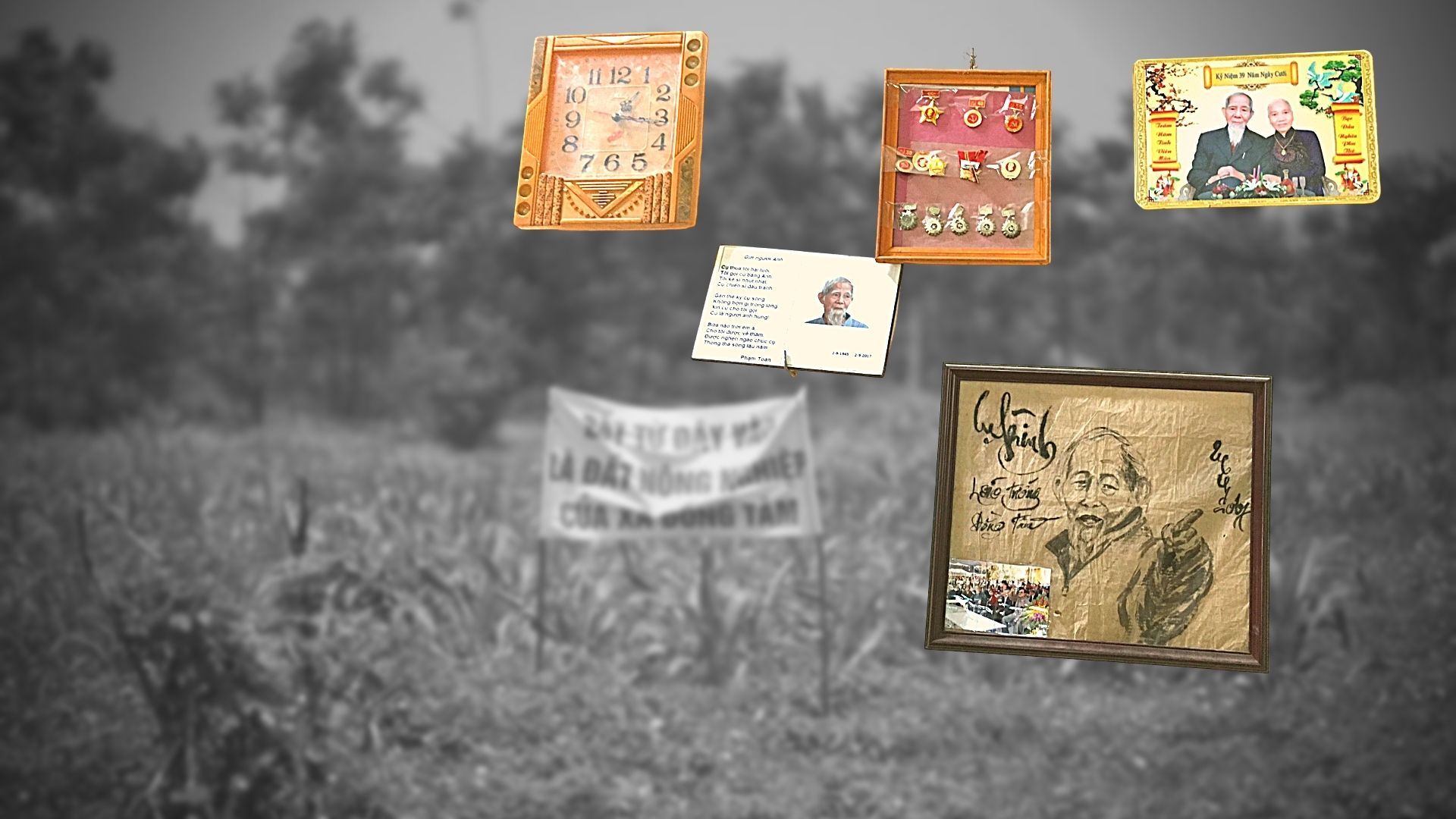
Mr. Le Dinh Kinh’s portrait and the medals that the government and the Vietnamese Communist Party awarded to him were hung on the wall opposite the main door. The same wall was marked by bullet holes, evidence of the attack one dawn last winter.
“These things, when he was alive, he treasured them so much,” Mrs. Thanh said, looking up at the medals. “He was given an award when he reached his 55th year as a Communist Party member.”
“What are your memories of him?” I asked the two women.
Du Thi Thanh:
Our house always needed a lot of upkeep, but he always forced me to take him to attend the Communist Party meetings in our ward. Before, he could go by himself, but starting in 2017, after his leg was broken during an assault by the police, he had to use a wheelchair. The first wheelchair was a gift from Mr. Chung (Nguyen Duc Chung – the former chairman of the Hanoi People’s Committee). Later, the Disabilities Association gave him another wheelchair. I remember when he tested out the second wheelchair, which he praised: ‘This one is smoother, my wife,’ he told me. ‘The first wheelchair came from Chung, I heard it was expensive, but the wheels were wobbly.’
I used the wheelchair to take him to his meetings, waited for him, and we would go back home together. People kept talking, one after another, which made me anxious because I could not know when the meeting would be adjourned.
More than that, the people did not obey any rules because when one person spoke, another would go outside to chat with others. It was just like the chatting done in the market. But it was only my husband and a few others who were thorough. I remember that he proposed to do roll calls to make sure the Communist Party’s meetings in our ward would have sound principles.
When we got home I was annoyed, and I told him if the Communist Party’s meetings were just like that, we should not go because we just sat there and did not benefit from anything. I told him that we were old and we should stay home to rest. However, he was angry with me. He said: ‘Why would you say that? I do not care if there were improper people there. I came because I want to be proper and exemplary.’
If you offer comments about his Communist Party carelessly, then you are bound to be berated.. From then on, if he asked me to take him to such meetings, I would go with him, and I stopped asking him to stay home.
Le Thi Thoa:
There are now only regrets…. Our father-daughter relationship had so many fights …. (She cried.)
I was never close to my father when he was alive. Among his children, I was the child that had so many opposite perspectives from him. I could not sit down and have a proper talk with him without us having a clash of opinions because we would fight right away after exchanging a few sentences. My father whole-heartedly trusted the Communist Party, and he believed in the Communist Party’s Secretary General Nguyen Phu Trong without condition. I warned him and told him: ‘Father, many officials nowadays have become corrupt.’ But my father scolded me and said we can’t tar the whole brush because the corrupt officials were only a small group and that they were the lower officials that covered their faults and smeared the Party.
I had wanted him to let go of the land dispute everytime I witnessed my father face grave danger. I cried and told him that I was scared. I stated that the Party had too many factions, and they could turn against each other to eliminate the opposition. My father responded to me that he was doing the right thing so he should not be afraid. He said the land of Senh field, where we had disputes with the government, belonged to the people of this ward. He also assured me that if he already made a mistake, the Party would have kicked him out a long time ago.
When he was in the hospital in 2017, some people gave him money when they visited him. He then gave the money to a policewoman and asked her to keep it for him. He always said: ‘(Nguyen Duc) Chung already said so (that the government would never prosecute Dong Tam villagers). Or, he would say ‘the people from the city had promised me already (to not prosecute),’ and that ‘things have to be reported to Mr. (Nguyen Phu) Trong because the Party would then be transparent.’ I was so mad, I stopped talking to him, ignoring the old man’s ideology.
From the time when he was still a local official right up until to his retirement, I saw him as a person who spent so much time volunteering for the community. I felt uneasy. He only cared about the ward and the village’s everyday issues, leaving my mother to take care of our household alone. As years passed , the Mieu Mon land dispute documents passed through the hands of many leaders , but he stored them all in his head. He memorized all of them, line by line, without fail, without a need to look at the papers.”
Mrs. Du Thi Thanh shows the bullet hole in the glass door. Photo courtesy: May/Luat Khoa Magazine.
Du Thi Thanh:
When he was an official, he only focused on his position and worked for the ward and the village. Even when his wife and kids suffered, he took no notice . When he retired, he began to farm the field. I guess he farmed to compensate his family because there had been so many years that he neglected us. The village people passed by our field and would tease him: ‘Oh, Mr. Kinh, Mr. Kinh. You were an official, why are you only now putting your head to the field?’
Le Thi Thoa:
Other people who were government officials had so much land. My father worked at the top positions in this ward, but my family didn’t even have a rice field when he retired. I remember that my parents would come to some undocumented land that nobody cared to claim . From dawn to dust, they would go there to work on that land, clearing, ploughing, digging, furrowing and cultivating the land till it was ready to be used for planting food crops. . They worked so hard and spent so much time on that field only to have their sweat and blood rewarded by a call from the government to donate all the cultivated land to the ward when harvesting time came. Is that reasonable? But then I have never heard my father blame the Party or curse the government. He only scolded me. (She smiled.)
I was irritated and slightly annoyed at the absurdity when I read online that people cast doubt on the source of money my father received from overseas, indicating it was from the reactionary forces. Truth be told, my father would forever continue believing in the Communist Party until his last dying breath.
If he truly believes that something is right and is not against his conscience, my father would fight to protect it till the very end. He used that mentality to protect the Senh field and the Communist Party.
Du Thi Thanh:
Until his last days, even after witnessing so many city officials do an about-face, he still believed in his Party. I worried for his safety, but he chided me: ‘You do not need to worry about me. I am a Communist Party member. A Party member must stand up and take care of the people. If we ignore the truth and don’t speak up, we are guilty in front of the people.’
I remember when he was young, he would pedal with only one leg, but he was incredibly fast. He would bike across the fields to go to the town center for a meeting. He was disabled in one leg, but he was talented so it helped him to become the head of the ward police force. He could only stand up on one leg, but he took care of all of the ward’s work thoroughly. The people in this ward respected and loved him.
Le Thi Thoa:
I recall that he told us he had played soccer when he was young and sprained his leg. Unfortunately, he did not receive proper treatment, which led to a permanent disability later on in life. My father was always so busy with work. When he was riding his Thong Nhat branded bicycle or when he got a ride on a motorbike to go to the district office, he always had to stretch out his disabled leg. Even having his meals or a cup of tea, he could not fold that leg. When he walked, it seemed as if he was dragging it along.
Du Thi Thanh:
But they shot and blasted his disabled leg.
Le Thi Thoa:
Dad died such an inconsolable death.. What is there left when all of the men in this house have been arrested. We can only pray to Heaven. We looked up at the sky and cried our hearts out about the injustice. When we fixed part of our home after the assault and repaired the damage caused by the police attack , our mother wept until she passed out because she was so heart-broken that our family now was left with only women and young children. My father’s belief caused all of that. If I knew in the end that our family would be this broken, I would have made more of an effort to stop my dad from disputing the land with the government. You should throw away everything, dad!” (Le Thi Thoa sobbed)
Mrs. Du Thi Thanh shows the bullet holes in the wall. Photo courtesy: May/Luat Khoa Magazine.Another bullet hole in the home of Mr. Le Dinh Kinh. Photo courtesy: May/Luat Khoa Magazine.
“We will walk (to court) from our village”
Du Thi Thanh:
My sons, my grandsons, are all in prison. It has been more than eight months, and our family did not receive any news about them. My son Chuc, did the wound on his head heal? Ten days after he was arrested, his wife gave birth to a son. His wife sent him a picture of the newborn baby, but the prison officials did not allow him to receive it. I believe that Doanh got shot in the arm, how is he now? Uy, and then Cong. My sons and my grandsons are all working people. They each have their own family . Their wives now have to raise their children alone and unsupported. If I knew this in advance, I’d rather kept my mouth shut . I would have forced all of them to be silent. How could any piece of land be more precious than having a peaceful family life?”
Le Thi Thoa:
The rental car company did not accept our reservation (or that of any of the villagers) to rent cars to go to the trial. The company told us that the police had forewarned them. An official in our ward advised us to stay home because we would not be allowed to enter the Hanoi courthouse. But regardless, we will go there. We will walk from our village to Hanoi and attend the trial. My mother wants to see her sons and grandsons. The young children in our house want to see their fathers; the wives want to see their husbands. No one should be able to prevent us from doing that.
Du Thi Thanh:
What do I expect at the trial? I just want to meet my sons and grandsons. I want them to issue a death certificate for my husband. He passed away more than eight months ago, but we have yet to receive the death certificate. The officials from our ward forced me to state the reason for his death as ‘died at home.’ No. That was not right. Mr. Le Dinh Kinh was shot to death at home. A bullet entered near his heart. Two bullets were fired into his head. His left knee was shattered. That was how my children’s father died. The bloodstain is still in our room, how could they lie like that?
The bloodstain is right here. It is very stubborn though, I could not wash it off.
“Just stay still here, I will go downstairs and get you a wet cloth to help you breathe better.” That was my last sentence to my husband. The fumes were so heavy. I was going back to his side when someone took my arms and dragged me away. When I came back home, the room was covered in blood. Our home was shattered. Can you see this door jamb protruding out? A bullet is stuck in it.
***
Mrs. Thanh relived the story as she walked me around her house.
I could see the remnants of bullets fired through their glass door. Their closets were also shot up, and the wall had a massive crack. There were areas of newly patched cement, but others were left untouched. Evidence of bullets was everywhere, substantial bullet holes, smaller holes, on the first floor and the second floor. They were also in the kitchen and the living room. There were also black stains on the floor, which Mrs. Thanh suspected it came from the tear gas.
She was walking with her hunched shoulder, her hair all white. Just like her daughter, she doesn’t believe in anyone because “only Heaven could help my sons and grandsons” during the trial starting next Monday. The two women did not say words like “justice”, “righteousness”, or “fairness” when they referred to the trial as I had imagined they might. They did not expect too much, just the simple wish to be able to see their loved ones and to somehow brush each other’s hands at the trial hearing.
I just wanted to write down their stories, documenting ordinary farmers who unfortunately have family members caught in the justice of law and now tried as defendants. Although I guaranteed that I would not write about the land dispute issues or give speculation on which side is right or wrong, not a single newspaper in Vietnam accepted to publish this article.
On September 7, 2020 when the Dong Tam trial begins, where would we see the faces of the mother, wives, and children of the 29 defendants from Hoanh Village and the Mit Village, both located in Dong Tam Ward? Broadcast on television? Captured on cameras or on the cover of newspapers? Would the state-owned media specifically describe these women as who they are and not as people from the reactionary force?
I hope that my imagination about their fate during the Dong Tam trial will not turn real. I also hope that there will be a place, a time to safely and freely tell their stories. Their voices have been silenced for so long.
***
The original article was written in Vietnamese by May and published in Luat Khoa Magazine. The English translation was done by Karie Nguyen.