Author: Luu Ly

  • Vietnam Officially Announces National Decline In The Number Of Buddhist Followers, Shocking Its Buddhist Sangha

    Vietnam Officially Announces National Decline In The Number Of Buddhist Followers, Shocking Its Buddhist Sangha

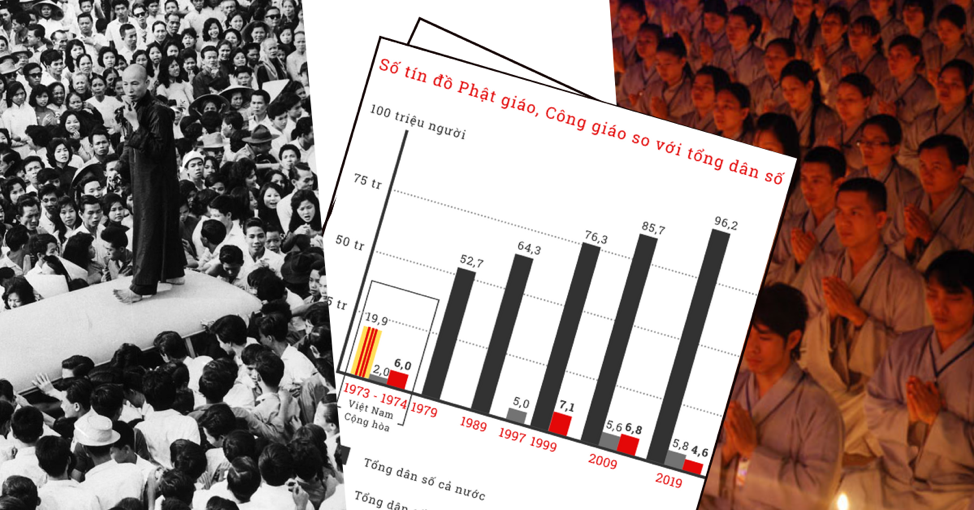
    According to Vietnam’s official statistics, in 2019, the religion with the largest number of followers in the country is Catholics with 5.9 million people. The number of followers of Buddhism is 4.6 million, ranking second. However, the numbers reported by this census contradict statistics from other state agencies, leading religious leaders and followers in Vietnam to question its accuracy.

    The Giac Ngo Newspaper – a Buddhist media – reported that this news “shocked” some monks, and that some  believers “burst into tears” when they heard the news. Many people naturally assumed that Vietnam would have more Buddhists than any other religious group.

    However, over the years, followers, monks and as well as senior sangha officials in Vietnam, have gone from one disappointment to another because the number of Buddhists has fallen dramatically in state statistics.

    The number of Buddhists in the 2009 Population and Housing Census was 6.8 million, a decrease of about 300,000 compared to 1999. Even so, Buddhism remained the religion with the largest number of followers in Vietnam.

    The situation only changed with the 2019 census results.

    In that year, the government announced that the number of Buddhists decreased by 30 percent compared to 2009. From 2019, Buddhism has lost its top position in the number of followers in Vietnam according to the State census.

    Over the past 50 years, Vietnam’s general population increased, but the number of Buddhist followers decreased

    Buddhism – a religion of about 2,000 years of development in Vietnam – now has only 4.6 million followers, accounting for about 4.78 percent of the total population.

    Meanwhile, the number of people who claimed to be Buddhist in the Republic of Vietnam (which only consisted of the south of Vietnam and a portion of the center) in 1963 was 9 to 11 million, accounting for 70 percent to 80 percent of the south’s total population as stated in the estimates that the US Central Intelligence Agency (CIA) compiled that year.

    The current figure of 4.6 million Buddhists is also less than the number of followers identified by the CIA as active Buddhists in the Republic of Vietnam in 1974, which was about 5-6 million.

    After 1975, the vibrant religious culture in the south suffered a period of “government watch” for more than 15 years. During that time period, major religions were restricted in their practices and the smaller religions were completely banned.

    According to State Magazine, a research journal of the Ministry of Home Affairs, in the first two censuses of 1979 and 1989, Vietnam did not record the number of religious followers.

    By the early 1990s, Vietnam began to officially recognize the religions that were previously popular in the South but which were banned after 1975, such as Hoa Hao and Cao Dai Buddhism. In 1999, the government started to keep statistics on the number of religious followers in the country.

    Nevertheless, as more statistics were completed, it was observed that the number of Buddhist followers were reported as having fallen. Throughout the three censuses (in 1999, 2009, and 2019), the number of Buddhists decreased by 35 percent while the national population increased by about 26 percent

    Graphics from Luat Khoa Magazine based on the data sources below.

    The Vietnam Buddhist Sangha refutes the state figures, but also does not publicize its own membership numbers

    Looking back, in 2012, the Buddhist Sangha of Vietnam opined about the number of Buddhists in Vietnam after the 2009 census results were published.

    Although Most Venerable Thich Bao Nghiem, vice chairman of the board of directors and head of the Board of the Dharma Preaching of the Central Vietnam Buddhist Sangha, acknowledged the 2009 census is quite “large, serious, and objective,” he also said at the time: “The statistical results …. about Buddhism are not accurate for many different reasons.” He explained that in Vietnam, apart from those who claim to follow other religions, the rest are really “followers of Buddhism, who love Buddhism and are influenced by Buddhism”. If one accepts Thich Bao Nghiem’s reasoning, then the number of followers of Buddhism in Vietnam could have been about 78 million in 2009 – which is the number we get when we subtract all people who declared themselves to have a different religion than Buddhism from the national population at that time.

    However, in 2019, the Vietnam Buddhist Sangha was again surprised when the State census stated that the number of Buddhist followers declined further and that Buddhism was no longer the religion with the most followers in Vietnam.

    Despite this continuing disappointment, over the years, the Vietnam Buddhist Sangha – with nearly 40 years of operation and the only state-recognized Buddhist organization in the country – still has not published the number of its own followers. The only official figure for Buddhists in Vietnam comes from state statistics.

    Meanwhile, other religions have tallied and announced the numbers of their own followers. For example, in 2018, the Vietnam Catholic Bishops’ Council announced that the whole country had about 7 million Catholics (Vietnam’s state statistics put the number at just about 5.86 million). Overseas branches of Hoa Hao Buddhism also stated that there were about 3 million Hoa Hao Buddhists in 2010 (state statistics in 2009 said just 1.3 million).

    Figures for the number of Buddhist followers from other state agencies are also inconsistent

    Unable or unwilling to declare the number of its own Buddhist believers, the Buddhist Sangha currently uses statistics from the Government Committee for Religious Affairs.

    Accordingly, the Sangha often uses the estimate given by Tran Thi Minh Nga that she used when she wrote an article in 2014 on the website of the Government Committee for Religious Affairs. Nga said that up to June 2010, Buddhism had had about 10 million followers in Vietnam.

    Meanwhile, the number of Buddhists in 2009 announced by the General Statistics Office was only 6.8 million.

    Nga did not cite the data source that she mentioned in her article at that time. In 2014, she was the deputy director of the Buddhist Department of the Government Committee for Religious Affairs. Currently, she is serving as the deputy head of the Government Committee for Religious Affairs.

    In a report on religious freedom in Vietnam in 2019, the US Department of State also used data from the Government Committee for Religious Affairs, which in January 2018 stated that about 14.9 percent of the total population was Buddhist. If applying this ratio to the total population in 2019, the number of Buddhists would have been about 14.3 million.

    According to Associate Professor Hoang Thu Huong of the University of Social Sciences and Humanities, the National University of Hanoi, Buddhist monks believe that Buddhists must include both 1) those believers who take refuge in the Three Jewels or Triple Gem (also known as the “Three Refuges”), and also 2) those who identify themselves as being influenced under Buddhism. Dr. Huong also said that because the criteria for inclined towards Buddhism could not be included in statistics survey questions, and that could be why the number of Buddhist followers differs among different state agencies.

    However, during the period of the Republic of Vietnam, the CIA recorded both of these statistics, including active believers (possibly including the Three Refuges) and self-proclaimed and sympathetic Buddhists.


    (*) Data sources for the chart listed above.


    This article was written in Vietnamese by Thai Thanh and previously published in Luat Khoa Magazine on February 18, 2021. The translation was done by Luu Ly.
  • Is The VCP “More Democratic” Than The CCP?

    Is The VCP “More Democratic” Than The CCP?

    This article was written in Vietnamese by Bui Cong Truc and previously published in Luat Khoa Magazine on January 20, 2021. The translation was done by Luu Ly.

    * * *

    How is the VCP “more democratic” than the CCP?

    Most of the active communist parties today are more or less based on the Soviet Communist Party model.

    The system originated with the majority power of the Party National Congress. This congress elects a minority group called the Communist Party Central Executive Committee (the Central Committee, for short).

    Theoretically, the Central Committee is the governing body that decides most of the important issues in terms of policies and personnel in the Communist Party organization. However, the organs elected by this body have certain privileges, and can completely surpass the power of the Central Committee itself, depending on the time period.

    These agencies include the Political Bureau (aka the Politburo), the Secretariats, or a typical body of the Soviet Union Communist Party, the Organizational Bureau.

    So are the power structures of both Communist parties similar? How has the individual history of each party, the Chinese Communist Party of China (CCP) and the Vietnamese Communist Party (VCP), affected each country’s economic and social development? This article will  provide readers with more information about the fundamental differences between these two Communist brothers.

    Two leaders of the two Communist parties, Xi Jinping and Nguyen Phu Trong. Photo taken during Nguyen Phu Trong’s visit to China in 2017. Photo: Xinhua News Agency.

    Conflicts between the Central Committee and the Politburo

    Many people accept, as common sense, that the Politburo is the central power for both the VCP and the CCP. However, the party rules of these two brothers have many differences.

    The first notable point is that the Central Committee of the CCP has only been  required to meet once a year since Deng Xiaoping reformed and re-institutionalized the political apparatus. Many Chinese observers assert that this was an intentional effort to limit the frequency of the CCP Central Committee’s meetings so that the authority of the body would be reduced as much as possible.

    The pressure to democratize within this Party is not insignificant and not recent, but for many reasons, these proposals have been unsuccessful. Arguably, the CCP’s Central Committee only plays a behind-the-scenes role, compared to the main playerr, the Politburo.

    Regulations in Vietnam are different. According to Article 16 of the VCP Charter, the Central Committee of the Party must meet at least twice a year.

    The fact that the Central Committee of the VCP meets more than once a year does not seem to say much about the different power structures of the two parties. However, in reality, the most important issues require a decision of this body. If we compare the total number of meetings and resolutions of the Party’s central organs in the two countries, especially since Deng Xiaoping’s faction took power, the VCP’s Central Committee has twice as many meetings as its Chinese counterpart.

    For example, only in 2016 did the VCP Central Committee convene the conference four times, with important contents including redefining the working regulations of the Central Committee, the Politburo, and the Secretariats; the working regulations of the Central Inspection Committee; regulations on the implementation of the Party Charter; and the regulations on the inspection, supervision and discipline of the Party. These were all important meetings to help Nguyen Phu Trong’s political coalition gain the upper hand. Once he was the leader of the control group within the VCP, his famous “anti-corruption” campaign followed and it has been the most controversial issue in Vietnam in  recent years.

    Another feature that is also noticed by many international commentators when comparing the two parties is the number of times that resolutions of a party’s central body are referred to in official legal documents.

    According to statistics cited by three experts, Regina Abrami (Harvard), Edmund Malesky (Chicago), and Yu Zheng (Connecticut), the percentage of legal normative documents promulgated by competent state agencies that cited Central Committee resolutions by the VCP Central Committee was quite high, averaging 23 percent. Meanwhile, this rate in China was only 5.5 percent.

    This statistic shows the direct influence of the VCP’s Central Committee on the policy making process. The difference of more than 17 percentage points is also an indication that the VCP’s Central Committee plays a greater role than its Chinese counterpart, at least on a legislative basis.

    https://2xjs7y10oiyz26vqxu2hok6y-wpengine.netdna-ssl.com/wp-content/uploads/2021/01/image1-3-1024x605.jpg
    This table compares the powers of the CCP and VCP Central Committees through two criteria: the number of meetings and the proportion of legal documents that quote the agency’s resolutions (Abrami, Malesky, & Zheng, 2008).

    The differences in the real power of the Central Committee of the CCP and the VCP are not limited to the numbers. In some specific political events, the power of the VCP’s Central Committee is also more clearly shown.

    For example, in 1997, when General Secretary Do Muoi decided to retire before the end of his term, his replacement Le Kha Phieu, was selected after an unusual meeting of the entire Central Committee.

    This approach is in stark contrast to the cases of Hu Yaobang and Zhao Ziyang in China. Finding replacements for these two to take the seat of general secretary was a private matter decided in Politburo secret meetings. In these meetings, there were also many retired “revolutionary elders” who did not have a role in deciding the next generation of leaders, according to the Party Charter.

    Not only that, in 2001, the Central Committee of the VCP even vetoed the Politburo’s request to allow Le Kha Phieu to continue holding the position of general secretary. Instead, the Central Committee elected Nong Duc Manh, who was the president of Vietnamese National Assembly at that time, to fill the most powerful seat.

    In 2006, former Prime Minister Vo Van Kiet also wrote an open letter to the Politburo requesting it to respect collective intelligence and the democratic decision of the Party’s Central Committee, and not make the Politburo the “superior” body.

    On the Chinese side, there has never been any case where the Central Committee directly and flatly opposed a proposal by the Politburo.

    So far, many people have questioned whether the VCP’s Central Committee still has real power over the Politburo, as well as if it has followed in the footsteps of it’s elder brother in the north.

    There is still reason to believe that the traditional competition between the 176 members representing various factions and schools within the Central Committee of the Communist Party still exists.

    The historical path of the two political parties

    So what is the reason for the difference between the VCP and the CCP? Many scholars often point to the history of the two political parties.

    For China, although Mao Zedong was seen as the CCP’s supreme leader for a long time, the power rivalry between factions within the party remained fierce, until Deng Xiaoping restored order according to his wishes.

    First, the policies of political and economic reform after the dire consequences left behind by Mao were enacted from the top down, and specifically from the Politburo. In a time when the Party’s political bodies were mostly ragged and lost across China, the top-down orientation seemed to make things easier to manage. This increased the legitimacy of a few powerful individuals in the Politburo.

    Not only that, but the Tiananmen Incident in 1989 created more controversy between the groups of “hard players” and “soft players” towards the protesters. The controversy further fueled the desire of Deng Xiaoping and the elites to concentrate more power, and to limit the mass discussions, of the Central Committee – which they saw as an impediment to the process of fast decision making and effective policy enforcement.

    https://2xjs7y10oiyz26vqxu2hok6y-wpengine.netdna-ssl.com/wp-content/uploads/2021/01/China-Deng-Xiao-ping-005-1-1024x819.jpg
    Mao Zedong and Deng Xiaoping in 1959. Photo: Kyodo News/ Associated Press.

    With Deng Xiaoping officially succeeding in selecting the general secretary without the consent of the Party’s Central Committee (a serious violation of the Party’s Charter), the few minorities in China gradually took control of political power.

    Since 1989, the three positions of the troika in the power structure of the socialist state of China have been the general secretary of the Communist Party, president of the State, and chairman of the Chinese Central Military Commission, all traditionally held by one person, which have been Jiang Zemin, Hu Jintao, and now Xi Jinping respectively.

    Prior to the 7th Party Congress in 1991, it can be said that the troika model in Vietnam was not much different from the Soviet Union. The general secretary had a central position in the Party with an important influence on its political policy and direction, while the chairperson of the Council of Ministers was the head of the executive branch with the obligation to enforce and guarantee the Party’s orientation. And finally, there was the president of the State, but that position often just has a symbolic meaning.

    However, the three titles of general secretary, prime minister, and president are the real “three-pillars” of power in the contemporary Vietnamese political apparatus.

    What happened?

    Some researchers point out that after the period of bad experiments with macroeconomic and microeconomic policies, chaos emerged in Vietnam’s society. Some senior leaders within the Party, such as Nguyen Van Linh and Vo Van Kiet, wished to promote more key reforms to revitalize Vietnam. One of the first things they did was to diversify and turn the Central Committee into a more authoritative institution, which they hoped in the future would be the point of consensus for the new reforms they proposed.

    Their first success was the  increase in the number of members of this body. Starting in 1986, during the 6th National Congress, leaders in the Party’s provincial committees began to be elected to the Central Committee, thereby displaying a large force supporting economic and political reforms.

    By the 7th Congress, Vo Van Kiet successfully persuaded the Party to allow local representatives to get nominated and elected as official members of the Central Committee. With that change, the voting power of local leaders was strengthened, making them  a majority group within the Party.

    https://2xjs7y10oiyz26vqxu2hok6y-wpengine.netdna-ssl.com/wp-content/uploads/2021/01/kiet_1.jpg
    Vo Van Kiet, who was the advocate of empowering the Party’s Central Committee. Photo courtesy: VNA.

    Obviously, the reformists’ wishes could only be fulfilled quite smoothly after the remaining four symbols of the Communist Party’s anti-colonial era, including Le Duan, Le Duc Tho, Pham Hung, and Truong Chinh, had passed away. After their deaths, the Party was left with a power vacuum, which created opportunities for the resurgence of the reform faction.

    According to many studies, before the 7th Congress of the VCP, two factions arose and became rival forces in the Party.

    The first group was made up of  former central leaders, or the Marx theorists, who had found a common voice under the leadership of general secretary Do Muoi.

    The second group, as previously mentioned, was the technocratic leaders, who tended to modernize and came from the grassroots level, such as Vo Van Kiet and his ally in the south, Phan Van Khai.

    By 1990, another group wanted to participate in defining the power model, and it was led by Le Duc Anh. Le Duc Anh was the commander-in-chief of the Vietnamese armed forces on the Cambodian battlefield, and he had just returned home. He wanted to strengthen the military’s role in governance, and he favored economic reform, but he also wanted to control its pace.

    During the 7th Congress, after these three groups compromised with one another, the VCP’s new tradition of power was formed. All three factions would have power and this was codified in the 1992 Constitution – which could be the most important outcome of the compromise. Do Muoi continued to hold the post of general secretary, Vo Van Kiet became prime minister and General Le Duc Anh succeeded to  the presidency.

    * * *

    In 1996, Le Kha Phieu was expecting to hold both the presidency and the position of general secretary, with a goal of unifying state power in a way that would be similar to China’s model. Nevertheless, this effort was unsuccessful. In 2018, when Nguyen Phu Trong concurrently held both of the aforementioned titles after President Tran Dai Quang died, people began to worry that a Chinese power structure model was being formed in Vietnam. That concern is not without foundation.

    Besides, there is not enough information to significantly compare whether the Vietnamese “three-pillars” model or the Chinese “monopoly” model is better. Some scholars argued that decision-making through a majority of a large body – such as the Party’s Central Committee – would reduce extremization and give highly compromising decisions. However, some other experts would argue that these compromising decisions only showed the lack of a definite direction from the Party’s central authority. It could deem that the Party only served a few politicians’ self-interests, considering the one-party and authoritarian political environment in Vietnam.

    When we examine whether the VCP or CCP can be deemed more “democratic,” it must be pointed out that neither system includes “the people” in their decision-making process. The members in both of these parties are still more concerned with their own power within their respective parties.