Author: Hoai Huong

  • Four Land Issues That Expose The Injustices Faced By Religious Organizations In Vietnam

    Four Land Issues That Expose The Injustices Faced By Religious Organizations In Vietnam

    After 1975, churches and sects in southern Vietnam found themselves in a difficult situation; they no longer had the right to decide the fate of their own religious facilities.

    Due to the harsh land policy of “the winning side,” priests were left without a church, Buddhist monks and nuns lost their pagodas, and the faithful were stripped of places to congregate, pray, and worship.

    The rationale for the construction of such locations changed from being based on the necessity of a religion’s expansion to being contingent on the decisions of the government. As such, plots of land formerly owned by religious institutions were left unused, underutilized, and were eventually overgrown with weeds. In fact, some sects had to beg local governments to allocate some space to establish their facilities because they could no longer buy the land themselves.

    It is unclear whether the four serious religion-related land problems below are solved by the new Prime Minister Pham Minh Chinh in his revised Draft of the Land Law.[1]

    1. Religious lands have been requisitioned by the government since 1975

    A year after the Chairman of Thua Thien-Hue ​​Provincial People’s Committee declared that the Thuy Tien Lake Water Park would be “revived,” its construction site still remained abandoned and in a dilapidated state. Its lake was virtually dry, wild weeds littered the ground, and so far, no investor has yet been announced.

    The plot at Thuy Tien Lake lies on Thien An Hill, which used to be managed by the Thien An Monastery. Following the requisition of this plot by the authorities in 1999, the land was assigned to a State-owned company to be transformed into a fee-paying recreational facility within 40 years.[2] However, in less than 10 years, this project proved to be ineffective and was unable to attract tourists as construction work remained unfinished. The original investor was replaced but the project was discontinued and has long been abandoned.

    Approximately 16 kilometers from the Thien An Monastery, right in the heart of Hue City, lies another plot that has forever lost any traces of its history of Catholicism; a monastery, which was more than 100 years old, had been turned into an ordinary building. What used to be a privately-owned high school on land owned by Lasan priests is currently the Hue Conservatory and the Huong River Theater;[3] authorities “borrowed” and took over the school after 1975.

    The school Ecole Pellerin. Photo: Lasan.

    In December 2020, one month after the main priest of the Thi Nghe Parish was delegated by the Archdiocese of Saigon to sue the Ho Chi Minh City People’s Committee in order to retrieve a primary school,[4] the authorities returnedfive religious facilities which they took after 1975.[5] However, this was too small of a number when we compared it to what the Catholic Church originally surrendered to the state since 1975. In an interview with the Vatican-based Fides News Agency in 2009, Cardinal Pham Minh Man recounted that Saigon alone had lost nearly 400 education, healthcare, charity, and humanitarian facilities after 1975.[6]

    For indigenous religions whose voices are practically non-existent, such as Hoa Hao Buddhism [7] and Caodaism,[8], and Baha’i [9], they continued to suffer great injustices in land use, following the Communist takeover of South Vietnam. These organizations have forever lost facilities that they took great pains to establish.

    In 2008, Prime Minister Nguyen Tan Dung issued a directive that permitted the continued use of religious facilities on lands assigned by the State, if the lands were used appropriately and efficiently; local authorities would look at situations on a case-by-case basis and return lands to the sects accordingly. [10] Nonetheless, this directive had little effect when it came to returning lands to religious organizations.

    In 2015, the Ministry of Construction reported that the number of complaints about housing and land-related to religious groups was significantly increasing. Most of the complaints were regarding religion-related plots borrowed or requisitioned by the government.[11]

    The land conflict between religious organizations and the government is an important problem as this relates to not only the interests of churches and sects but also to their millions of believers. Religious facilities are not only places of worship but also venues for education, charity, aid, and leisure.

    While you are reading this article, the faithful at the An Hoa Parish are still praying day and night and keep hoping that their land will not be allocated to others, divided, or put up for sale.[12]

    2. Religious organizations have trouble receiving lands from individuals

    Did you know that the Baha’i religion was not recognized by the Vietnamese government after 1975? This religion was only permitted to resume its religious activities in 2008. However, the religious leaders of Baha’i continued to petition the government to assign them a piece of land to build their headquarters, but that petition has not been responded to. [13]

    You may wonder why the Baha’i clergy did not purchase land from one of their followers instead?

    This is because the Land Law in Vietnam does not allow such transactions.[4]

    Specifically, Article 169, Paragraph 1, Section (g) states that religious organizations are only entitled to receive land use rights via a land assignment by the State in accordance with religion policy, land zoning, and the State’s overall plan.

    As such, no matter how large its budget is, it is impossible for the Baha’i religion to buy land to establish its office, even though this religion was already officially recognized by the State. The re-establishment of offices for religions founded before 1975 is something totally alien to the current land policy.

    In 2020, Catholic followers at the Dong Dinh Parish, in the Nho Quan District, Ninh Binh Province, reacted sharply in response to how local authorities handled their request to expand their church.[15]

    The statue of Mother Mary in the disputed land between the Dong Dinh Parish and the government. Photo: Dong Dinh Parish.

    The Dong Dinh Parish had previously petitioned the State to increase the land size of their church. The district-level officials of the Fatherland Front guided them through the procedure to regain their land-use rights so that they could get land allocated to them for the parish.

    However, after receiving land donations from parishioners, the commune-level authorities declared that they will construct a dam in the area that will separate the church from the parishioners’ land.

    The faithful reacted angrily. They built a steel fence around the land and erected seven statues of saints in protest against the inconsistency of the local authorities.

    In 2017, a team that conducted research on laws that affected religions in Vietnam, which included journalist Pham Doan Trang, assessed the prevention of civil transactions of religion-related lands. Their research had found that religious organizations and their followers were given unequal treatment under the law.[16]

    3. Religious facilities need a license prior to being given a location

    In 2009, the government expelled young monks of the Lang Mai congregation from the Bat Nha Pagoda in Lam Dong Province. Previously, the pagoda concluded that its premises had to be expanded in order to accommodate and support these new monks. However, the State refused to issue the license for the expansion so it was impossible for them to be given more land and recruited more young monks for the Lang Mai congregation.

    The Bat Nha Pagoda in Lam Dong Province was once the place where Lang Mai monks practiced. Photo: chuahoanghiem.com

    Lang Mai is a Buddhist sect founded by Thich Nhat Hanh, an internationally-known Vietnamese monk. Despite being a well-known sect overseas, it is not licensed to practice in Vietnam. These aforementioned monks were the first, and also the last, practitioners of this religion in Vietnam.

    In southern Vietnam, the religious facilities of Hoa Hao Buddhism are frequently harassed by police when they are just faithful congregate gathered at their temples. [17] The police are adamant in claiming that some of the sects in Hoa Hao Buddhism are illegal. Sadly, this is also the case for many other independent Caodaism facilities.

    The Land Law stipulates that land assignment for religious facilities is based not on the demands of these organizations, but instead on the religion policy, land zoning, and the land-use plans approved by the State.[18]

    In “The Collision of Religion And The Vietnamese State,” a report released in May 2021, Aerolyne Reed cites Vo Quoc Hung Thinh’s research for Legal Initiatives for Vietnam regarding Vietnam’s policy on religion. She summarizes Hung Thinh’s main points which allege that Vietnam’s licensing, land assigning, and the construction of religious facilities only fuel personal interests and pave the way for cronyism among the government officials.[19]

    Vo Quoc Hung Thinh also claims that most recently approved projects to build pagodas, such as the pagodas of Lung Cu and Bai Dinh, do not purely belong to religious organizations, but are partnerships between some government-approved religious and commercial groups.

    Land ownership and the building of religious facilities are closely connected to religious activities. The fact that the government has the right to assign land and grant construction permits sends a very clear message about its power to decide the fate of religious organizations.

    The 2013 Land Law stipulates that land disputes, in which one party is a religious facility or an organization, is handled by the provincial-level chairman of the People’s Committee (Article 203, Paragraph 3, Point b). In case of disagreement with the settlement, a religious organization is entitled to lodge a complaint to the Ministry of Natural Resources and Environment or bring the case to court in accordance with administrative lawsuit procedures.

    In reality, local authorities and the central government deal with complaints about religion-related lands by staying quiet and refusing to respond, prolonging the settlement duration, or sowing discord among the plaintiffs with the aim of trying their patience to the extent that the petitioners eventually abandon the lawsuit.

    Front side (above) and backside (below) of the primary school of the Thien An Monastery before 1975. Photo: Thien An Monastery

    In early 2000, because the lodged land complaint of the Thien An Monastery was not addressed thoroughly, local authorities started construction on the monastery’s land. [20] Sadly, this is not the only issue plaguing the Thien An Monastery; the monastery has also been complaining about one of their schools being taken over by the government after 1975.[21]

    Heiner Bielefeldt, the United Nations special rapporteur on freedom of religion and belief, states that the petitions of religious communities, in general, are not well responded to by administrative agencies or courts in Vietnam. [22] In many cases, complainants are sent back to their localities to have their complaints re-considered. More often than not, this leads to the prolongment of settlements and to these cases being ignored or forgotten.

    In his 2014 report, following his official visit to Vietnam, Heiner Bielefeldt notes that Vietnam – as a country – is legally inefficient in addressing religion-related land disputes. [23] Furthermore, religious communities that are officially recognized by the State also express their disappointment over ineffective legal procedures.


    This article was written in Vietnamese by Nguyen Vu and was previously published in Luat Khoa Magazine on June 7, 2021. The English translation was done by Hoai Huong.

    Bibliography:

    1.  N. An (2021, May 1). Thủ tướng yêu cầu sớm xây dựng dự án Luật đất đai sửa đổi. TUOI TRE ONLINE. https://tuoitre.vn/thu-tuong-yeu-cau-som-xay-dung-du-an-luat-dat-dai-sua-doi-20210501081853663.htm

    2.  Anh, T. (2017, July 6). Không thừa nhận việc Đan viện Thiên An đòi hơn 107 ha đất và rừng thông. baothuathienhue. https://baothuathienhue.vn/khong-thua-nhan-viec-dan-vien-thien-an-doi-hon-107-ha-dat-va-rung-thong-a44163.html

    3.  Thái Thanh. (2020, September 3). 10 trường học Công giáo chính quyền mượn, lấy nhưng không chịu trả. Luật Khoa Tạp Chí. https://www.luatkhoa.org/2020/09/10-truong-hoc-cong-giao-chinh-quyn-muon-lay-nhung-khong-chiu-tra/

    4.  Phương, T. (2021, January 27). Tôn giáo tháng 11/2020: Tổng giáo phận Sài Gòn kiện chính quyền TP. Hồ Chí Minh. Luật Khoa Tạp Chí. https://www.luatkhoa.org/2020/12/ton-giao-thang-11-2020-tong-giao-phan-sai-gon-kien-chinh-quyen-tp-ho-chi-minh/#1-t%E1%BB%95ng-gi%C3%A1o-ph%E1%BA%ADn-s%C3%A0i-g%C3%B2n-ki%E1%BB%87n-ubnd-tp-h%E1%BB%93-ch%C3%AD-minh-%C4%91%C3%B2i-l%E1%BA%A1i-tr%C6%B0%E1%BB%9Dng-ph%C6%B0%E1%BB%9Bc-an-th%E1%BB%8B-ngh%C3%A8-

    5.  Thanh, T. (2021, January 16). Tôn giáo tháng 12/2020: Pháp Luân Công gặp rắc rối với chính quyền. Luật Khoa Tạp Chí. https://www.luatkhoa.org/2021/01/ton-giao-thang-12-2020-phap-luan-cong-gap-rac-roi-voi-chinh-quyen/#6-ch%C3%ADnh-quy%E1%BB%81n-tp-h%E1%BB%93-ch%C3%AD-minh-trao-l%E1%BA%A1i-5-c%C6%A1-s%E1%BB%9F-cho-t%E1%BB%95ng-gi%C3%A1o-ph%E1%BA%ADn-s%C3%A0i-g%C3%B2n

    6.  Tổng Giáo phận Sài Gòn. (09–12-09). ĐHY GB Phạm Minh Mẫn trả lời phỏng vấn Fides. TGP Sài Gòn. https://tgpsaigon.net/bai-viet/dhy-gb-pham-minh-man-tra-loi-phong-van-fides-43852

    7.  Phương, T. (2020, March 29). Lịch sử thăng trầm và đầy bi kịch của Phật giáo Hòa Hảo. Luật Khoa Tạp Chí. https://www.luatkhoa.org/2019/08/lich-su-thang-tram-va-day-bi-kich-cua-phat-giao-hoa-hao/

    8.  Phương, T. (2020b, December 6). Tôn giáo tháng 9/2020: Số phận của những Thánh thất Cao Đài độc lập. Luật Khoa Tạp Chí. https://www.luatkhoa.org/2020/10/ton-giao-thang-chin-so-phan-cua-nhung-thanh-that-cao-dai-doc-lap/

    9.  Duy, T. (2020, November 13). Tôn giáo Baha’i: Ký ức nhọc nhằn trên đất Việt. Luật Khoa Tạp Chí. https://www.luatkhoa.org/2020/07/ton-giao-bahai-ky-uc-nhoc-nhan-tren-dat-viet/

    10.  Chỉ thị 1940/CT-TTg của Thủ tướng Chính phủ về nhà, đất liên quan đến tôn giáo, ban hành ngày 31/12/2018. https://thuvienphapluat.vn/van-ban/bat-dong-san/Chi-thi-1940-CT-TTg-nha-dat-lien-quan-ton-giao-83510.aspx

    11.  Vân, H. (2015, January 7). Khiếu nại đòi nhà đất tôn giáo tăng ở một số tỉnh phía nam và Hà Nội. PLO. https://plo.vn/bat-dong-san/khieu-nai-doi-nha-dat-ton-giao-tang-o-mot-so-tinh-phia-nam-va-ha-noi-522362.html

    12.  Facebook Giáo xứ An Hòa. (2021, March 29). Facebook. https://www.facebook.com/giaoxu.anhoa.900/posts/205721937988187

    13.  Thư tháng Baha’i 202. (2014, March 27). Bahai.Org.Vn. http://bahai.org.vn/wp172/wp-content/uploads/2014/04/Thu_thang_202.pdf#1-tranh-ch%E1%BA%A5p-nh%C3%A0-%C4%91%E1%BA%A5t-v%C3%A0-ch%C3%ADnh-s%C3%A1ch-%C4%91%E1%BA%A5t-%C4%91ai-ph%C3%A2n-bi%E1%BB%87t-nh%E1%BA%B1m-ki%E1%BB%83m-so%C3%A1t-c%C3%A1c-t%C3%B4n-gi%C3%A1o-ph%C3%A1t-tri%E1%BB%83n-

    14.  Luật Đất đai 2013 (Luật số: 45/2013/QH13). https://thuvienphapluat.vn/van-ban/Bat-dong-san/Luat-dat-dai-2013-215836.aspx

    15.  Thanh, T. (2020b, November 13). Tôn giáo tháng 6: Tín đồ về từ rừng, tranh chấp đất đai, VN phản đối báo cáo của Mỹ. . .. Luật Khoa Tạp Chí. https://www.luatkhoa.org/2020/07/ton-giao-thang-6-tin-do-ve-tu-rung-tranh-chap-dat-dai-vn-phan-doi-bao-cao-cua-my/

    16.  Mục III.B.69, Trang thứ 36 của Báo cáo – nghiên cứu: Đánh giá Luật tín ngưỡng, tôn giáo 2016 và tình hình thực hiện quyền tự do tín ngưỡng, tôn giáo. (2017, November 1).

    17.  Human Rights Watch. (2020, October 28). Việt Nam: Hãy chấm dứt đàn áp các nhà hoạt động tôn giáo. https://www.hrw.org/vi/news/2018/02/08/314768

    18.  Mục 2, Chương 2; Điều 159.2 của Luật Đất đai 2013. https://thuvienphapluat.vn/van-ban/Bat-dong-san/Luat-dat-dai-2013-215836.aspx

    19.  Vo Quoc, H. T. (2021, May 5). The Collision Of Religion And The Vietnamese State. The Vietnamese. https://www.thevietnamese.org/2021/05/the-collision-of-religion-and-the-vietnamese-state/

    20.  Thanh, T. (2020b, September 28). 45 năm đất Đan viện Thiên An dưới tay chính quyền. Luật Khoa Tạp Chí. https://www.luatkhoa.org/2020/08/45-nam-dat-dan-vien-thien-an-duoi-tay-chinh-quyen/

    21.  Ibid., [20].

    22.  Tổ nghiên cứu tôn giáo (2017, November 1). Báo cáo – nghiên cứu: Đánh giá Luật tín ngưỡng, tôn giáo 2016 và tình hình thực hiện quyền tự do tín ngưỡng, tôn giáo.

    23.  United Nations High Commissioner for Refugees. (2015, January 30). Refworld | Report of the Special Rapporteur on freedom of religion or belief, Addendum: Mission to Viet Nam (21 to 31 July 2014). Refworld. https://www.refworld.org/docid/54f432530.html
  • Freedom Of Speech In Vietnam: Where Government Is The Boss

    Freedom Of Speech In Vietnam: Where Government Is The Boss

    In ASEAN, there are still stories of the independent media that will give us inspiration and encouragement. Here are the two examples of those stories.

    First story

    Two years ago, a tuk-tuk took a group of international journalists along alleys full of twists and turns in Chiang Mai, Thailand, before stopping in front of a private radio station.

    Uncle Sangmuang Mangkorn, the colleague and guide, then gave the journalists a tour around the radio station and showed us the facilities of MAP Radio.

    MAP stands for the Migrant Assistance Programme, and it is a foundation that runs several community radio stations in support of migrant workers in Chiang Mai and Mae Sot.

    Most people have a preconception of radio stations being quite large and full of modern equipment and technology. Yet, the MAP Radio office is far from this ideal. Inside were just two small transmitting rooms and two employees working on a live program. This was all they had.

    Warmly referred to as “Uncle” Sangmuang, he and some of his close friends founded MAP Radio in 1966 when an influx of Myanmar migrants came to Chiang Mai to work at construction sites. Myanmar workers frequently got into trouble in Thailand, and they had no avenues available to access information that would be essential for the duration of their stay. MAP Radio operates both as a radio station focusing on labor rights, health, education and an organization to help and campaign for migrant workers. MAP Radio also broadcasts in some of the workers’ mother tongues.

    A recording room at MAP Radio – Migrant Assistance Programme. Photo: MAP Radio/Facebook

    Second Story

    In 2018, Malaysiakini, a 4-language online newspaper in Malaysia, issued a publication concerning deaths in police stations. The paper discovered that only one-fourth of these deaths captured public attention. Hence, the paper created a separate web page to gather information about these deaths, teach basic ways to protect oneself from abuse by authorities, and share the experiences of victims under arrest.

    In 2021, Malaysiakini was fined RP $500,000 (more than USD $120,000) by a court in Malaysia on charges that readers’ comments on its website resulted in a decline of public trust in the judiciary system. Immediately after the court’s ruling, Malaysiakini called on its readers to make donations to help it pay the fine. Within a few hours, they had collected more than the amount needed.

    Compared to the rest of Southeast Asia and the world, freedom of speech and free press in Vietnam has a quite different fate.

    Vietnam: When the government acts as the big boss

    In 2018, a Vietnamese activist, Nguyen Ngoc Nhu Quynh, was sentenced to 10 years in prison for collecting information about unexplained deaths in police stations. After spending two years in jail, she was exiled to the United States for political reasons.

    Fast forward towards the year 2020, it was a terrible one for the press in Vietnam as mainstream media continued to operate under government control.

    Vietnam’s independent press development has taken a step backward during the past two years. We now do not have Bao Sach (The Clean Newspaper) anymore because its founding members have been arrested in late 2020 and early 2021.

    Three members of the Independent Journalists Association of Vietnam, journalist Pham Doan Trang, land rights activist Can Thi Theu, and her two sons, together with many others, were also detained in 2020 and 2021. At some of their trials, heavy sentences were handed out.

    Vietnam imprisoned all of them for speaking out against abuses by the government and participating in activities that displeased the authorities.

    In a few months, Chung Hoang Chuong, the owner of a SIM card shop in Ninh Kieu Town, Can Tho, will complete his 18-month sentence. He was arrested in early 2020 for posting comments concerning the Dong Tam incident. The final post on his Facebook account attracted around 1,400 comments, many of which criticized him for his daring anti-state viewpoints.

    The government uses penal charges against people who exercise their right of freedom of speech in Vietnam when it feels that that such speech negatively affects the interests of the Vietnamese Communist Party. In these charges, the authorities always regarded the Party’s interests as the people’s; when the Party’s interests are compromised, so are the people’s.

    From left, Pham Chi Dung, Nguyen Tuong Thuy, and Le Huu Minh Tuan – three members of the Vietnamese Independent Journalists Association of Vietnam, convicted according to Article 117 of the Penal Code. Photo: Luat Khoa.

    The VCP always regurgitates the idea that the people are masters of Vietnam. But in reality, the Party and the government behave like they are the bosses of the people. At a moment’s notice, they are ready to punish a particular civilian if he/she criticizes them. Here, the VCP shows its true colors; party leaders are the true masters of the land and not a government whose primary responsibility is to serve the people.

    In a particular business, the owner has the right to punish or dismiss some workers since he holds ownership of the company. However, Vietnam is not owned by the Party; ownership of this land belongs to us, the people.

    In Myanmar, the military regime has controlled the country for a long time. Following the transfer to a civilian government, the military, by default, accounts for 25 percent of seats in the National Assembly. Nonetheless, the central and local governments should be run by civilian leaders.

    The political system in Vietnam is similar, if not worse, than the situation in  Myanmar; replace the term “Myanmar junta” with “one-party regime” to see these similarities. The National Assembly, the courts, the People’s Procuracy, and the central and local authorities are under the control of VCP members. Even in elections, the Party handpicks candidates to ensure the Party’s continued existence and dominance. Such an administration leaves the people with no other option than obedience.

    Side effects of controlling the press

    Have you ever wondered how one gets daily news and information about Vietnam? He or she may listen to the radio in the morning, reads online papers in the afternoon, and watches TV or follows social media after work in the evening. In Vietnam, except for social media platforms, all other sources of information are controlled by the State.

    A civilian reads a Party newspaper in Hanoi. Photo: AFP.

    Imagine for a moment that you live in a neighborhood where residents can buy groceries at only one store. Whatever the store is selling will decide what you eat each day. If the commodities are plentiful and diverse, your family can be assured that they will receive proper nutrition. However, if what is being sold is neither nutritious nor varied, you are left with no other choice than to accept what the store has available. In other words, your family’s health and yours depend entirely on what the store owner has for sale.

    Now, let’s visualize that there are lots of stores in your neighborhood. In case you dislike what’s available in one, you can go to another instead. Better products will be available to you since competition exists among the stores to provide the best goods and services. They respect your demands because satisfying their customers’ needs means they get more enormous profits.

    Controlling the press is similar to allowing people to do their shopping at only one store. For decades, Vietnamese authorities have dictated what people should know and what they should not;  they have decided which media outlets are permitted to operate, how they should function, and which types of news are not allowed to be released. This whole mechanism determines what information you can get and how you can obtain it.

    Thus, the responsibility falls on an independent press to become the best way for information to reach the people. An ordinary civilian has no time to look into matters that don’t personally affect his or her life. Take, for example, the suspicious construction of toll booths, a stretch of forest cleared and made into a golf course, the sale of counterfeit medicines, corrupt government officials, the misallocation of the national budget, and the troubles in reforming the education system. For all these things to reach the ears of the masses, we need the involvement of the free press. Only when journalists are free from the risk of persecution and imprisonment can they provide this critical information.

    Regrettably, each of us has been forced to do our shopping at the only one store for a tremendously long time. Even worse, we dare not speak about our need for information because it is too dangerous. Some of us do not even know what information we need in the first place.

    Without proper access to information, the people are robbed of their right to make counter-arguments, and they become increasingly less and less able to make their voices heard. Eventually, they relinquish their own land’s mastership and become puppets of those who hold the strings.


    This article was written in Vietnamese by Tan Thanh and was previously published in the Luat Khoa Magazine on April 24, 2021.

  • Ao Dai, The Freedom Index, And An Election Goes Uninterested In Vietnam

    Ao Dai, The Freedom Index, And An Election Goes Uninterested In Vietnam

    Why are so few paying attention to this country’s grand affairs, such as our upcoming general election on May 23, 2021?

    Maybe the op-ed article written in Vietnamese by Huynh Minh Triet that was previously published in the Luat Khoa Magazine on March 17, 2021, would offer us some perspectives on this question? The translation was done by Hoai Huong.

    ***

    In March 2021, with the most crucial election in Vietnam about to start in two months which should be the event that attracts the most public attention in the country, what has sparked controversy was a Japanese adult movie and a freedom-ranking list of a foreign organization.

    Freedom House, an international non-governmental organization, on March 5 categorized Vietnam as a country that has neither political freedom nor internet freedom. The online Vietnamese population immediately rushed to the Freedom House Facebook page, scolding it both in English and Vietnamese. Even the postings on this account that were irrelevant to Vietnam also came under fire.

    Furthermore, on March 10, Japan released a soft porn movie in which the main actress, who wore a Vietnamese ao dai, was a young girl of Vietnamese origin. Again, the online population in Vietnam vehemently protested, expressing their hurt feelings because the movie humiliated them. The press quickly gathered the most impressive comments to prove that the national superiority complex had been hurt.

    Wow, if only our national affairs captured public attention in the same way as Japanese sex movies or the Freedom House rankings!

    Vietnam is currently undergoing the tense process where our general election on May 23 has the utmost important responsibility to select our National Assembly’s deputies who will represent all of us. Nevertheless, such a significant event received virtually no considerable discussion on social media.

    On March 9, Tran Quoc Khanh, an independent candidate, was arbitrarily arrested. His news was covered superficially in newspapers and mentioned on just a few Facebook accounts of interested individuals. Word of the arrest came and went unnoticed among the online population.

    Aren’t the Vietnamese interested in elections?

    No, they are. But just not with their own country’s elections.

    The Vietnamese were one of the peoples around the world most enthusiastic about the US presidential election in 2020, and their fondness for Donald Trump might have contributed to this phenomenon.

    Vietnamese people created all kinds of news channels to support Trump and made all kinds of projections and comments about the US election on social media platforms. We grew openly hostile to one another and even humiliated one another because we supported different candidates in the US presidential election. Worse still, following the election, the Vietnamese online population rushed the US Embassy Facebook account to express frustration over the failure of their idol Trump.

    In Vietnam’s elections, however, things were different. No relationships turned sour when the VCP arranged for Nguyen Phu Trong to seize power again. There were no vehement protests or objections when candidates who were not Vietnamese Communist Party members were detained or had their names crossed off the list.

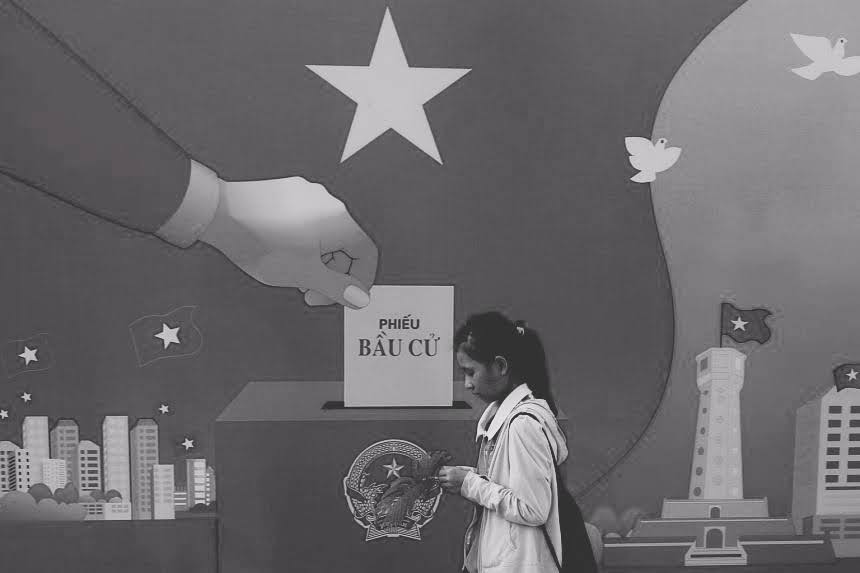
    However, we discussed US voting laws with great passion and many of us cursed “the damn Democratic Party” for allegedly wanting to ease restrictions so that illegal immigrants could vote. Many shouted with joy when Trump criticized voting via postal services as he claimed this would lead to cheating. In fact, however, many of us have never seen a ballot box in Vietnam.

    Is it true that a political system in which the people can only vote for candidates recommended by the Party is so perfect that we do not care about domestic elections?

    No, definitely not.

    Are we so insensitive to our responsibilities, while having surplus energy for trivial matters that are not even related to Vietnam?

    Probably.

    But there may be another reason: that is because we are scared.

    The widespread fear from the land reform campaign (in North Vietnam in the early 1950s) has not actually subsided. Fears have now been heightened by the 2018 Cyber Security Law – an identical copy of China’s. Under this new law, all that we speak up about or write about on social media platforms can be used as a pretext for the authorities to harass and arrest us.

    Few of us dare to confront the authorities because we are all afraid of being murdered in a police station, upon which the government will claim that we have “committed suicide due to a guilty conscience,” as it has stated during Vietnam’s review under the International Covenant on Civil and Political Rights in March 2019 to rationalize the unusually high number of people who died unexplained in police stations.

    Thus, in the face of events really close to us and of great importance, we remain silent and “project” our depression onto safer events such as Japanese adult films and the freedom rankings of an organization thousands of miles away.

    A Myanmar demonstrator under arrest in the capital city Yangon on February 27th, 2021. Photo: Reuters

    Now, let’s take a look at a neighboring country, Myanmar. At the time I wrote this article, 150 people had been killed while taking part in demonstrations to protest against the military coup that overthrew the democratically-elected government led by Aung San Sui Kyi. For the Burmese, the ballot is their life. For us Vietnamese, how many of us can’t be bothered to even think about the weight our ballot can carry?

    Freedom is not free. The Myanmar people are declaring with dignity that they are ready to pay an exorbitant price to have freedom.

    We may feel free to criticize the Freedom House rankings, but this does not render us freer.

    So, how can we change this? I have not come up with an answer yet. But if most of us keep staying silent for our own sake, and then throw our bursting surplus energies into things which are trivial or less important – and also less risky – to preserve the self-respect of a cowardly collective consciousness, then we will never find the answer.